Boston Dynamics opens a training centre at Hyundai's US metaplant: Atlas enters shop-floor training
From a CES unveiling to a real workshop
On September 21, Boston Dynamics announced the opening of its Robotics Metaplant Application Center (RMAC) inside the Hyundai Motor Group Metaplant America (HMGMA) campus outside Savannah, Georgia. The move follows January, when Boston Dynamics and Hyundai Motor Group unveiled Atlas at the HMG Media Day during CES 2026.
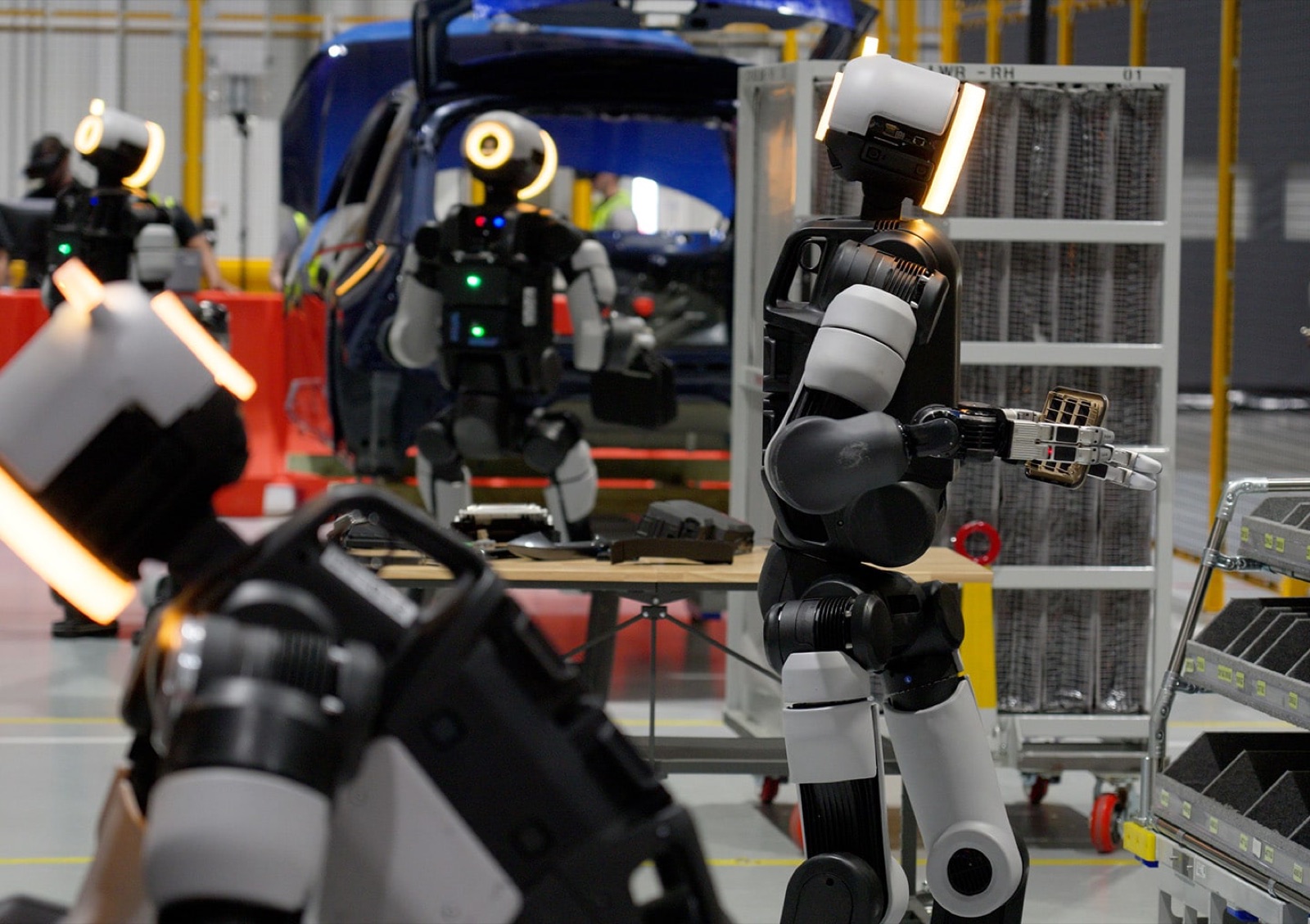
RMAC is not a showroom but a testbed and training center, and its job is to integrate Atlas robots directly into the group's automobile manufacturing operations. In other words, for the first time a humanoid is being treated as a component of a production system rather than a display unit wheeled into a plant.
What the robots practise there is very concrete: preparing the logistics and sequencing of automotive parts in real environments — placing parts in the correct order for assembly. This is one of the most everyday and most reliability-critical jobs in a car plant. It does not demand spectacular athleticism; it demands long, repeatable, error-free work alongside people.
A timeline is attached: by 2030, Atlas applications will extend to component assembly. Over time the robot will also take on new tasks involving repetitive motions and strenuous work such as lifting heavy loads — precisely the part of industrial work where a humanoid's return on investment is easiest to calculate.
A 25,000-unit target and a 30,000-a-year factory
The scale targets are the hardest numbers in the announcement. Hyundai Motor Group plans to expand Atlas deployment quickly across its global network over the next few years, beginning with 25,000 units at Hyundai and Kia plants worldwide. The group will also build a new production facility in the United States capable of making 30,000 robots a year.
Zack Jackowski, chief product and technology officer at Boston Dynamics, put it this way: together with Hyundai Motor Group the two are pioneering physical AI at enterprise scale, and they have established a clear strategy to optimise supply chain, production, testing and deployment capabilities for Atlas. RMAC, he said, reinforces a shared ambition to build a future in which robots amplify human potential by making work safer and more productive.
Seen from outside, building the training centre before talking about jobs on the line is the most notable methodological shift in this wave of humanoids entering factories. Demo videos can be edited and labs can be repeated, but a real line generates endless anomalies every day: incoming parts sit slightly off, a pallet jams, a worker nearby changes the traffic pattern. That kind of data cannot be synthesised in an office; it can only be collected through long-term operation on site — and it is the real output of a training centre.
There is also a corporate-structure backdrop: Hyundai Motor Group completed a controlling acquisition of Boston Dynamics in 2021, and Atlas's technology route has since shifted visibly from research robot toward industrial product — electric, manufacturable, factory-facing. Putting the training centre inside its own vehicle plant effectively makes customer and shareholder the same party, removing the most expensive step in humanoid deployment: persuading a customer to set aside line space for an unproven category.
It also explains why a car group would want this. Carmakers hold large amounts of high-value scenarios, takt-time requirements and process knowledge; robotics companies hold the body and the learning system. Each side brings half, and what they get back is a data flywheel: the longer the robot runs, the more anomaly samples accumulate, the steadier the policy becomes, and the further upstream the tasks it can take on.
Ten times larger next year, and an eye on other industries
The first phase of RMAC is already operating at HMGMA, and expansion is already underway: next year operations will move into a new building on the HMGMA campus, expanding RMAC to roughly ten times its current size.
Beyond supporting Atlas's preparation for automotive deployment, Boston Dynamics plans to begin exploring use cases in other industries next year. The company says it is in discussions with several existing Spot and Stretch customers across manufacturing, aerospace, semiconductors, logistics, food and beverage, and life sciences to extend data collection and other tasks so that Atlas's training can continue through 2027.
The logic is clear: Atlas does not only need data from car factories but from as wide a range of real operations as possible. Bringing customers already running inspection and material-handling robots for years into that training network means using existing sites and task types to add chapters a humanoid's "textbook" does not cover.
For context, Boston Dynamics has three product lines: Spot, a quadruped for industrial inspection; Stretch, a box-moving robot for logistics and retail; and Atlas, an electric humanoid platform still in development. The company describes itself as a provider of AI-enabled mobile robots that work in unstructured, unsafe or hard-to-traverse spaces.
The doubts deserve equal weight. Both 25,000 units and 30,000 robots a year are group-level plans, not current output or deployment. What actually happened in 2026 is that the robot entered a supervised industrial training environment. That is still a long way from replacing workers: Atlas is handling parts logistics and sequencing, and it does so with humans retaining oversight.
Across the industry, a recognisable path is forming for humanoids entering factories: first prove supervised steps at a training centre, then put validated tasks on a live line, and only at the end take on complex assembly. How fast each step moves depends on safety certification, takt-time matching and unit cost — not on how human the robot's movements look. That may be what makes this announcement worth recording: it is about production lines, data and supply chains, not about a performance.
More broadly, humanoids entering factories have gone from individual cases to a trend over the past two years: Figure's robots moved into BMW's US vehicle plant for logistics, and Agility's Digit has logged tens of thousands of hours at GXO, Schaeffler, Amazon and Toyota Motor Manufacturing Canada. These cases share one feature: the work is logistics, carrying and sequencing around the line rather than the highest-value final assembly. That division of labour is unlikely to change soon — it is a technical boundary as much as a boundary of responsibility.