ASML's third-quarter net sales hit a record €11.66 billion as AI demand turns capacity into the bottleneck
€11.66 billion in a single quarter
On October 14 ASML published its third-quarter 2026 results: total net sales of €11.662 billion, a record and at the high end of its earlier guidance, with a 57.5 percent gross margin, €4.96 billion of net income and basic earnings per share of €12.95. Headquartered in Veldhoven, the Netherlands, ASML is the leading supplier of semiconductor lithography equipment and the only commercial maker of extreme-ultraviolet systems.
Across three quarters the slope is clear. Second-quarter total net sales were €9.326 billion with a 54.0 percent gross margin, €2.918 billion of net income and €7.59 of earnings per share; the third quarter delivered €11.662 billion, 57.5 percent, €4.96 billion and €12.95 respectively. Operating income rose from €3.456 billion to €5.173 billion, lifting the operating margin from 37.1 percent to 44.4 percent.
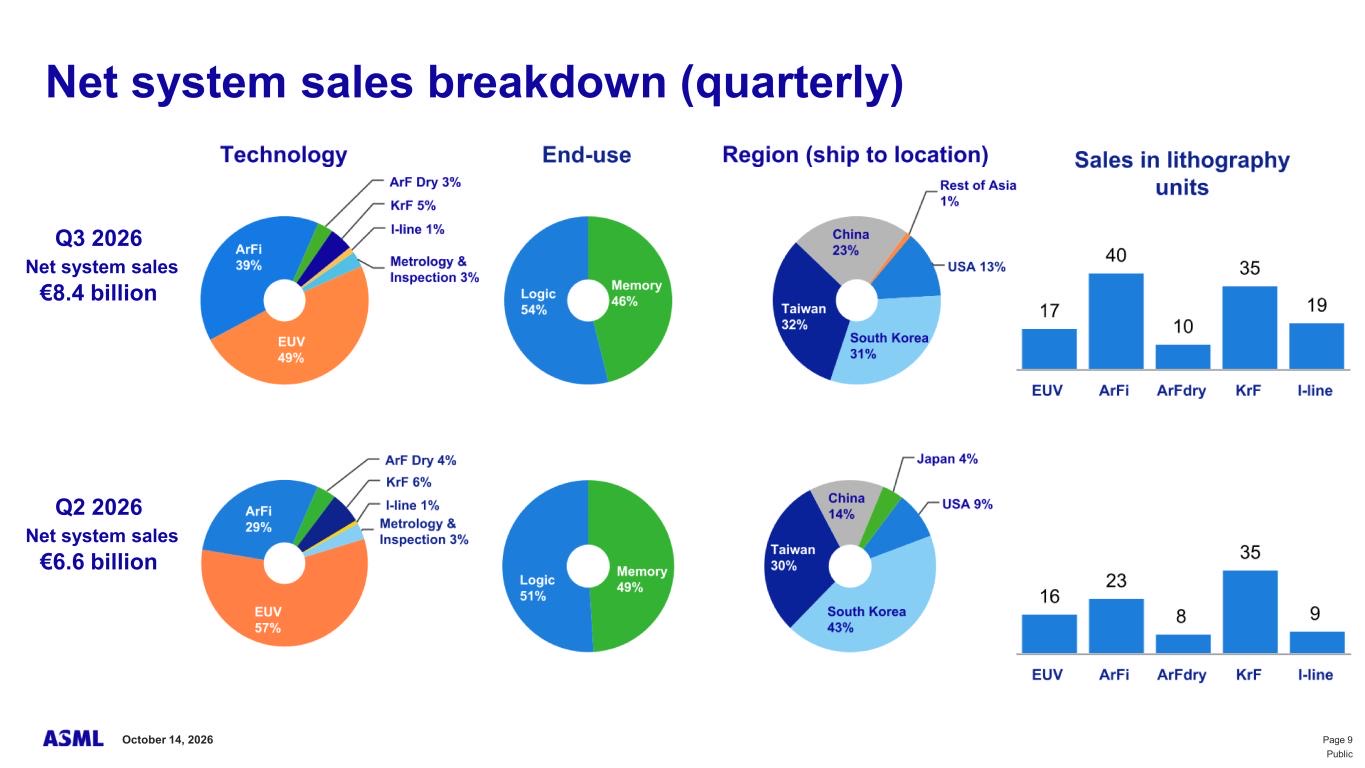
Break the revenue down and net system sales came to €8.4 billion against €6.6 billion in the second quarter, while service and field-option sales — what ASML calls Installed Base Management — contributed €3.289 billion. That line beat guidance for a blunt reason the company states outright: continued strong demand for productivity upgrades. This revenue carries high margins and does not depend on new production capacity, which is why it pushed gross margin above guidance.
Unit shipments are scaling too: 113 new lithography systems were sold in the third quarter versus 86 in the second, plus eight used systems against five. Not all 113 are EUV tools; a large share are deep-ultraviolet machines, and because EUV and DUV systems differ enormously in price, unit growth does not translate proportionally into revenue growth.
The cash position thickened as well. Cash and short-term investments ended the quarter at €12.735 billion versus €7.582 billion at the end of the second quarter, with €11.798 billion of net cash from operating activities in the period. For an order-driven equipment maker with long delivery cycles, that cushion matters for both capacity expansion and research spending.
Guidance raised — and the problem becomes building fast enough
For the fourth quarter ASML guides to total net sales of €14.2-15.2 billion at a gross margin around 57 percent, of which roughly €3.7 billion comes from Installed Base Management, plus about €1.2 billion of research spending and €0.4 billion of selling, general and administrative costs. For the full year it now expects €44-45 billion of total net sales, a gross margin around 56 percent and an annualised effective tax rate around 17 percent.
What matters more than the numbers is chief executive Christophe Fouquet's description of demand: customers keep raising their short- and medium-term equipment forecasts, driven primarily by their own views on the size and duration of AI-related investment. With visibility that long, some customers are already expressing interest in placing orders for 2029 and even 2030.
The corollary appears in the company's own assessment: with the supply it currently plans, neither 2027 nor 2028 will fully meet customer demand. ASML had said it planned to raise capacity for low-NA EUV and DUV immersion tools by about 30 percent in 2027 and was studying a further 30 percent increase for 2028; it now says it is investigating ways to expand 2028 capacity beyond that.
The wording on order momentum is worth noting too: ASML says order-book momentum has increased quarter over quarter this year. Customer interest and actual orders are different things — the first is expressed intent, the second enters the backlog and eventually becomes revenue, with capital-spending reviews, export controls and supply conditions in between.
Why lithography capacity cannot simply be added
To gauge the weight of these results, start with where lithography sits in chipmaking: it transfers circuit patterns layer by layer onto silicon wafers and sets transistor dimensions and density. EUV uses 13.5-nanometre extreme-ultraviolet light, which virtually every material absorbs, so the entire optical path works by reflection inside vacuum and the source relies on high-power lasers striking tin droplets to create a plasma. DUV immersion tools take a different route and serve high-volume production at mature and middle nodes.
Capacity for such tools does not double by lining up more assembly bays. An EUV system contains tens of thousands of parts drawn from a highly concentrated supplier base spanning precision optics, ultra-high vacuum, fine mechanics and laser systems, while yields and lead times depend on fab construction and customer qualification downstream. That is why a sudden lengthening of demand moves the bottleneck from demand to supply.
On the demand side, ASML compresses the long-term logic into a sentence: advanced logic and memory processes will need a greater number of critical lithography exposures. The more advanced the process, the more layers and the tighter the overlay requirements — and the more value sits in pattern transfer. That trend does not depend on any single product generation; it is a by-product of advanced-node progress.
Two items from the quarter's business summary are worth flagging. First, ASML and TSMC announced an initiative to pioneer the industry's transition to 12-inch photomasks for High NA EUV, which the company says enables more than 40 percent higher productivity for a dual-mask exposure — cost has always been the central argument around High NA, and this kind of supporting improvement is what makes it economically defensible. Second, ASML shipped YieldStar 550, its next-generation overlay metrology system for advanced logic and memory nodes: lithography yield depends not only on exposure but on measurement and correction, which is what the idea of holistic lithography covers.
Shareholder returns, and the caveats
Cash returns continue. In the third quarter ASML bought back about 2.8 million shares for roughly €4.1 billion under its 2026-2028 programme, and it paid an interim dividend of €1.88 per ordinary share; a second quarterly interim dividend of €1.88 per share over 2026 will be payable on November 4.
The caveats are explicit. In its forward-looking statements ASML warns that judgments about demand and capacity depend on customer capital spending, export controls, geopolitics and supply chains; that interest in 2029 and 2030 orders is intent rather than commitment; and that expanding 2028 capacity further is still being studied, without quantified targets. Part of the quarter-on-quarter jump also came from service-like Installed Base Management revenue, which is steadier than system shipments but tied to the size of the installed fleet.
Compressed into one line: the €11.66 billion quarter is impressive, but the real information is that the bottleneck has moved. For the past two years the market worried about whether AI capital spending would stop; now an equipment supplier is saying that even on its most aggressive expansion plan it cannot build what customers want over the next two years. For anyone tracking the compute investment cycle, that is a harder signal than a quarter's net income.