Huawei launches the Atlas 960E SuperPoD: the industry's first NPO-based supernode, 4,096 NPUs at 8 EFLOPS
SuperPoD: designing the whole cluster as one machine
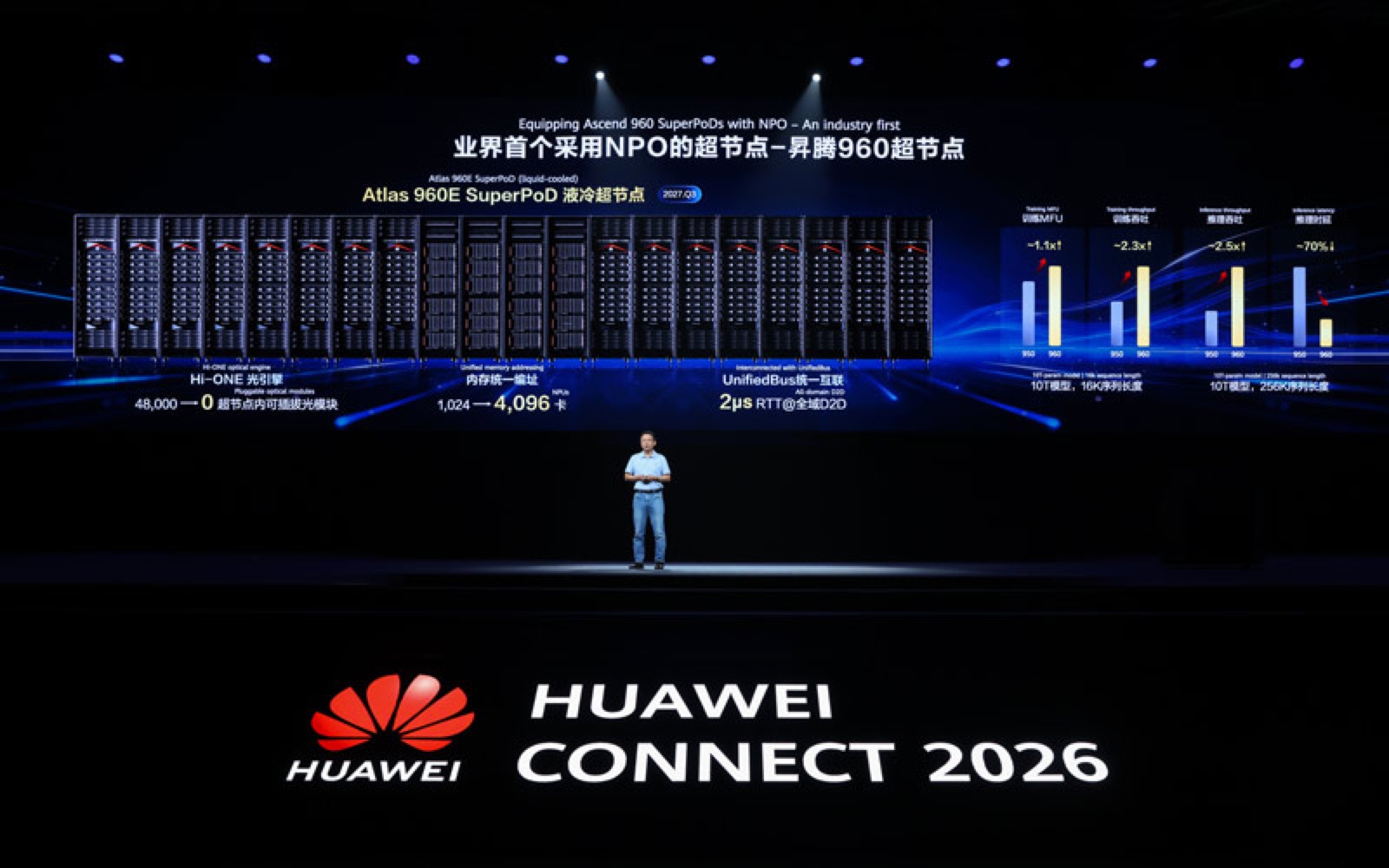
On September 17, HUAWEI CONNECT 2026 opened in Shanghai. In his keynote, rotating chairman David Wang launched the Atlas 960E SuperPoD, positioned as the industry's first NPO-based SuperPoD and aimed at training and inference for models with ten trillion parameters. Huawei restated its AI strategy: computing power at the center, competitiveness through system and architecture innovation, and ecosystems built by going open source and open system.
To follow the announcement it helps to know what "SuperPoD" means in Huawei's vocabulary. It is not a server or a chip, but a way of interconnecting large numbers of NPUs peer to peer under a single protocol, supporting memory access across physical servers, short-reach copper where possible and optics where distance demands it — so that the whole cluster looks more like one computer to software. The endpoint of that road is the SuperCluster: ten-thousand-card scale computing built out of SuperPoDs.
The concrete numbers for the Atlas 960E are: up to 4,096 NPUs in a single SuperPoD, 8 EFLOPS at FP8 and 16 EFLOPS at FP4, an orthogonal architecture with a fully liquid-cooled design, and unified memory addressing enabled by UnifiedBus. Huawei says that scale is what ten-trillion-parameter models require.
For interconnect, Huawei uses its own UnifiedBus, which carries the unified memory addressing that lets a single SuperPoD scale to 4,096 NPUs. This is the fundamental difference between a SuperPoD and a pile of servers wired together: the former places memory access across servers inside one protocol, so software does not have to be rewritten as the system grows. The performance figures come from Huawei's own materials and have not been independently verified.
Hi-ONE: 5,500 optical engines replace 48,000 optical modules
Optics is the most conspicuous variable in this system. The traditional approach pairs every NPU with a full set of 800G optical modules, and as scale grows, module count, power consumption and failure points all expand together. Huawei's alternative moves the optical engine closer to the switch chip, shortening electrical traces and replacing a large number of modules with a few engines.
To see why NPO deserves attention, look at where optical interconnect sits in a very large cluster. As node counts climb from hundreds to thousands, the reach and power of electrical links quickly become untenable, so the industry keeps moving the optical-electrical conversion point closer to the switch chip: from pluggable optical modules to near-packaged optics, and on to co-packaging optical engines with the chip. Each step buys higher bandwidth density and lower energy per bit. Huawei has focused on the near-packaged step and says the product is already in mass production.
The SuperPoD contains 5,500 Hi-ONE optical engines. Huawei says connecting the same number of NPUs the traditional way would require 48,000 800G optical modules; with Hi-ONE, power consumption falls by more than 550 kilowatts, fault-free operating time doubles and system availability reaches 99.8%. Hi-ONE stands for High-density Optical-interconnect-Node Engine, with 7.2 Tbit/s of transmission capacity per engine. Huawei calls it the industry's first mass-produced, highest-capacity NPO product and the only NPO with a built-in light source.
"Built-in light source" is worth a second look. The reliability bottleneck in optical interconnect is often not the engine itself but the coupling and lifetime management of external lasers. Building the source into the engine can in principle simplify the system and reduce external fibers and connectors, while raising the bar for packaging and thermal design. Huawei stresses that Hi-ONE balances optical, mechanical, electrical, electromagnetic and thermal performance in one multi-physics design.
Beyond AI: TaiShan 950 and context storage
Huawei also carried the architecture from AI into general-purpose computing. The upgraded TaiShan 950 SuperPoD is likewise based on all-optical UnifiedBus networking, supports up to 4,096 nodes and offers a unified memory pool of up to 256 TB. Huawei lists three beneficiaries: higher-density agent sandboxes, faster sandbox startup and better agent vector search performance.
On the storage side Huawei launched OceanStor M900, a UnifiedBus-powered context memory storage cluster that supports one-hop direct access and provides petabyte-scale KV cache capacity for the L3.5 layer. L3.5 refers to the middle tier in large-model inference that belongs neither to GPU memory nor to conventional main memory — KV cache grows exponentially as conversations lengthen, and where it lives directly determines the cost of long-context serving.
From 512,000 to a million NPUs — and open-source CANN
Beyond the SuperPoD lies the SuperCluster. Huawei's expansion path: connect multiple Atlas 960E SuperPoDs using UnifiedBus networking or RoCE to form a SuperCluster; in a two-tier, four-plane Clos architecture it can interconnect up to 512,000 NPUs; with a multi-rail topology on top, up to one million NPUs.
Huawei also lists open source and open system as part of its strategy. The launch notes that CANN is now open source and openly accessible and has moved into sustained, community-driven development — in Huawei's words, taking the platform from usable to user-friendly and marking a new inflection point for the Ascend ecosystem. For users that means the software stack no longer iterates purely at one vendor's discretion, which is one of the key variables in whether domestic computing power is genuinely adopted by outside teams.
The doubts deserve equal space. Nearly every headline number in this launch — 8 EFLOPS, 4,096 NPUs, 99.8% availability, a million-NPU cluster — comes from Huawei's own materials and reflects product plans and design targets rather than measured results in a customer data center. The SuperPoD route itself is still evolving: optical engine yields, software support for unified addressing and cluster-scale operations are all things only time can verify.
Still, one thing is worth putting in a wider context: the center of competition is shifting from the peak throughput of a single chip to systems, interconnect and software ecosystems. Optical interconnect, unified addressing, liquid cooling and cluster scale used to be infrastructure engineering; today they directly determine whether a large model can be trained at all and what a single inference costs. Huawei's chosen road is to get optics and systems right first, then attract developers with an open ecosystem — and whether that works will not be decided by the EFLOPS on a keynote slide, but by whether that 99.8% availability keeps holding in customer racks.