Iluvatar CoreX puts 144 GPUs into a single rack, shifting China's compute race to rack-scale systems
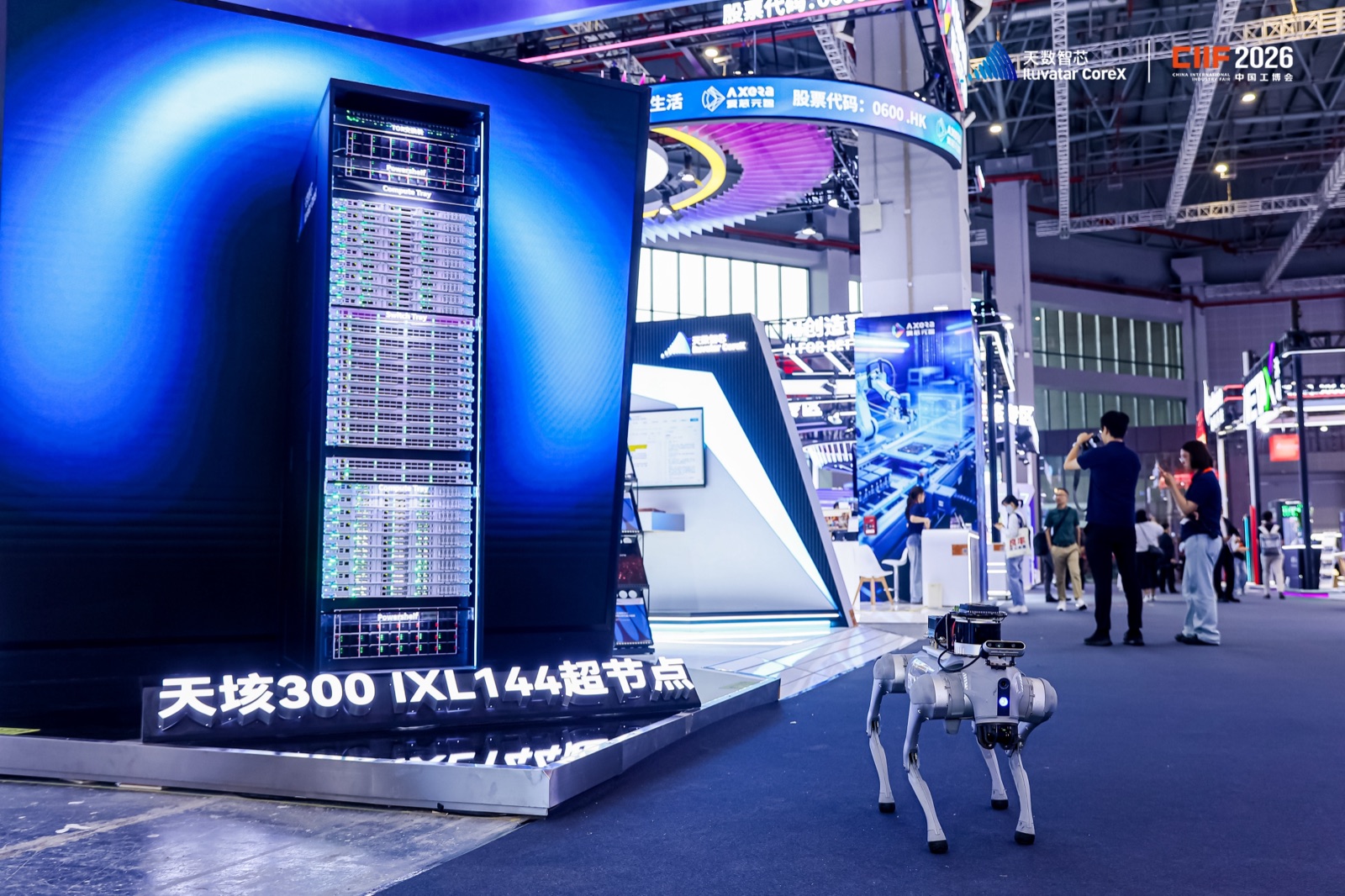
144 GPUs and 18 CPUs in one cabinet
On October 12, at the China International Industry Fair in Shanghai, Iluvatar CoreX presented its first systematic supernode, the TianGai 300 IXL144. According to the company, the system integrates 144 graphics processors and 18 central processors inside a single cabinet, gathering into one rack the compute that used to be spread across multiple servers and enclosures.
Connect the timeline and the significance sharpens. In January the company published a four-generation architecture roadmap; in July it launched the TianGai 300 accelerator at the World Artificial Intelligence Conference; in October at the industry fair it showed a rack-scale system built on that accelerator. The company's own framing follows the same line: the flagship GPU's capability is extending from a single chip to a whole cabinet, iterating continuously in real machine rooms.
At the event the company put it this way: a supernode is not a single product but a systems engineering problem, and the ultimate competition is over system economics. The IXL144 is the first product in that systematic supernode family, with complete offerings for different compute scales and different machine-room conditions to follow. That framing defines the real shift in the competition: not peak performance per card, but how much usable compute a rack delivers and how much retrofitting it demands.
One easily missed premise: according to the company, the TianGai series has already been deployed at the ten-thousand-card scale. The single-cabinet system builds on existing shipments and operational experience rather than starting from a blank sheet — and for buyers, that is what decides whether it reads as an extension of a shipping product line or an entirely new bet.
What a supernode is, and why everyone is building one
A supernode is, at heart, dozens or hundreds of accelerators linked by high-bandwidth, low-latency interconnect into one larger compute domain, so that card-to-card traffic behaves as close as possible to direct die-to-die links. Training large models requires parameters, gradients and activations to be exchanged between cards at high frequency, and that communication can consume a significant share of available compute; making the exchange faster and the paths shorter raises the useful output of the same set of chips.
That also explains how a supernode differs from the conventional scale-out cluster, which networks many servers together so traffic crosses network stacks and switches, paying higher latency and bandwidth costs. A supernode builds high-bandwidth links inside the cabinet, lifting the ceiling on how many cards a single job can span. The two approaches are not substitutes, but for very large model training the in-rack segment often sets the efficiency ceiling.
Chinese vendors feel extra urgency here for another reason: when a single card is constrained by process technology and memory bandwidth, using rack density, interconnect topology and software-stack efficiency to offset the per-card gap is the more realistic route. The talk of a first year of the supernode comes precisely from that shift — from chasing a single-point metric to chasing system-level output.
The demand side is moving just as plainly. An IDC report cited in the coverage finds that agents are pushing compute demand higher still, with China's intelligent-compute capacity projected to reach 2,576.5 EFLOPS in 2026, up 87.9 percent year on year; at that pace, supernodes are moving from technical validation toward scaled deployment. That matters for reading the timing of this showing: it is not an isolated demo so much as a response to how buyers are starting to behave.
Three accounts the customer has to settle
The coverage reduces the step from technical validation to volume procurement to three accounts. The first is software: do existing models and code have to be rewritten from scratch. The second is the machine room: does the rack require dedicated changes to power, floor loading and cooling, or even a new building. The third is operations: can the cost per million effective tokens come down, and can compute scale on demand without sitting idle. Only when all three are added up does the real question of whether to buy get answered.
Iluvatar CoreX's stated answer is to do three things at once: raise integration density, stay friendly to existing machine rooms, and remain compatible with existing code. On the product that means a single-cabinet form close to standard rack conventions; a general-purpose GPU architecture compatible with mainstream software ecosystems to lower migration cost; and whole-cabinet interconnect so all 144 GPUs work together. Each maps onto one of the three accounts, and the logic is coherent — the hard part is making all three true at once.
Start with the software account. Moving a model from one ecosystem to another costs more than the training script: it involves operator-library coverage, distributed-training framework support, inference serving and tuning toolchains, and engineers' learning curve. None of that appears in a purchase contract, yet it often decides whether a project ships on schedule — which is exactly why a general-purpose architecture compatible with mainstream ecosystems is treated as a headline feature.
Now the machine-room account. A high-density rack is not a matter of a few extra cables: rising power density pushes against air-cooling limits and calls for liquid cooling, weight distribution loads the floor, and power distribution, piping and monitoring often need floor-wide changes. In an existing data centre that engineering can outvalue the equipment itself, which is why avoiding a new building is a quantifiable benefit.
Finally the operations account. Cost per million effective tokens is set by energy consumption, depreciation, utilisation and software-stack efficiency: better density and interconnect dilute communication overhead and idle time, but the final figure depends on the model, the concurrency, real utilisation and local power prices. Cost comparisons in this industry therefore hold under stated conditions, and treating them as universal conclusions requires care.
What this round of competition is about
Placed in context, it is worth separating what this is from what it is not. The coverage describes a debut and a first systematic supernode — a first public showing of a design, not the announcement of completed large-scale commercial delivery. Key parameters such as exact rack density, interconnect latency, measured performance, whole-cabinet power and cooling specifications, and customer orders have yet to be published by the company as a full white paper or test report, so phrases like highest density or lowest cost should be read with their comparison basis in mind.
The direction, though, is clear. The focus of competition in Chinese compute is shifting from per-card specifications to rack density, chip interconnect, software stacks and the system economics of a full cabinet; for buyers, the questions that decide outcomes were never the peak-performance tables but how much of the model must change, how much of the machine room must be rebuilt, and what a million effective tokens costs. Whoever settles all three accounts at once is the one who wins volume orders.