Meta brings 102.4T switching and Ethernet scale-up to OCP 2026: 72 accelerators per rack
The 102.4T generation and a liquid-cooled network rack
On October 12, Meta published a set of networking infrastructure results at the 2026 Open Compute Project Global Summit. Two pieces of hardware led the announcement: IcePack, the company's first liquid-cooled network rack, and IceCube, a switch blade rated at 102.4 Tbps.
These systems serve Meta's own models and agents: the workloads named in the post include the Muse Wonder and Muse Spark models and Muse, its personal AI agent built for everyone. In other words, this generation of networking is not about benchmarks but about keeping ever-larger training and inference jobs inside one cluster. Meta also made its pitch explicit: engineers, silicon vendors, system integrators and operators are invited to work with the OCP community on open, efficient and sustainable AI infrastructure.
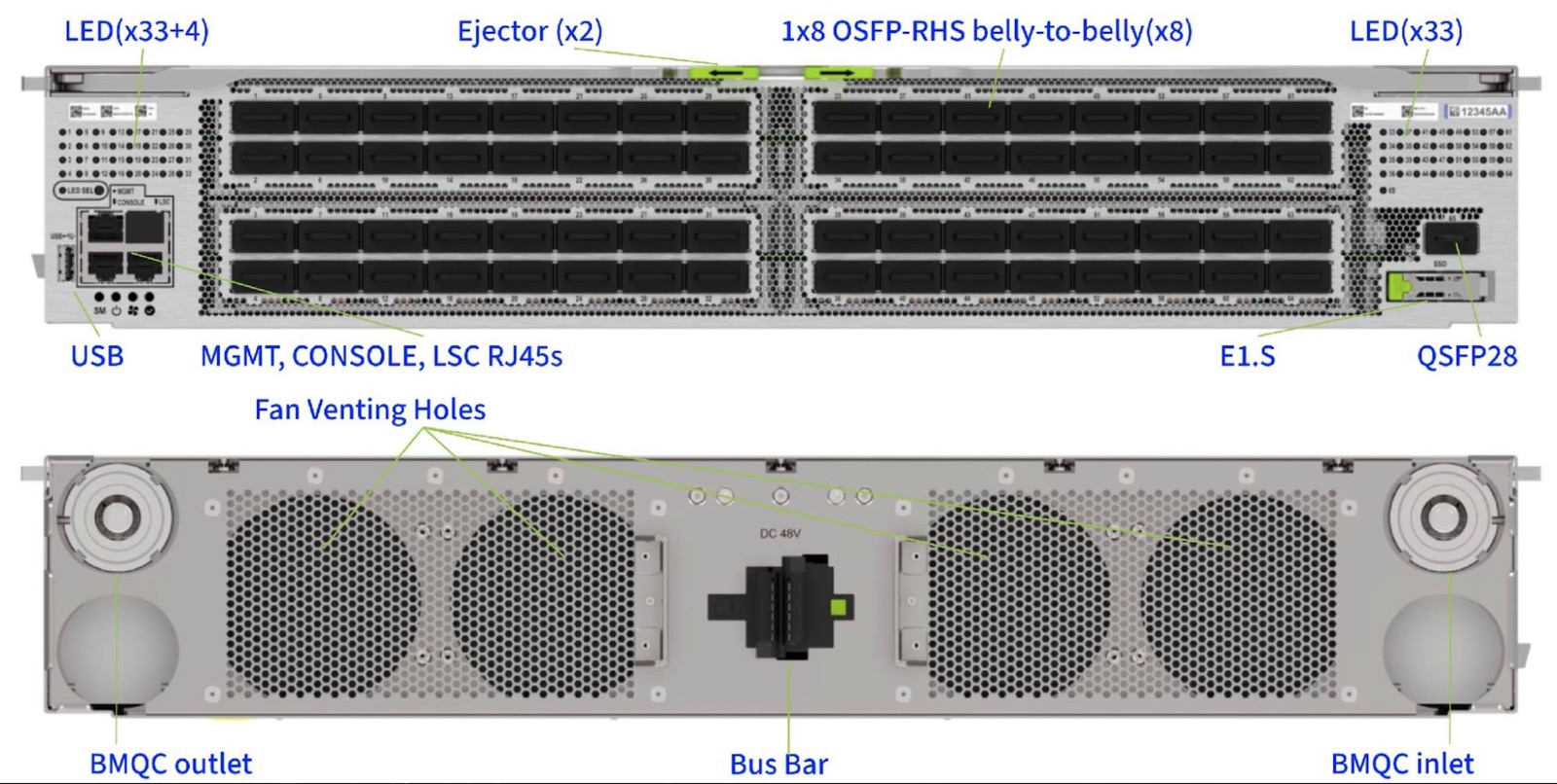
IcePack is based on OCP's ORV3-HPRv1 rack standard and is Meta's first-generation liquid-cooled network rack. It holds IceCube switch blades: 102.4 Tbps of switching capacity with 128x800G of non-blocking capacity. IceCube comes in two variants, one built on Broadcom's Tomahawk6C switch ASIC and one on NVIDIA's Spectrum-6 switch ASIC; both run Meta's open-source FBOSS network operating system and use OCP's SAI, the Switch Abstraction Interface, to talk to the hardware.
This generation doubles the bandwidth of the previous 51.2T platforms while meeting the thermal density next-generation AI data centers require. That is why liquid cooling shows up on network gear: as clusters head toward gigawatt scale, switches must deliver multiples of the bandwidth inside ever tighter power and cooling envelopes, and air cooling alone no longer suffices.
FPF: eight links from every GPU to eight switches
The more interesting change is in topology. Meta introduced Flattened Planar Fabric (FPF), a multiplane backend fabric that, in Meta's words, fundamentally changes how GPUs connect to the network and the network's control plane.
Concretely, each GPU connects through eight independent 100G links to eight different switches, one per plane. That replaces the traditional single-plane uplink architecture and yields four benefits: larger non-blocking GPU clusters than single-plane topologies, which is what Meta's largest training jobs need; a flattened topology, going from the three-tier Clos of its previous fabric to a two-tier Clos, removing a layer of switches to cut hops, latency and infrastructure cost; NIC-level hardware load balancing, where the NIC sprays every packet across all eight planes instead of leaving balancing to switches; and a combined control plane that includes switches and hosts, letting the host steer traffic away from a downed plane.
The work was done in close collaboration with NVIDIA and runs inside Meta's own infrastructure, using NVIDIA Spectrum-X multiplane innovations to keep performance high under assorted failures and operational lifecycle scenarios. Meta shared the learnings with its cloud partners to help standardize multiplane fabrics on their side. It is not only a technical matter: Meta cannot close its capacity gap by building data centers alone, since construction timelines run in years while demand moves in months, so it also uses leased facilities and public cloud capacity. Making GPUs in the cloud behave like GPUs in its own campuses requires the network to be standardized.
The layer above is BAG, short for backend aggregation. An Ethernet-based centralized super-spine, it interconnects multiple spine-layer fabrics into one mega cluster spanning buildings, campuses and regions, operating at petabit scale — capacity between a pair of regions reaches tens of petabits per second. Meta's scale markers: Prometheus at roughly 1 gigawatt in 2026, with Hyperion scaling toward 5 gigawatts. Distance becomes a design constraint here: lossless Ethernet needs buffer headroom proportional to cable length, and once links stretch tens of kilometers, buffer management turns from a tuning detail into a first-order problem. FBOSS measures actual cable length in place — timing probe traffic on an uncongested queue to derive round-trip distance — and allocates headroom against the measurement.
Scale-up over Ethernet
Scale-up refers to the high-bandwidth, ultra-low-latency interconnect between accelerators inside a rack or pod, traditionally the domain of proprietary technologies. Meta set out to show Ethernet can do it too: it introduced Tahan, an Ethernet-based scale-up switch purpose-built for its MTIA 300 training accelerators, built on Broadcom's 51.2 Tbps Tomahawk 5 ASIC with 64x800G total capacity, half of which provides scale-up connectivity to accelerators over the backplane. Four Tahan switches interconnect 16 accelerators in a non-blocking topology, or 6.4 Tbps per accelerator. More important, Tahan reuses exactly the same lossless RoCE transport as the scale-out network — routed IPv6, PFC and AI-tuned QoS — unifying both fabrics under FBOSS.
The next generation is already drawn: a scale-up blade with 216x400G, built on 102.4 Tbps Broadcom Tomahawk6C silicon, in which eight switches interconnect 72 accelerators per rack, a marked density increase over this generation. A future generation is planned to adopt OCP's ESUN, Ethernet for Scale-Up Networking, as the scale-up data plane. ESUN is an initiative Meta founded within OCP last year; participants include AMD, Arista, ARM, Broadcom, Cisco, HPE, Marvell, Microsoft and NVIDIA. The ESUN 1.0 Network Operator Requirements Base Specification was released earlier this year, and version 1.1 is close, tackling switch profiles and inter-packet gap reduction.
OSPA and MetaRoCE: standardizing one layer up
Meta also co-leads a new OCP initiative with Microsoft and Alibaba: the Open Switch Platform Architecture (OSPA). The reasoning: SAI made switch data plane software portable across silicon, but the switch platform layer beneath it remained proprietary and fragmented, so every new hardware platform required months of duplicated custom engineering. OSPA standardizes power management and sequencing, sensor and environment control including thermal and fan management, hardware inventory management and device enumeration, out-of-band hardware interfaces such as management Ethernet, serial console, USB and LEDs, firmware maintenance and updates, and platform troubleshooting and diagnostics.
On transport, Meta announced open-source implementations of MetaRoCE, its RDMA transport protocol optimized for AI cluster networks. It provides the congestion control and reliability semantics distributed AI training demands and is purpose-built for the traffic patterns of collective communication over large-scale Ethernet. Meta also deployed Segment Routing over IPv6, or SRv6, with FBOSS on its regional backbone, running on open shallow-buffer switch platforms powered by Cisco SiliconOne.
Put together, Meta's intent is clear: it wants AI infrastructure — from switches and racks to transport protocols — built on open standards, with itself as both the largest user and the main contributor to those standards. Whether the broader ecosystem accepts that road depends on whether other companies are willing to spend engineering resources on ESUN, OSPA and MetaRoCE — the old problem of standardization, and the reason Meta put an invitation in the announcement.