DeepSeek apologizes after a five-hour outage: a full week of API spending returned as credits
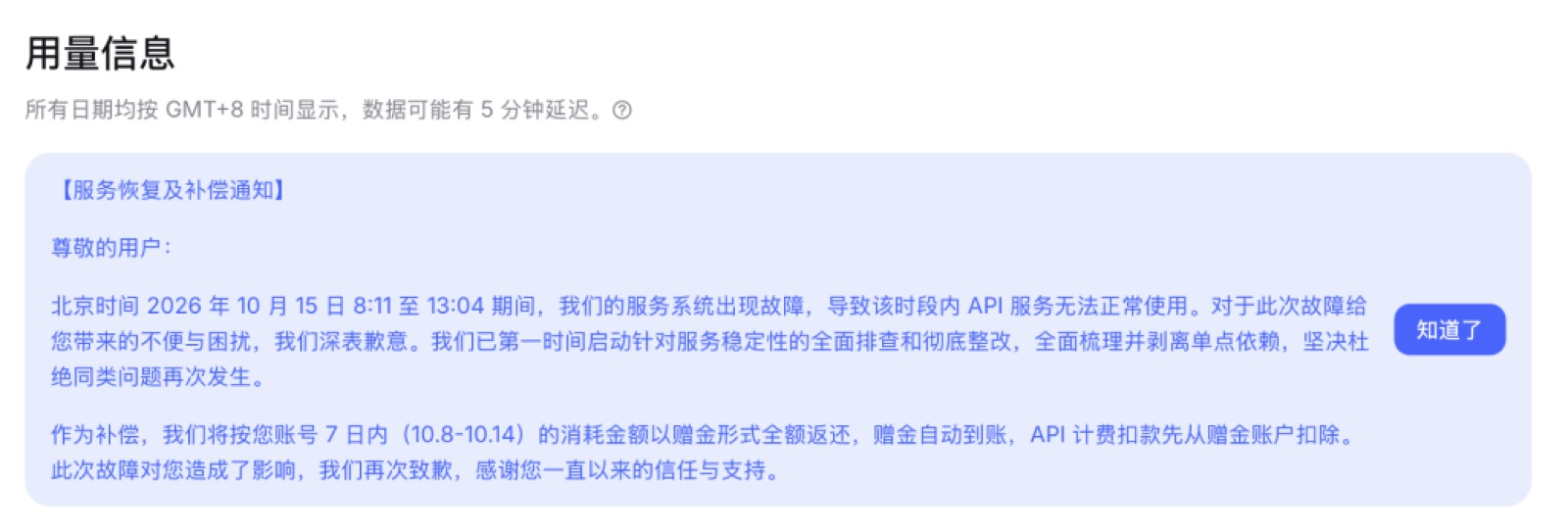
On October 15, DeepSeek suffered a rare, hours-long disruption: from 8:11 to 13:04 Beijing time its service systems failed, a gap of 4 hours 53 minutes. That evening the DeepSeek Open Platform published a service-restoration and compensation notice, apologizing and offering a strikingly direct remedy — 100% of each account's API spending over the prior seven days, returned as credits.
Timeline: from "server temporarily unavailable" to recovery
Users spotted the failure first. On the morning of the 15th, many people saw DeepSeek's chat respond with a "server temporarily unavailable" message. The DeepSeek API status page then confirmed that chat, the V4 Pro API and the V4 Flash API were all interrupted, with 8:11 as the starting point.
The status page tracked the repair: at 9:06 it read "root cause identified, fix in progress," and only at 13:04 did it declare the issue resolved and service restored. Nearly five hours end to end — a hard stop measured in minutes for a company that positions itself as infrastructure.
Beyond chat, two flagship APIs were affected, cutting off real downstream business: agent platforms, coding tools and batch pipelines built on DeepSeek all failed during the window and had to retry, degrade or fall back to manual work. For developers who treat the API as a production dependency, a near five-hour stop is not a notice; it is an incident.
Notably, chat and the APIs went down together. In common architectures they share underlying components such as inference clusters, scheduling gateways and the account system — which also explains why "removing single points of dependency" became the headline phrase of the official remediation: the more shared a component is, the closer it sits to being a system-wide single point, and the costlier it is to add redundancy and isolation.
Nor was it isolated. According to an event calendar compiled by The Paper, both September 2 and September 15 saw partial chat and API outages, October 12 saw a partial chat outage, and since September there have been nine further episodes of "web and API performance degradation." Combined with September's dense release cadence (V4.1-Flash going live, price cuts, rising usage), the frequency has pushed stability onto the same stage as new models.
Compensation: seven days of spending returned in full
The notice was short: for each account, all consumption between October 8 and 14 (seven days) is returned in full as credits; the credits land automatically with no claim required; and future API charges are deducted from the credit balance first. The official wording: "the account's consumption over the 7 days (10.8-10.14) will be returned in full in the form of credits."
The formula is worth a second look: rather than compensating only the calls that failed inside the outage window, DeepSeek refunds a full seven days of spend. For users that amounts to a week of free API usage; for DeepSeek it is a simple, undisputed formula that scales with usage — heavy users benefit most, and nobody has to itemize losses.
Note the form: credits, not cash, usable only against future API charges. According to media reports, users have already posted screenshots of their balances — from a few cents to thousands of yuan, depending on each account's usage the week before.
Why credits rather than cash? It is not unusual in the large-model industry: returning platform balance after an API incident satisfies the compensation duty while keeping the value inside the ecosystem — whether it is realized depends on the user continuing to spend there. DeepSeek bound "a full week" to "credits," giving generously while keeping the form manageable.
The boundaries matter too. Several outlets note the compensation targets users connecting directly through the DeepSeek platform; those reaching it via third-party apps or resellers should contact their own providers. And under standard platform terms, liability for outages is usually capped at recently consumed service fees, with indirect losses excluded.
The official stance: removing single points of dependency
Beyond the apology, the notice carried a second key sentence: "We have immediately launched a comprehensive review and thorough remediation of service stability, mapping out and removing single points of dependency, so that similar problems are resolutely prevented." In engineering terms, a single point of dependency is a component without redundancy — when it fails, the whole chain fails with it. DeepSeek did not disclose a root cause, but making "removing single points" the watchword effectively confirms the nature of the incident.
Some media also noticed that different status pages told slightly different stories about the 15th — one showed "no incidents" for the day, out of step with the same day's status updates and compensation notice. For a platform whose business is APIs, consistency between the status page and its announcements is itself part of being trustworthy infrastructure.
Zoom out: in 2026 the large-model race has moved from capability releases to service quality. As capabilities converge and price wars persist, availability — SLAs, incident transparency, compensation mechanisms — becomes the real selection criterion for developers and enterprise customers. However strong the model, if a platform degrades repeatedly in one week and stops for five hours at a time, its users must budget redundancy and fallbacks.
Against industry norms there is no uniform standard for outage compensation; standard terms usually cap liability at recently consumed service fees, and this "full refund of a week's spending" sits well above that floor. In a sense, it anchors the default expectation for what AI infrastructure owes after an incident one notch higher.
For developers the takeaway is direct: avoiding single points of dependency is not only the platform's job — multi-vendor setups, automatic degradation during failures, and subscription monitoring of status pages and announcements are the unglamorous engineering that makes a large model fit for production. From outage to apology to compensation, DeepSeek ran a textbook response in a single day; whether "removing single points of dependency" is delivered will show the next time pressure arrives.