Ambarella launches X7, its first standalone AI accelerator, to add compute to installed Arm and x86 systems
Putting AI into equipment sold a decade ago and due to run for another ten years
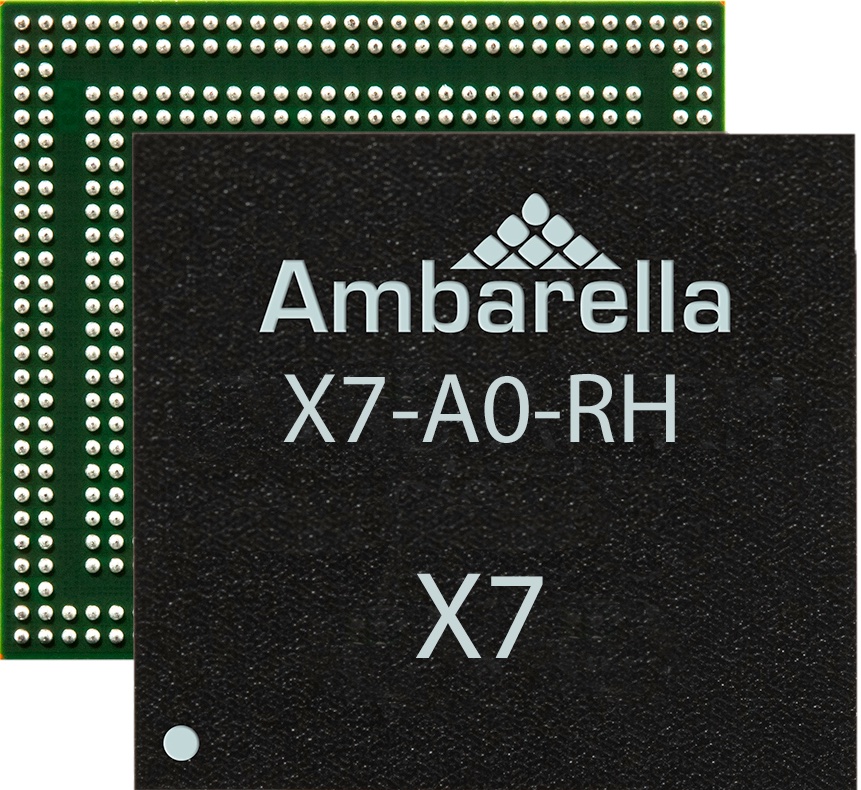
On September 15 in Santa Clara, Ambarella (NASDAQ: AMBA) introduced the X7 edge AI accelerator, the company's first dedicated CVflow AI accelerator chip. It is positioned not as a host but as an AI co-processor for Arm and x86 main processors: add it to a system and you gain or expand AI capability without redesigning the underlying platform.
The announcement describes a very specific market: cameras, gateways and industrial controllers already installed in the field, many with limited AI capability or none at all, yet with years of operating life remaining. Their owners and operators are now asking for AI features that did not exist when the hardware was designed. Ambarella puts the number of such systems in the physical world at millions. X7 targets two audiences: the OEMs and system builders responsible for that installed base, and teams validating new AI features before committing to a next-generation redesign.
There is an easily overlooked economics here. Industrial and security equipment refreshes far more slowly than consumer electronics; a system on a shelf, a production line or a street corner often has a service life beyond ten years. Once it is mounted on a wall, cabled and accepted, replacing the whole unit costs more than the hardware itself: downtime, installation and re-certification all count. Adding an accelerator without changing the host is therefore an easier case to make to decision-makers than swapping a whole SoC generation.
Two to five watts: the hard constraint on whether AI features ship
Ambarella states the constraints bluntly: a camera or inspection system that once ran a single detection model now runs several at once, often combining conventional computer vision, vision-language models and a natural-language interface. Whether such features can actually operate inside an embedded product depends on inflexible factors — power, thermal headroom, latency and system cost.
X7's answer is a 2 to 5 watt envelope. According to the announcement, that is the operating range in current customer designs, which lets the accelerator fit within a platform's existing energy and thermal constraints, keep the enclosure size and avoid a significant increase in bill-of-materials cost. This matters a great deal: in an already finalised product, the enclosure, fans and power delivery are usually the hardest things to change, and any accelerator that exceeds the original thermal design power forces a mechanical redesign — at which point the promise of "no redesign" evaporates.
On workload coverage, X7 supports CNNs, vision transformers, multimodal transformers and hybrid networks, using the same CVflow computer vision and deep learning processor Ambarella integrates into its own SoCs. Model architectures have shifted markedly in recent years, from convolutional networks to transformers to multimodal systems, and whether an edge device keeps up depends on whether the accelerator's operator set and memory bandwidth cover the new architectures — which is why vendors usually put the model families they support ahead of raw TOPS numbers.
How it attaches, and software continuity
X7 is a host-agnostic accelerator: it connects over a single lane of PCIe Gen 3 or over USB 3.2 and appears to the system as a standard PCIe device. The host can also be one of Ambarella's own SoCs, so a customer already shipping an Ambarella-based product has a path to better AI performance on a given workload without a board redesign.
On the software side, X7 is supported by the Cooper developer platform — the same environment that serves every Ambarella AI SoC, including the compiler, quantization and profiling tools, C++ and Python runtime APIs, and the scheduling and memory management that multi-model pipelines require. Models from the Cooper Model Garden are likewise designed to run on X7, with the same documentation, sample code and engineering support Ambarella gives its SoC customers.
The more consequential point is that nothing has to be rewritten. Because X7 shares the CVflow architecture with Ambarella's SoC portfolio, a model or perception pipeline built for one of those SoCs is designed to carry forward to X7, following the same path used when a product line moves to a next-generation integrated SoC. CVflow is now in its third generation; Ambarella has been building neural processing into silicon since 2015 and says its AI processors number more than 50 million in the field.
The XCalibur reference design and the route to market
The accompanying reference design and development platform is called XCalibur: a standard 2280-format M.2 card with LPDDR5 memory and PCIe throughput above 840 MB/s, able to process several video streams and AI models at once. Ambarella says it intends to make the complete XCalibur design files available to customers so an OEM or ODM can move from evaluation to a production module on the same design — the usual way of turning a sample into something deliverable, and the factor that sets a customer's integration time.
The target markets are broad: retail and physical security, industrial inspection and manufacturing, mobile robots and drones, intelligent transportation and critical infrastructure, plus enterprise edge systems such as kiosks, point-of-sale terminals, gateways and on-premise AI appliances. Ambarella notes specifically that X7 is not limited to cameras — it handles a range of digital and physical data modalities, which suits edge-infrastructure inference systems as well as endpoints such as robots. Beyond direct sales, the channel includes the Capgemini and Macnica relationships announced on September 3: Capgemini for complex enterprise deployments, Macnica for small and midsize customers, independent software vendors, OEMs, ODMs and systems integrators across the Americas and EMEA.
On availability, X7 is sampling now and XCalibur evaluation kits are available to qualified customers. Ambarella discussed X7 in more detail at the AI Infrastructure Summit held at the Santa Clara Convention Center from September 15 to 17.
President and chief executive Fermi Wang puts it this way: many of our customers' systems in the field were designed before the AI workloads their end users now expect were possible, and X7 brings the same third-generation CVflow engine that runs in more than 50 million of Ambarella's AI SoCs to platforms customers have already deployed at scale. He also draws the boundary — integrated SoCs remain the strongest choice when a team designs the whole system around AI, while X7 covers every other scenario, whether the platform is already in the field or still being prototyped.
Scepticism is warranted too. Every power, throughput and compute figure comes from Ambarella's own customer designs rather than independent benchmarks; "50 million" is cumulative shipments, not currently active units; and a sampling part is still a long way from volume production, with engineering validation and yield ramp in between. The two things worth watching are whether cards like this actually ship in volume into installed equipment, and whether porting the software stack really goes as smoothly as the announcement suggests when the host is somebody else's x86 platform.