Zijing Semiconductor passes ten million automotive-grade chips shipped: a RISC-V automotive MCU completes the volume-production loop
What ten million units actually means
On October 8, Hunan Zijing Semiconductor disclosed that shipments of its automotive-grade chips had passed 10 million units. For a chip company that only spun out of Great Wall Motor's technology centre in 2024 and has operated independently for a little over two years, that is a signal of scale — but the meaning goes beyond the number itself.
The hard part of automotive chips has never been building one; it is getting one designed into a car and keeping it there. Three barriers stand in the way: high entry requirements, with long certification and validation regimes; long development cycles, where definition to volume production is measured in years; and strict validation, with chip-level, module-level and whole-vehicle testing stacked on top of one another. A company that can keep shipping at the ten-million-unit level has at least completed the whole path from samples to production and from a single customer to volume supply, rather than stalling at one or two design wins.
Zijing frames the disclosure as the entry to a phase of scale replication: the company says it has crossed the key stage defined by high barriers, long cycles and strict validation. The other side of scale is business-model validation — automotive customers face extremely high switching costs, so once a chip enters the production configuration of a body domain, it usually means years of continuous supply. That is where the ten million figure matters: it shows that enough programmes chose it.
M100: a fully domestic RISC-V automotive MCU
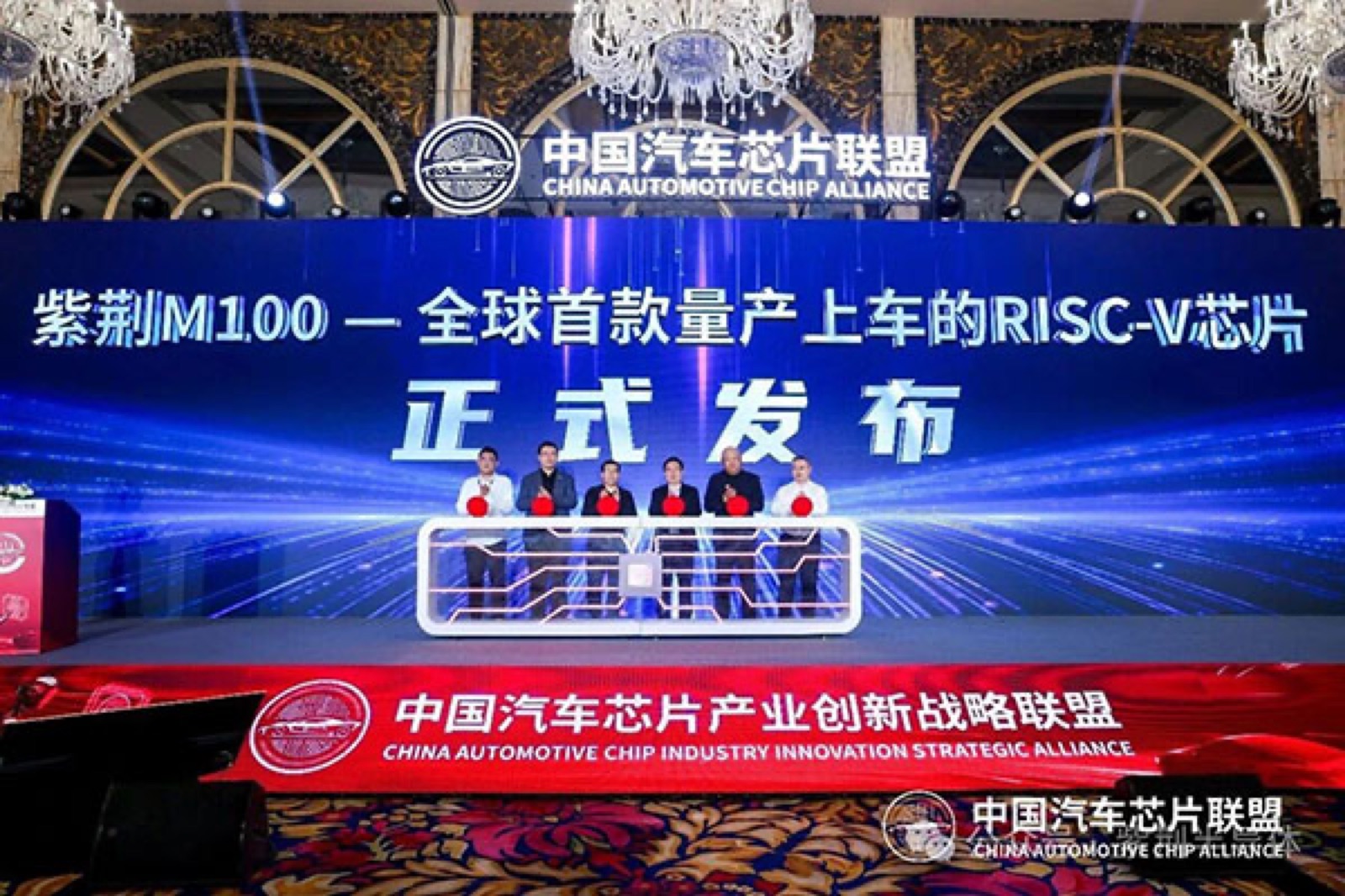
Zijing's first flagship product is the Zijing M100. In the company's account, the M100 is China's first automotive-grade MCU designed on an open RISC-V core, achieving volume production and vehicle deployment on December 18, 2025, and the world's first RISC-V automotive-grade chip in volume production on vehicles. Its applications concentrate on body control: combination headlamps, ambient lighting and combination switches — positions that demand little compute but impose severe requirements on reliability, temperature range and long-term supply, which makes them exactly the right entry point for a new architecture.
To grasp the weight of this, it helps to know how the automotive MCU market is structured. For a long time the microcontrollers in body control, gateways and instrument clusters came almost exclusively from a handful of international vendors on Arm architectures, producing a de facto architectural closure: what OEMs and Tier 1s could do was limited to interior remodelling on top of a fixed instruction set. Supporters see RISC-V's openness and customisability as a way out — no IP licence fees or royalties, custom instructions for a specific scenario, and security modules, drivers and architecture all held in-house.
According to the company, the M100 achieves full domestic sourcing across IP, manufacturing and packaging and testing, and has obtained a complete set of certifications including AEC-Q100 and ISO 26262 ASIL-B functional safety, qualifying it to supply mainstream automakers. On validation, Zijing says the M100 passed more than 800 chip-level tests, more than 1,400 tests at lighting supplier Mande Optoelectronics and all nine major software and hardware test categories at vehicle level. At the sixth Intelligent Automotive Chip Ecosystem Conference on September 16, 2026, Zijing disclosed that the M100 had entered volume shipment and said it had established partnerships with more than 15 customers.
A caveat is in order: claims such as "China's first" and "the world's first" come from the company's own account, and the industry does not use one single standard for "volume production on vehicles" — a design win, a small pilot build and a full production configuration are different stages. Treating this as a company-disclosed milestone is reasonable; it is not yet third-party audited market data.
From M100 to M200 and M300: from a single breakthrough to a product matrix
One MCU in volume production only proves that a single position works; continued growth depends on a product matrix. Zijing has laid out M100, M200 and M300 MCU and SoC families, paired with A100P, A100T, A100S, A100M and A100I power and driver chips, aiming for fairly complete coverage of body and control-system scenarios.
The disclosed roadmap puts the M200 into tape-out in the fourth quarter of 2026 on a 40-nanometre process, extending applications from body lighting into instrument clusters, telematics boxes, gateways, body control modules, shock absorbers and stabiliser bars — all of them high-volume, cost-sensitive positions. The M300 targets intelligent processors for zonal controllers, centred on high compute, large memory and many I/O, pointing at higher-performance, more highly integrated in-vehicle control. From M100 to M300 the direction is clear: from single functions toward the centralisation of vehicle electrical and electronic architectures.
The software toolchain is just as much a barrier for automotive MCUs. Zijing says it has developed more than 15 core IP blocks in-house and built a full-stack toolchain including its own MCAL, low-level drivers (SDK), a real-time operating system and a development and debugging environment. In the automotive world, whether hardware gets adopted depends heavily on whether AUTOSAR basic software, compilers, debuggers and functional-safety-certified tools are all in place — and this is exactly where RISC-V is widely described as having a weak ecosystem: some tools have automotive-certified versions, yet in practice debugging information and instructions can still be unobservable.
Certification is the other hard barrier. The company says it holds ISO 26262 ASIL-D functional safety process certification, ISO 26262 ASIL-B product certification, ISO 9001 quality management certification, ASPICE software certification and AEC-Q100 among others. Process certification (ASIL-D, covering the development process) and product certification (ASIL-B, covering a specific chip) operate at different levels: the first decides whether a team is qualified to develop safety-related chips at all, the second decides which safety integrity level of function a given chip may serve.
The second curve: spilling automotive know-how into embodied AI
While automotive chips scale up, Zijing is extending its RISC-V architecture know-how into embodied intelligence. According to the disclosure, its first "cerebellum" control chip, the Zijing E100, is under development on a RISC-V processor design. Its modular, scalable architecture is meant to serve compute needs ranging from low-power joint control to high-performance intelligent main control, providing a computing base for robot systems.
The direction fits Great Wall Motor's ecosystem strategy. In 2025 the automaker signed a strategic cooperation agreement with Unitree Robotics covering robot R&D, smart-manufacturing upgrades and intelligent vehicle innovation, with emphasis on embodied-AI fundamentals, joint vehicle-plus-robot scenarios and factory digitalisation; the initial work centres on off-road scenarios, exploring coordinated operation in complex environments. For a chip company incubated by an automaker and rooted in automotive-grade work, embodied AI is both a new market and a place to reuse existing capability: motor control, real-time communication, functional safety and automotive-grade reliability are precisely the low-level competences robot joints and controllers also need.
The market data the company cites sets the scale of both growth curves: the global RISC-V automotive MCU market was worth about $291 million in 2024 and is expected to reach $1.232 billion by 2031; for embodied-AI chips, global shipments in 2025 were roughly 800,000 units, with the market expected to approach RMB 20.84 billion by 2032 at a compound annual growth rate of about 42.2%. These figures come from market research firms and are directional rather than precise forecasts.
A few reservations deserve to be stated. First, every figure here comes from company disclosures and market research houses, with no independent audit; the ten million figure is cumulative shipments of the whole automotive-grade line, not the volume of the M100 alone. Second, the real bottleneck for the RISC-V automotive ecosystem remains software and standards — the company itself lists accelerating standard-setting and avoiding architectural fragmentation as its most critical work. Third, entering through low-compute positions such as body control is the pragmatic path for RISC-V in cars, but reaching powertrain, chassis and autonomous-driving domains — with higher safety integrity levels and deeper ecosystem lock-in — demands a body of validation far beyond the ten-million order of magnitude.