Espressif's ESP32-E22: a first tri-band Wi-Fi 6E connectivity co-processor
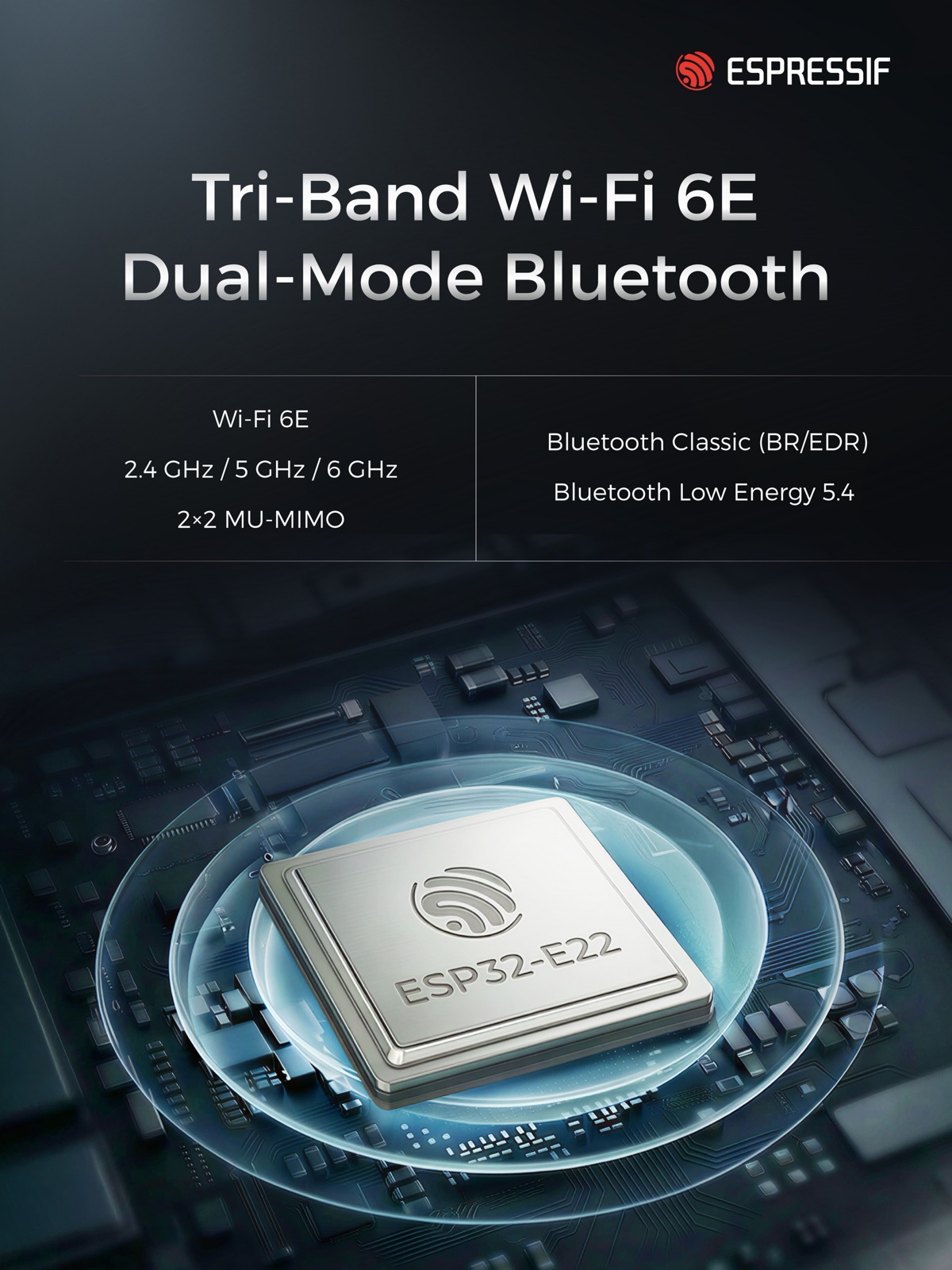
On January 19, Espressif announced the ESP32-E22 in Shanghai. It is the company’s first Wi-Fi 6E SoC and the foundation of a new high-performance wireless connectivity line. Its shape differs from the usual ESP32 module: rather than making a host manage the network, it takes over the whole networking stack. In product philosophy it is a fork in the road — from “one chip does everything” to specialised roles. Espressif’s positioning is clear: this is not a host but the dedicated wireless chip beside a host — and for products that already have a main chip, that is far cheaper than switching platforms.
The E22 is positioned as a Radio Co-Processor (RCP): the entire Wi-Fi and Bluetooth stack — security, authentication, scanning, roaming and Bluetooth host functions — is offloaded to the E22, leaving the host to focus on application logic. Think of it as a Wi-Fi network card: the host only sends and receives data while link management and radio timing belong to the co-processor. That division of labour matured long ago in PC wireless cards and in-car infotainment, and Espressif is now bringing it into embedded lines. There is a hidden benefit too: networking standards and certification requirements change fastest, so keeping that layer in a separate co-processor means the host does not have to be replaced along with it.
Why move the whole protocol stack out
The RCP form factor is nothing new: a PC wireless card or an in-car communication module is essentially a host plus a dedicated radio subsystem. Moving the same idea into embedded suggests a substantial part of the target audience already has its own main chip and just wants the radio done properly — those customers do not need another complete connected SoC, only the missing radio piece.
For a system designer, the split solves a complexity problem. Wi-Fi and Bluetooth stacks must handle authentication, security, roaming and coexistence: lots of code, long tuning cycles, and different certification requirements per region. Once that layer lives in a separate device, the host can be an Espressif SoC or a third-party processor, as long as it offers a high-speed host interface such as PCIe 2.1 or SDIO 3.0 — leaving far more freedom in choosing the host.
That is in fact the default for many teams: rather than maintaining a large wireless stack themselves, treat it as a black box and spend engineering effort on real product differentiation. Espressif stresses two things — its self-developed RISC-V processor architecture and its Wi-Fi 6E protocol stack — citing long-term support, greater flexibility and a more resilient supply chain. For industrial and consumer products that need long-term availability, that weighs as much as any spec sheet: only by owning the stack can a vendor tune it to customer needs and maintain it over years.
Tri-band and 2.4 Gbps: what the numbers mean
The E22 brings 6 GHz capability to customers for the first time: Wi-Fi 6E spans 2.4, 5 and 6 GHz, paired with 160 MHz channel bandwidth, 2×2 MU-MIMO, beamforming and link-layer scheduling to deliver high throughput and low latency in crowded environments. The value of 6 GHz is that it is a newly opened lane — relatively clean spectrum with little interference — while a 160 MHz channel raises the bandwidth ceiling for a single transmission. MU-MIMO and beamforming pay off mainly when many devices share the air: the first lets one transmission serve several clients at once, the second aims energy at the receiver.
On modulation the E22 supports 1024-QAM, and the chip supports rates up to 2.4 Gbps. Note that this is a physical-layer peak: real throughput depends on band, channel width, antenna conditions and the peer device, and usually falls well short. Judging a radio chip means checking whether it sustains that configuration steadily with 6 GHz, 160 MHz and 2×2 all pushed to the limit, not reading the maximum of one parameter. In engineering terms, whether that rate is reachable often comes down to antenna design and thermals — the chip is only half of it.
Bluetooth is dual-mode: the controller supports both Classic (BR/EDR) and Bluetooth LE 5.4, covering interoperability with existing devices and new low-power links, with coexistence algorithms keeping both reliable when active at once. That combination lets it talk to older audio and HID gear as well as low-power sensor networks.
Putting all that radio capability into one chip has a cost: coexistence. On 2.4 GHz, Wi-Fi and Bluetooth share spectrum, and poor scheduling means mutual interference. The fact that Espressif lists coexistence algorithms as a selling point suggests maturity at that layer is where it wants to be judged, not just paper specifications.
Target scenarios and product line
Espressif’s list concentrates on bandwidth-sensitive use cases: high-bandwidth streaming and wireless video links, next-generation smart-home hubs and connected appliances, industrial automation, bridging devices, and AR/VR accessories needing low latency. What they share is that the host is usually somebody else — a display-equipped main chip or a real-time control MCU — with the E22 simply doing the networking properly. And all of them ultimately move streams: video, audio or sensor data, not the occasional status report.
Take wireless video: pushing an encoded stream over Wi-Fi tests sustained throughput and jitter control rather than a peak benchmark. Industrial automation cares more about stability and roaming behaviour amid interference. A bridging device is essentially giving a host with no wireless capability a way into the wireless world — the most direct use of the RCP form factor. For teams building video products, that split means choosing the host platform they know best and handing off the hardest part, the radio — which is precisely why a co-processor exists.
Engineering samples can be requested now. For designers, samples mean the early work on RF layout, antenna matching and thermal design can begin — work that often becomes the project bottleneck well before software integration does. The sample stage is also when customer feedback counts most, since interface definitions, drivers and stack details can still be adjusted.
Placed back in Espressif’s map, the signal is clear: the co-processor — the network-card approach to Wi-Fi — has formally entered its product line, and its in-house RISC-V now reaches from the host into the radio domain. Note also that it keeps both paths open, with an Espressif SoC or a third-party processor as host; the precondition for selling a co-processor is precisely that it is not fussy about the host. Espressif is listed on Shanghai’s STAR Market under 688018.SH.