Google DeepMind launches Gemini Robotics 2: whole-body intelligence for robots
Three models, each with a job
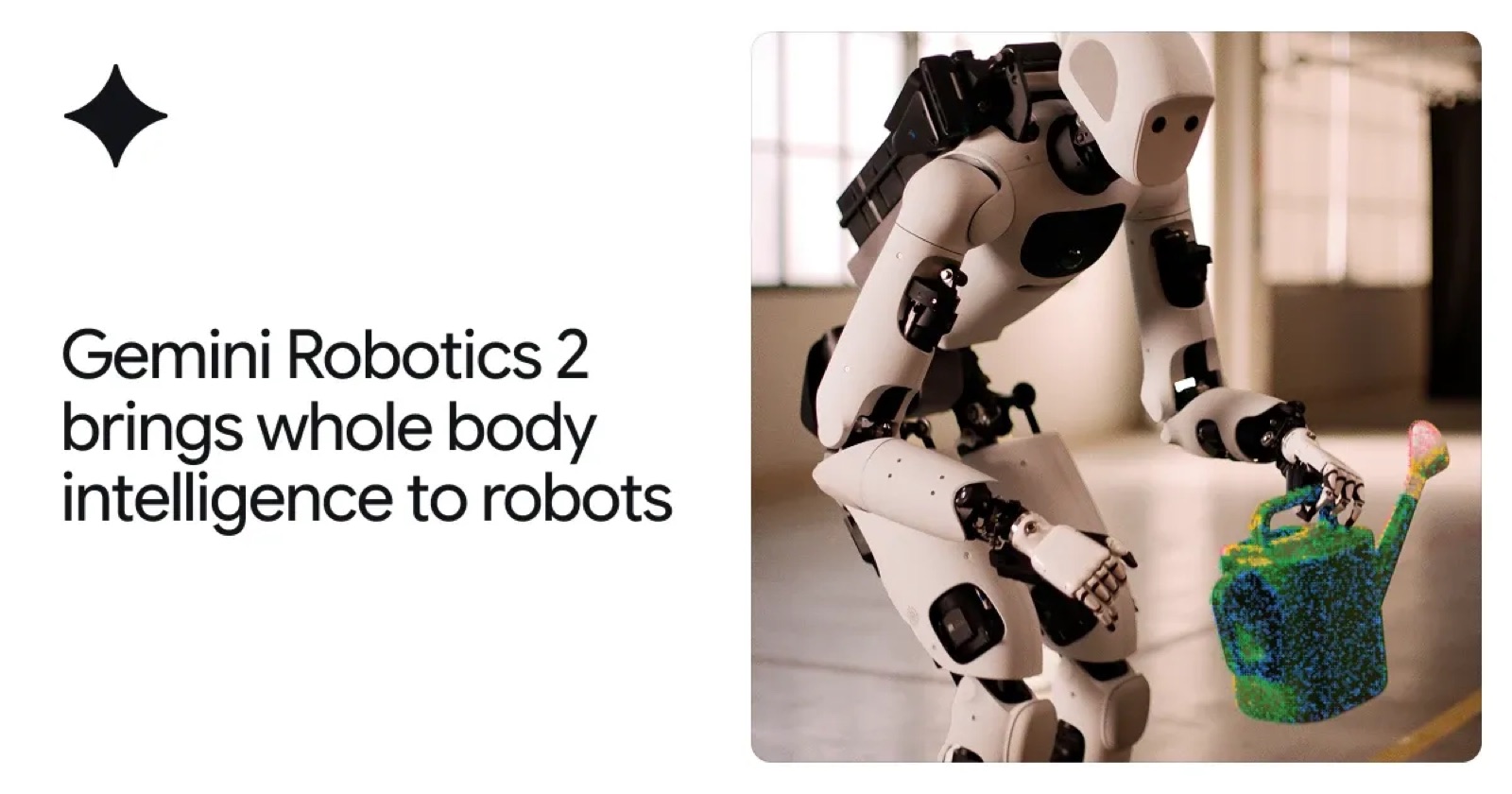
On July 30, Google DeepMind introduced the Gemini Robotics 2 family, built around whole-body intelligence: robots can manipulate objects while walking, crouching and stretching, combining bimanual coordination, operation in cluttered spaces and multi-robot teamwork. The positioning is not a robot but an intelligence layer powering the next generation of genuinely adaptable robots — from feet to fingertips.
The announcement starts with the problem. Most robots are pre-programmed or teleoperated for narrow, repetitive task sequences; they cannot truly learn for themselves or adapt to unpredictable environments, and transferring a learned skill from one robot body to another remains extremely difficult. To tackle the hardest problems at scale, robots of every shape and size need AI models that let them think, act and interact. Gemini Robotics 2 is the answer to both.
It consists of three models with distinct jobs. Gemini Robotics 2 is the most advanced vision-language-action model, turning vision and language into motor control; it can drive a full humanoid from feet to fingertips as well as other bi-arm robots, and raises the bar on manipulation with both hands and grippers. Gemini Robotics ER 2 is the embodied-reasoning model, a vision-language model acting as the robot's agent: it understands the physical world, communicates with people, plans multi-step tasks lasting several minutes and coordinates multiple robots. Gemini Robotics On-Device 2 is the most efficient VLA, optimized to run locally on robotic devices and able to adapt to a completely new embodiment with a few hours of data.
One concrete example: told to put the watering can into the green bin on the bottom shelf, the Apptronik Apollo 2 running Gemini Robotics 2 processes the instruction, walks to the table, picks up the watering can, takes a few steps to the shelves and places it precisely. DeepMind also admits a shortcoming: robot movement speed still has a long way to go.
From tabletop tasks to feet-to-fingertips
The most visible change is scope of control. Earlier models drove a humanoid's upper body for tabletop tasks; Gemini Robotics 2 extends control to the whole humanoid for the first time, translating intent into whole-body control. The reasoning is simple: the world is built for human movement — reaching, bending, balancing in tight, cluttered spaces that other robot form factors cannot enter at all.
Dexterity gets equal billing. The same model works on hands and on grippers: on Apollo 2 it can drive a five-fingered, 22-degree-of-freedom SharpaWave hand through delicate actions such as tying knots or sealing a ziplock bag, while on the Franka Duo platform it operates a standard two-finger parallel gripper for complex tasks like tight packing. DeepMind says it is still pushing precision and speed toward human-level dexterity.
How to read the numbers: dexterous hands are still the weak spot
The evaluation setup says as much as the numbers. The same model checkpoint runs on three embodiments: an Apptronik Apollo 2 with Inspire hands, an Apollo 2 with SharpaWave hands, and a Franka Duo with a Robotiq gripper. That is what cross-embodiment means here — the weights stay put while the body changes.
By the company's own measurements, Apollo 2 with Inspire hands scored 68.4% picking up from a table, 45.7% from the floor and 76.3% from a shelf; on the Franka Duo bi-arm platform, general pick-and-place reached 74.2%, diverse tool kitting 78.9% and precise insertion 89.6%. DeepMind notes that each bar represents an average success rate across multiple tasks in the same skill category, not a best-case single task.
Multi-finger dexterity is clearly harder. With the SharpaWave hands on Apollo 2, unscrewing a bulb reached 92% while screwing one in reached 36%; tying a trash bag 44%, using a dustpan 32% and sealing a ziplock bag 40%. DeepMind's own caption states that whole-body and gripper-based dexterous tasks reach medium to high success rates while multi-finger manipulation remains challenging — four of those five tasks sit below 50%.
Two caveats belong with the numbers. First, they are all company-run measurements with error bars, not an independently reproduced benchmark. Second, numbers from different skill categories cannot be compared directly — picking up an object and screwing in a light bulb are not the same difficulty. It is the shared problem of every robot-model release: capability genuinely advances, while reliable delivery still awaits a great deal of field validation.
Reasoning, safety, and who can use it today
Gemini Robotics ER 2 serves as the robot's high-level brain: it observes the room, reasons about the steps a task requires, coordinates with the VLA to carry them out and tracks progress until the job is done, which allows self-correction and generalization to novel situations and goals. This update makes longer sequences more reliable — tasks lasting several minutes and involving hundreds of decisions — and the model can now tell when a task begins and ends and pinpoint when key events occur, which DeepMind calls a step change in progress understanding.
On safety, DeepMind also released ASIMOV-Agentic, a benchmark for how well an embodied-reasoning agent orchestrates safety and resolves uncertainty: refusing unsafe tool calls from a VLA, predicting whether a task is possible, and proactively requesting human intervention when unsure. It calls ER 2 its safest robotics model to date on safety-constraint-following and human-proximity benchmarks, better at detecting nearby people, triggering safety tool calls and bringing the robot to a safe stop when someone comes too close.
Availability remains tiered: ER 2 is available through Google AI Studio and in private preview on the Gemini Enterprise Agent Platform, while the VLA and on-device models are limited to early-access partners, with a trusted-tester program to apply to. The on-device adaptation bar is deliberately low — a few hours of data, typically fewer than 200 examples, is enough for a new bi-arm embodiment even when its shape, sensors and degrees of freedom differ drastically, with Dexmate, SO101 and Trossen platforms shown in the demos.
Zoom out and the route runs from the original Gemini Robotics in March 2025 to here: from robot arms with grippers doing tabletop work toward whole-body coordination and cross-embodiment transfer, with body makers such as Apptronik, Boston Dynamics and Agile Robots named in the acknowledgements. This is plainly not a consumer product but a layer of intelligence meant to be installed in many kinds of robots — and the real test is whether these self-reported numbers reproduce on partners' floors.