Generalist's New Progress: From the UMI-Paradigm Two-Finger Gripper to End-Effector Generalization
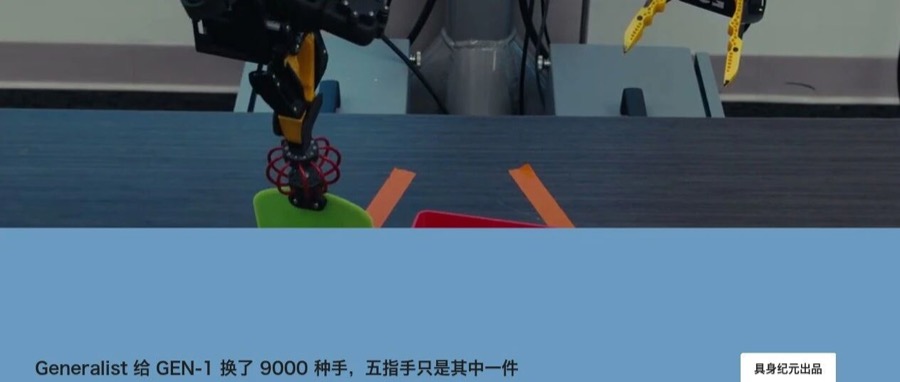
GEN-1 is Generalist's embodied foundation model, and the range of end effectors it now supports is quite broad: five-fingered anthropomorphic hands, specialized tools with entirely new actuation methods, and various forms in between are all included. The official framing of this update is that by adapting GEN-1 to these new hands, they have demonstrated that a single foundation model can learn sensorimotor policies on robots with fundamentally different modes of physical interaction, and that these capabilities can transfer.
GEN-1 was pretrained on Generalist's proprietary robot dataset. This dataset now covers a large number of different end effectors, with more than 500,000 hours of real interaction data.
Some of these end effectors are entirely new forms with their own actuation schemes and camera mounting positions, and several come directly from real commercial settings. Others are off-the-shelf tools, 3D-printed parts, or custom modifications of standard two-finger grippers. For the latter category alone, the official figure is approximately 9,000 variants, selected to expose the model to as wide a range of contact physics as possible.
In Generalist's account, each end effector is a distinct sensorimotor interface, a channel through which GEN-1 perceives the physical world in order to learn geometry, contact, and dynamics. Pretraining on thousands of such interfaces teaches the model general-purpose sensorimotor representations, that is, a kind of physical common sense that can transfer to new hands and new grasping methods.
Each hand is a vocabulary for acting in the world. This section redefines "swapping a gripper" from a hardware problem into a language problem, and it is the most thought-provoking part of the entire blog post.