GPT-6 reaches all ChatGPT users with the new "Intelligent UI"
On October 7, OpenAI pushed GPT-6 out to every ChatGPT user. Plus, Pro, Business and Enterprise tiers got it the same day inside the Chat tab, with Free and Go following a day later. OpenAI puts the scale at more than 1.2 billion people using ChatGPT each week, so the move amounts to placing an entire next-generation model in front of that audience. Paid tiers run on GPT-6 Sol and the free and Go tiers on GPT-6 Luna, both tuned for everyday conversation; enterprise availability still depends on workplace admin settings. Note also that only the ChatGPT chat experience changed — the models behind Work and Codex are not part of this release.
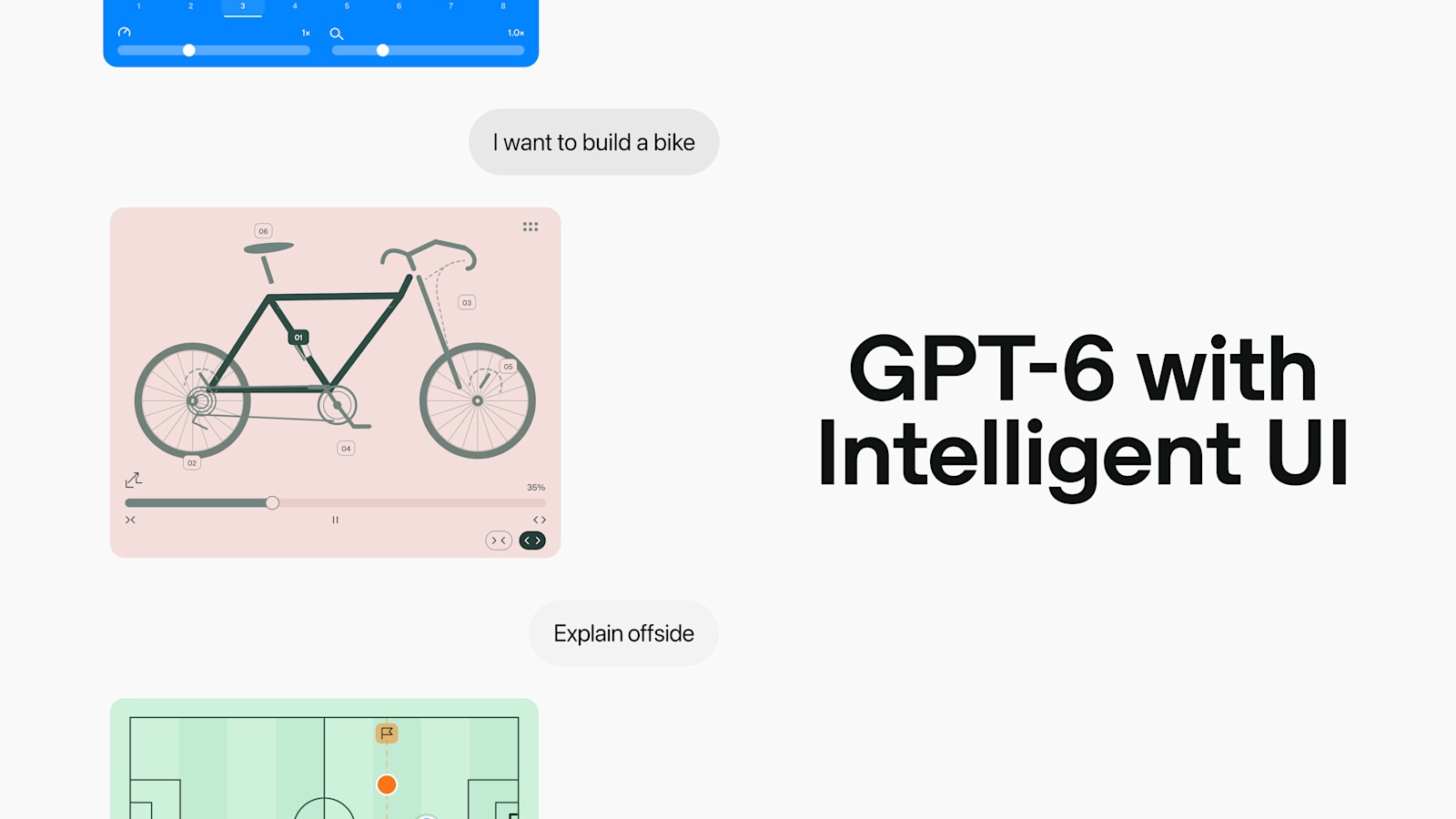
The headline capability is called Intelligent UI. Put simply, an answer is no longer just a block of text: it can combine prose, graphics and interactive elements — charts, tappable buttons, forms, and small tools usable right inside the conversation. OpenAI's examples include a calculator for exploring how savings could grow, a bill splitter for dinner with friends, and a small game you can play without leaving the chat.
How it actually works
Two layers sit underneath. One is a library of native, streamable components that gives every response a consistent design foundation; the other is a compiler that processes the interface while the model is still generating. Together they let the interface appear progressively instead of waiting for the whole response to finish. The model is not merely picking components: it decides content, layout, visuals and interaction, and OpenAI says it expanded its training methods to get there, including evaluating the interfaces it creates for clarity, usefulness and completeness. The company also acknowledges that the model's design judgment still has room to improve and that what it can build will keep expanding.
The most vivid demo in the announcement is a seven-speed bicycle. The answer breaks the bike into connected systems — frame, drivetrain, brakes, cockpit and wheels — and selecting one shows what it does: the frame carries the rider, the drivetrain turns effort into motion, the hand brakes turn a squeeze into controlled slowing. Two everyday cases came up as well: the timing for a Sunday roast can sit alongside the recipe, and the stops on a road trip can appear on a map with notes on what is worth a detour.
OpenAI groups these uses into three buckets: more visual answers to everyday questions, easier learning of complex topics, and creating a usable little tool for the task at hand just by asking. When learning, visual and interactive explanations let you change an input to see what happens, or work through a problem step by step. The company stresses that all of this keeps the experience fast and familiar across web and mobile — the component library supplies a consistent design foundation precisely so generated interfaces do not feel foreign.
Why is the form of an answer worth discussing on its own? Because a chat box is a general-purpose container, while many tasks are naturally structured: a timeline, a side-by-side comparison, a route on a map, or a parameter you want to nudge back and forth. Those forms used to be designed in advance by product teams, leaving users to fill in a fixed structure; letting the model generate the interface folds "how to express this" into the answer itself. That is the most substantive change this update makes to the experience.
OpenAI also set out the boundary: Intelligent UI still needs work on the model's design judgment, and what it can create will keep expanding. The company calls this a starting point for a ChatGPT that shapes an interface around what you are trying to do, with the long-term aim of generating more of the interfaces people need for everyday tasks — which is why the accompanying training and evaluation includes a specific check for whether an interface is clear, useful and complete.
Intelligent UI does not mean every answer becomes an interface, though. OpenAI frames the format as a function of the question: a comparison may work best side by side, an explanation may be easier to grasp through an interactive diagram, and when a simple text answer is the most useful response, ChatGPT can just give text. In other words, deciding when interactivity helps and when plain prose is better is left to the model itself.
Starting sooner, judging better
On speed, GPT-6 introduces thinking interleaved with answering. Reasoning models let users tackle much harder problems but forced them to wait until the model finished thinking; now ChatGPT can think and answer at the same time. It was trained to take the user's waiting time into account and compose an answer progressively from what it knows and what it has found so far, building the response across several partial pieces — each adding information rather than filler — while keeping the final answer as cohesive and factual as one written in a single pass.
Two numbers stand out. First, on questions that require web search, GPT-6 Instant starts answering 44% sooner on average than GPT-5.6 Instant. Second, in an internal evaluation of high-value everyday agentic tasks, GPT-6 Extra High began answering in the same amount of time as GPT-5.6 Medium while scoring better overall than GPT-5.6 Extra High. Answers that need search also got better as a whole: the model makes smarter decisions about when to look something up and more reliably finds information that supports its answer, and on an internal evaluation of difficult problems it addressed the key aspect of the question more often than GPT-5.6.
Safety and the timeline
On safety, OpenAI says GPT-6 builds on several of Astra's advances. It showed stronger resistance to attempts to bypass its safety training, particularly attacks that adapt across multiple turns; it is also trained to respond safely in higher-risk scenarios while avoiding unnecessary refusals of harmless requests, using conversation history and context to recognize risks that a single prompt would not reveal. Alignment evaluations ran throughout training, and OpenAI says this generation is better at recognizing and communicating the limits of its own capabilities, including when it lacks the information or tools it needs. The full results and review are documented in the system card.
Seen against September's pace, this release reads as the mainstreaming step. GPT-6 Astra, on September 3, is the strongest tier today, with its cybersecurity capability rated "Critical" in the safety documentation; GPT-6 Sol and Luna filled in the everyday tiers on September 22; and GPT-6.1 Sol on September 29 came close to Astra at roughly one fifth of the price. By October 7 those capabilities were spread across the whole user base: Sol for paid tiers, Luna for free ones.
In form, ChatGPT is shifting from a chat box toward a generated interface: users no longer want only text but something they can click, fill in and use directly. OpenAI frames the ambition more broadly — for decades people had to learn how to use software, navigating fixed interfaces designed around particular tasks, and the company believes that will reverse: instead of people adapting to software, software will adapt to people. You describe what you want to accomplish and work with an experience built around it, and Intelligent UI is a step in that direction. Tiered capability plus steady price cuts is the real thread running through this rollout.