Apollo Go goes live on Uber in Dubai: its first market with both self-operated and partner-based service
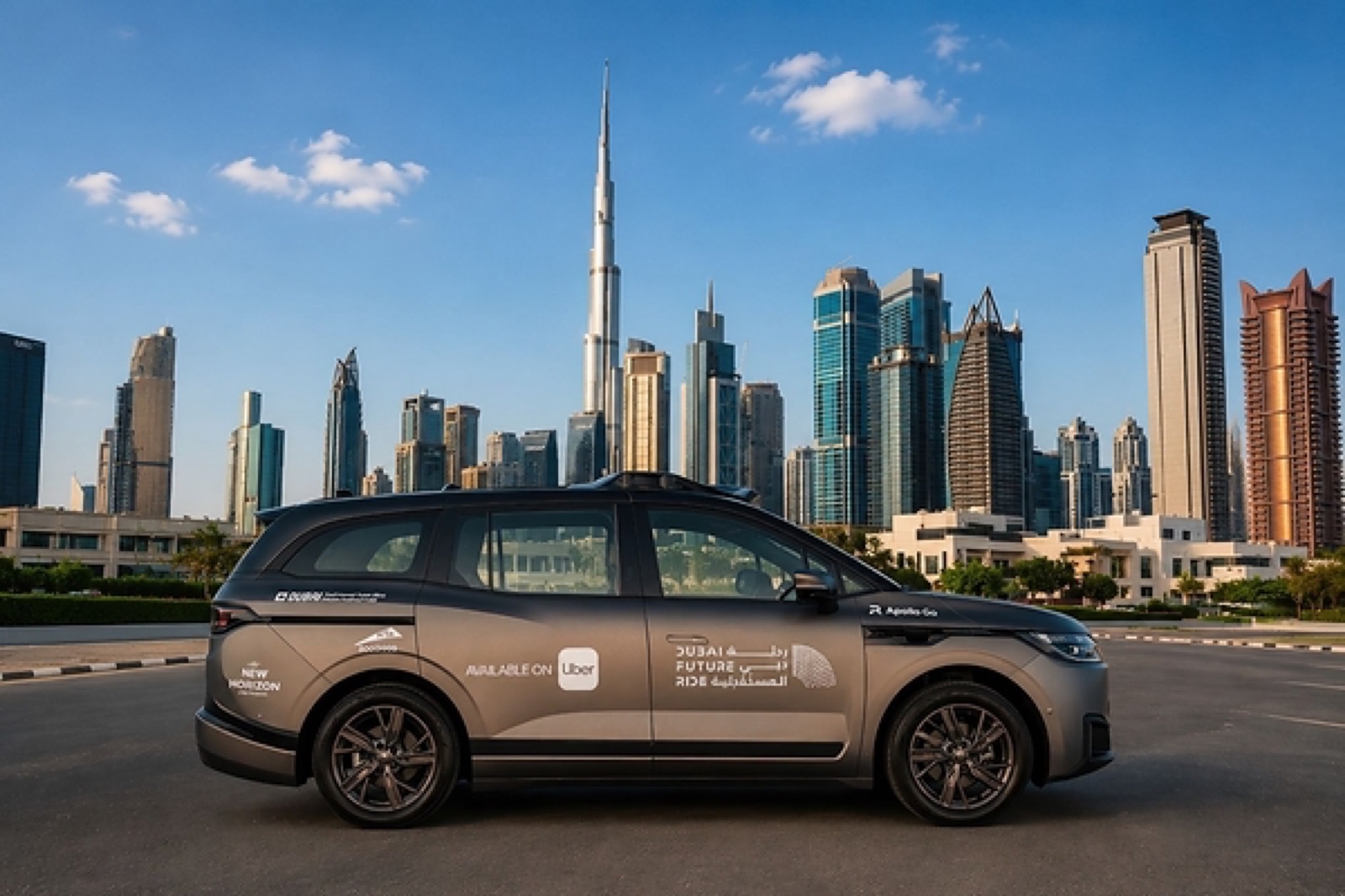
Day one in Dubai: hailing a fully driverless car inside the Uber app
On August 20, Baidu announced that fully driverless vehicles from Apollo Go, its autonomous ride-hailing service, are now live on the Uber platform in Dubai. From that day, riders in the city can call an Apollo Go vehicle with nobody in the driver's seat directly through the Uber app. Fleet operations are handled by New Horizon Luxury Transport — the vehicles are run by a local operator, while the autonomous driving technology comes from Baidu.
There are two ways to be matched with one. A rider booking Uber Comfort or UberX may be matched with a fully driverless Apollo Go vehicle, or may select the "Autonomous" option in the Uber app. At launch the service area is limited to select locations in Umm Suqeim and Jumeirah, with Baidu saying the operating territory will expand later. Service-area boundaries are the norm for this kind of service: only repeatedly validated stretches of road are included, so a city's coverage tends to grow a block at a time.
This is not a one-off market opening. It is the first deployment of the multi-year strategic partnership the two companies announced in July 2025, which aims to bring thousands of Apollo Go autonomous vehicles onto the Uber platform across multiple global markets. For Apollo Go, Dubai carries a further distinction: it is the first city where the company runs both a self-operated app and a third-party platform partnership internationally.
A timeline: from a testing permit to a "dual model"
Rewinding the timeline makes it clearer. In January 2026, Apollo Go received Dubai's first permit for fully autonomous testing without a safety driver — "without a safety driver" being the key qualifier, meaning no one needs to be on board during testing. Around the same period, Apollo Go set up an overseas operation centre in Dubai to prepare for local operations.
In March 2026, Apollo Go began commercial fully driverless rides in Dubai through its own app — the first international app deployment for the company. In other words, it had already run commercial service through its own entry point locally before joining Uber; what Uber adds is a second entry point reaching a much wider pool of users.
So riders in Dubai now have two largely independent entry points: Apollo Go's own app and the Uber app. Nan Yang, a Baidu vice president, called the launch an important milestone in the partnership and said Dubai is the starting point for expanding its coverage; he also noted that Dubai is the first city where Apollo Go has successfully established a "dual model" — offering both self-operated and partner-operated autonomous ride-hailing services internationally. Sarfraz Maredia, Uber's global head of autonomous driving, said the partnership coming to life is an important step in scaling autonomous ride-hailing globally, and that going live in Dubai marks the first time its "multi-partner" vision has been realized on public roads.
Two routes to market, and what "multi-partner" means
In industry terms, there are broadly two routes for autonomous ride-hailing, or robotaxi, services. One is to build your own app and face riders directly, keeping the brand, the account, payments and operations in your own hands — the upside is full control of experience and data, the cost is building a user base and a service organization from scratch in an unfamiliar market. The other is to plug into an existing ride-hailing platform and put your vehicles into an order network someone else has already proven. What makes Dubai unusual is that Apollo Go is taking both routes at once.
Platform integration scales faster because the platform has already built the infrastructure scaling requires: a traffic funnel, dispatch and matching systems, payments, customer service, and city-level compliance and operating experience. For the technology side, what the platform saves is mainly the work of building user awareness from zero; for the platform, what it gets is a fully driverless technology stack that already works. Each side brings half, and the result is vehicles and orders meeting quickly in one city.
"Multi-partner" is the other key to reading this launch. For a platform like Uber, autonomy is not about tying itself to a single technology supplier, but about bringing several technology providers onto the same ride-hailing network; the platform's role shifts from assigning trips to drivers to assigning trips to different sources of capacity, including both human drivers and the autonomous fleets of different companies. That is what Maredia meant by the multi-partner vision being realized on public roads — riders see one app, but behind it are several kinds of supply.
The difference between "fully driverless" and "supervised" is the other premise for reading this news. Fully driverless means no safety driver on board, with the entire trip handled by the system, usually paired with remote assistance and ground operations teams for situations the vehicle cannot resolve on its own; that is a different thing from testing with a safety driver seated inside and ready to take over. Within that division of labour, the fleet operator takes on what concerns day-to-day vehicle operations — dispatch, cleaning, charging, maintenance and on-site support — while the technology provider supplies the autonomous driving system itself.
Why the Middle East is a testbed, and that set of numbers
The Middle East becoming a testbed for autonomous driving internationalization looks less like a coincidence. On policy and regulation, authorities there have been willing to grant testing and operating permits early, leaving room to start running and expand afterwards; on road networks, wide, relatively structured roads are friendly to early validation; on demand, high acceptance of ride-hailing, demographics and payment capacity all support the market. For autonomous driving companies hoping to move beyond their home market, the region offers real operating data relatively quickly, and makes it easier to build partnerships with global platforms.
The figures Baidu gave in this announcement: at that point Apollo Go had spanned 28 cities globally, and its fleets had accumulated over 350 million autonomous kilometres, including more than 240 million fully driverless kilometres; as of the end of June, its fully driverless vehicles recorded an average of roughly one airbag deployment every 14.4 million kilometres.
Those numbers need to be read together with what they are. Airbag deployment is one of the incident measures autonomous driving companies commonly use; it corresponds to a collision of at least a certain severity, and dividing it into mileage yields a frequency — one incident every so many kilometres. Such statistics are compiled by the company itself rather than reproduced by an independent third party, and the mileage definition (whether test mileage is included, whether all cities and all vehicles are covered) affects the result. So it can indicate the broad state of a safety system, but it is not suitable for direct comparison with other companies' figures, nor does it guarantee future operating performance.
Taken apart, this launch shows a triangular structure: the technology provider supplies the autonomous driving system, a local operator runs the fleet and field operations, and a global platform provides the users and the order entry point. For Chinese autonomous driving companies, the value of that structure is that it sidesteps the heaviest route — building a user base from zero in every new country — and instead puts the technology into an existing ride-hailing network; keeping the self-operated app in Dubai as well shows the two routes are not mutually exclusive. What is worth watching next: whether the service area expands as planned, whether the fleet grows from the first vehicles toward the "thousands" in the partnership's goal, and which new markets this combination of technology, local operator and global platform will be copied to.