Waymo opens to the public in Las Vegas: Ojai and the 6th-generation Driver carry their first riders
From testing to riders: day one in Las Vegas
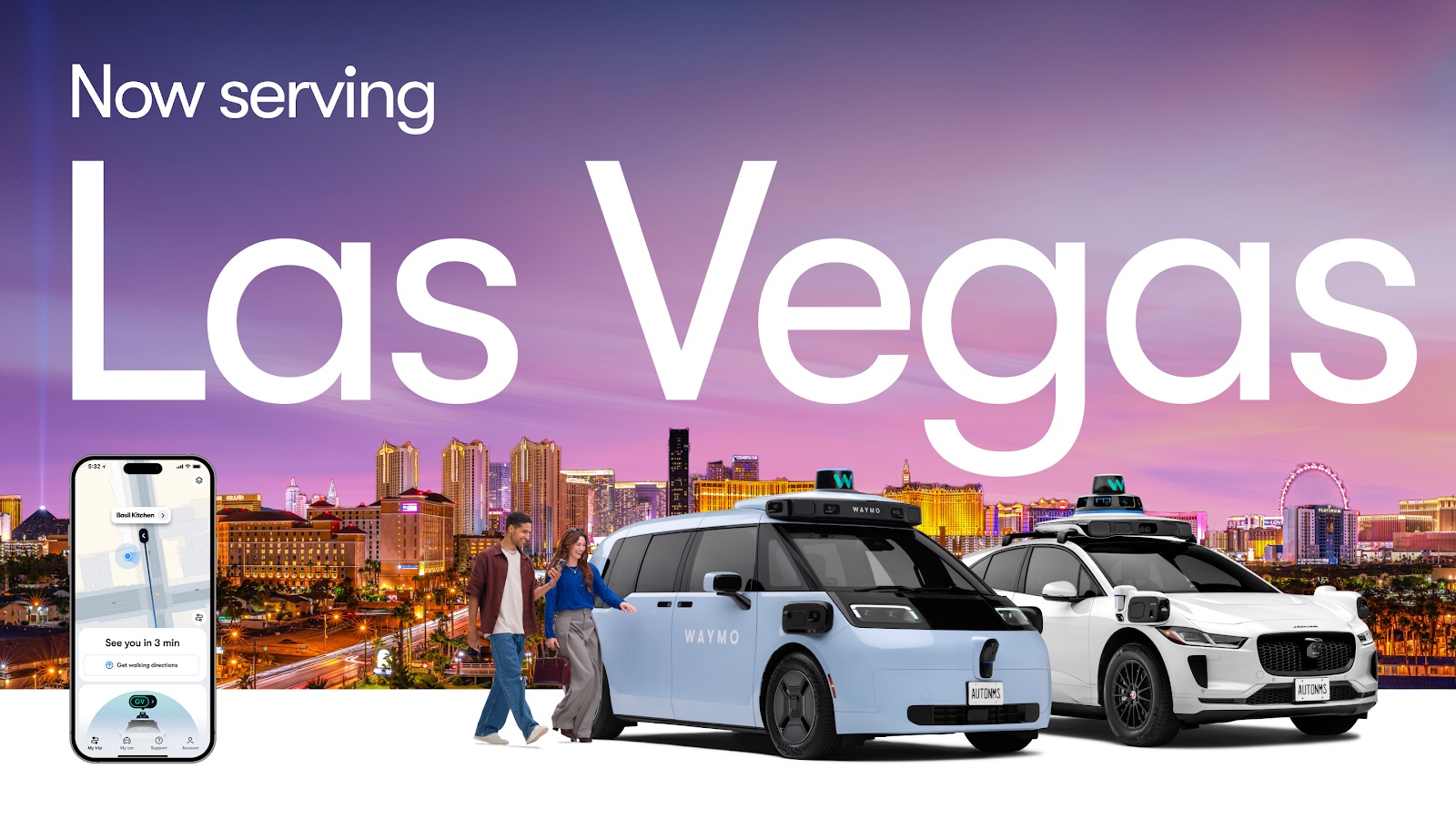
On September 14, Waymo announced on its official blog that from that day residents and visitors in Las Vegas could hail fully autonomous trips — the city's first public riders. In Waymo's usage, public riders has a specific meaning: no safety operator sits in the driver's seat, passengers complete the whole trip on their own in the back, and remote assistants plus ground operations teams handle anything unusual. After months studying Vegas roads, the company said, more than 100,000 people had expressed interest in riding.
The service area is described as nearly 24 miles, running from Boulder Junction up the iconic Strip to Sahara Avenue while also connecting the edge of Spring Valley with Winchester. The service area is the boundary of driverless service: only repeatedly validated roads are included, the car will not drive outside it, and that is why coverage in each city always grows block by block. Waymo said it would first take riders to two landmark destinations, Allegiant Stadium and The Venetian.
"Cruising down Las Vegas Boulevard in a Waymo will make anyone feel like a high roller," said Jackie Hyun, Head of Marketing at Waymo, describing the Ojai vehicle as offering a spacious cabin, large screens and plenty of customizations that help riders arrive safely and comfortably across the nearly 24-mile service area. For a city built on tourism and nightlife, those experience details are not trivial: screens, climate and music settings are often what a rider uses to decide whether to take another trip.
Ojai and the 6th-generation Waymo Driver: a fleet generation change
One distinctive detail in Las Vegas is the fleet itself: together with Denver and San Diego, the city becomes one of the first to run majority-Ojai fleets, with Ojai powered by the 6th-generation Waymo Driver. In this industry a vehicle generation change usually cuts cost more than a model update does — sensor count, compute platform and wiring all get simpler — and per-vehicle cost is what decides whether a fleet can grow from hundreds to thousands.
In autonomous-driving engineering, a numbered Driver generation refers to the whole hardware and software stack — sensor suite, compute platform and driving model iterating together — while the vehicle is the platform that carries that stack. A generation change usually means lower per-vehicle cost, better performance in bad weather and fewer blind spots, and it means a fleet can be scaled up faster. For riders, those changes ultimately show up as more cars, shorter waits and more places you can go.
The post quotes Las Vegas Mayor Shelley Berkley: Las Vegas and its neighborhoods are evolving rapidly, and expanding smart, clean transit options is essential for the city's future. The public rollout of Waymo's all-electric autonomous ride-hailing brings technology directly onto municipal streets, helping residents and patrons travel seamlessly between cultural districts and neighborhood centers. By investing in cleaner, safer urban mobility, she said, the city remains accessible, vibrant and forward-looking.
Small at first, then opening by degrees
Waymo said explicitly that it will steadily give access to more riders in Clark County, working toward opening the service to everyone. That is its familiar cadence: invitations and waitlists first, then a gradual widening of access, and only at the end general availability. A waitlist doubles as demand research — the number and location of sign-ups tell the company whether a city justifies another fleet and another operations team.
That cadence reflects both regulation and operations. Driverless service requires test and commercial permits city by city, and the mapping, intersections and construction information inside the service area must be validated first. For riders the visible difference is whether you can get a car and where it will take you; for the company it is about running the safety system and remote-assistance operations to a stable state inside a limited area before replicating them at larger scale.
On safety, Waymo restated its published record: over the same distance driven, the Waymo Driver is involved in 94% fewer serious-injury-or-worse crashes than human drivers. That figure comes from the company's own comparative study rather than an independently reproduced benchmark. Such studies typically compare the company's own injury-crash records against the baseline rate for human driving over comparable mileage; when definitions or samples change, the size of the conclusion changes too, so these numbers are best read together with their method.
What comes after Las Vegas
Las Vegas is the latest stop in a recent run of expansion. Over the same period the company pushed service into more US cities and airports, and its cities page lists upcoming markets including Baltimore, Boston, Charlotte, Chicago, Detroit, Minneapolis, New Orleans, New York, Philadelphia, Pittsburgh, Portland, Sacramento, Seattle, St. Louis and Washington, D.C., along with London and Tokyo.
Put Las Vegas in industry context: over the past two years, driverless ride-hailing in the United States moved from single-city trials to multi-city operations, and the pace has been constrained mainly by three things — regulatory permits, fleet production capacity, and the unit economics of operations, which include charging, cleaning, remote assistance and maintenance. The bigger the service area and the more cities, the heavier the demand for remote operators and ground staff, and those unglamorous links are often the real bottleneck. Tourism-heavy cities like Las Vegas see sharp swings in demand but concentrated destinations such as airports, convention centers, arenas and hotels, which is relatively friendly to fixed-route shuttling yet a real test for peak-hour dispatch.
For riders, Waymo in Las Vegas is still autonomy with boundaries: where the car can go is set by the service area, and extreme situations may still involve remote or on-site human intervention. Riders can also feel another boundary — weather and hours: heavy rain, thick fog or road closures around a big event can temporarily shrink service. Such boundaries exist in driverless service in every city; what differs between companies is where the line is drawn and how often it moves.
Waymo closes the post by saying it has prepared for this day for years — during initial testing in Las Vegas it kept validating the Waymo Driver's performance across town. After September 14, the focus shifts from whether the system can drive to whether it can reliably serve a city known for nightlife and large events: night traffic, pedestrians who have been drinking, and convention or show traffic that closes streets at short notice are the exam this city sets for an autonomous driver.
For Waymo itself, launching a city is not the finish line: the post says it will steadily widen access to more Clark County riders and eventually open the service to everyone, while the more than a dozen upcoming US markets plus London and Tokyo listed on its site show that the small-first, widen-later playbook will be repeated many times over. How cheap each repetition turns out to be will depend on how smoothly the process runs in Las Vegas this time.