XPeng's second-generation VLA gets its first major upgrade: from 3D space to 4D space-time
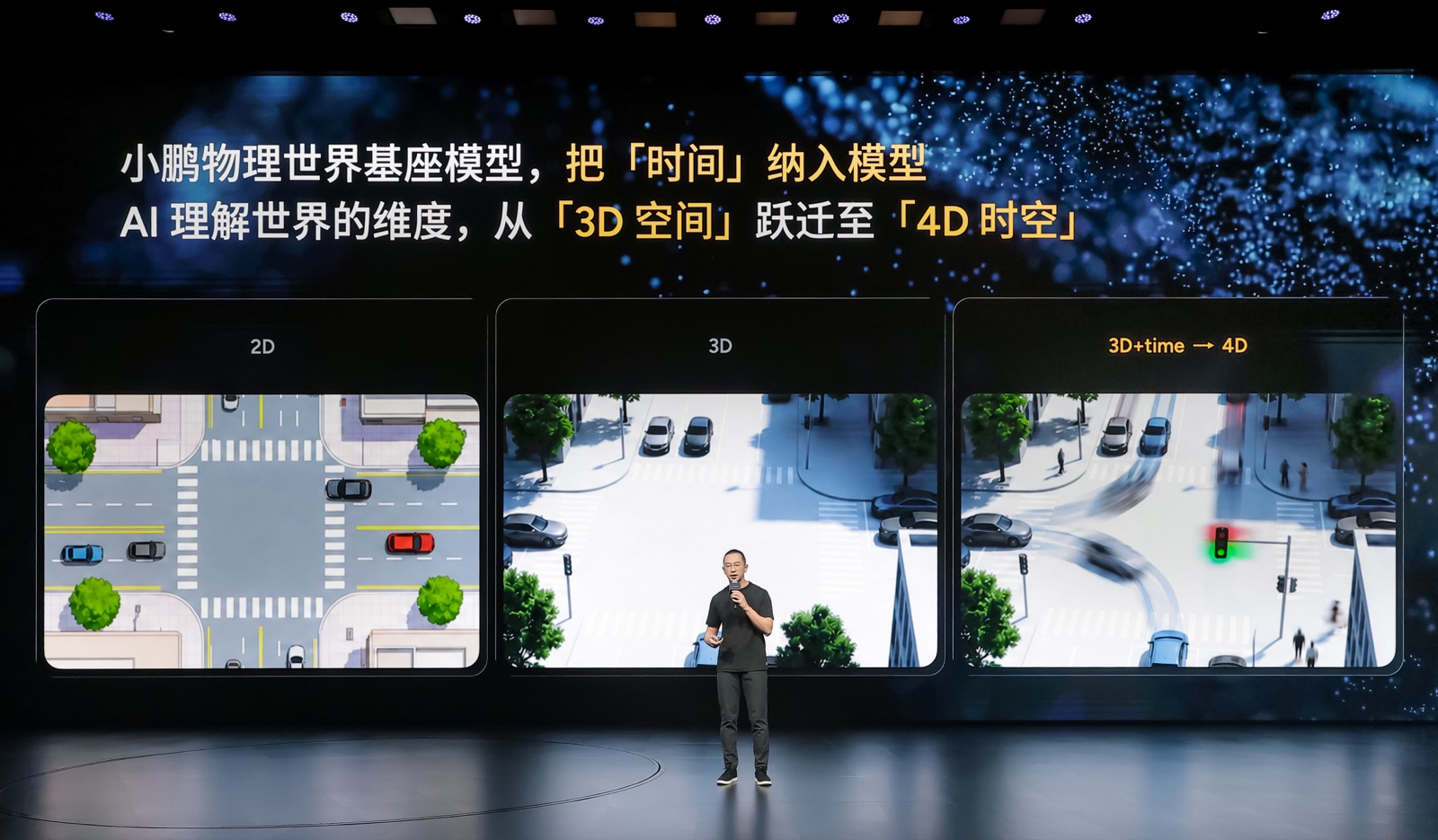
Teaching the model to understand time
On August 27, XPeng held an event in Guangzhou themed TIME — a physical-AI briefing and a hands-on day for the new version of its second-generation VLA model. According to the company's announcement, the model has received its first major upgrade, and the new XOS 6.3.0 software release will debut globally on the XPeng G9L. VLA refers to architectures that put vision, language and action into a single model, and what this upgrade changes is precisely its understanding of time.
The core of the upgrade is summed up in one line: making the AI genuinely understand time, moving from a static 3D understanding of physical space to a dynamic 4D understanding of space and time. The company's framing: the real world is not a stack of still images but a continuously evolving process. Conventional models can recognize vehicles, pedestrians, roads and traffic signals, but recognizing is far from enough to make complex decisions in the physical world.
Concretely, the new version introduces the Infini-VLA long-horizon architecture: the model remembers the previous 30 seconds of the world, giving driving decisions a longer context. Road events that unfold in sequence are no longer cut into independent frames; the actions, positions and scenes that came before are chained together into a fuller temporal understanding. Handing memory of the past to a dedicated architecture rather than stacking single-frame inference is the key methodological difference in this upgrade.
On the inference side, the model moves to streaming inference — autoregressive, away from discrete inference toward continuous inference — with the company citing a 300% improvement in end-to-end response speed. Where a conventional model runs see, compute, output, then see again in series, the new version aims to watch, think and act in parallel. On board a car this is not only about speed: as long as response time undercuts a human's reaction to a sudden event, the vehicle's behavior looks closer to a human driving rhythm.
Prediction is handled by the X-Foresight world model. The company says it can forecast what will happen within the next six seconds and simulate how nearby traffic participants might behave. On real roads a car ahead may brake abruptly, a pedestrian may change direction, or another vehicle may cut in — predicting more possible futures is what makes a better action selectable. For a driver-assist car, being willing to consider several futures often reduces hard braking and hesitation more than raw reaction speed does.
Parameters, architecture and distillation
On scale, the company says the on-vehicle model's parameter count grew 3.5 times, and that this is more than 15 times that of mainstream VLA models. It also introduces an MoT hybrid architecture that dynamically allocates model capacity per task, reducing interference among urban roads, campuses and parking scenarios by handing different problems to different experts. That is exactly where on-vehicle deployment gets hard: compute, memory and power are all hard limits, so the larger the model, the more capability has to come from architecture rather than from piling on parameters. A larger model also brings stronger generalization, which XPeng argues is what makes rapid entry into global markets possible; combining look-ahead trajectory prediction, a much longer effective time horizon and faster decision response, the company claims a 20-fold improvement in multi-dimensional safety capability. Such multiples are the company's own measure, and how it actually feels still depends on user feedback after the release reaches production cars.
At the same time, XPeng uses its own learned token compression and distillation training to achieve high-quality visual understanding with fewer effective tokens, without sacrificing input information or model capacity — which lets the base model's capability be deployed on platforms with less compute. The company says the distilled Turing VLA 2.0 Lite is expected to begin its first rollout in September, debuting on the XPeng G9L Max. Letting older models and lower-compute platforms run the new model is the most direct commercial value of that distillation route.
From VLA to a whole-vehicle brain: Master Agent
The upgrade is not limited to advanced driver assistance. XPeng introduced Master Agent for the first time, fusing VLA and VLM across driving and cabin, and described it as rebuilding the car's brain the way one would build a robot's — meaning vehicle intelligence is no longer split into one system that drives and another that runs the cabin, but shares a single center for understanding and deciding.
Master Agent is built on XPeng's own Omni omni-modal model. It understands natural language and fuzzy semantics, decomposes user intent into tasks automatically, and dispatches vertical agents for driving, chassis, cabin and body control to execute them together, closing the loop from understanding to action. In the company's words, the vehicle has a unified brain for the first time, moving from answering single commands to understanding intent, planning tasks and coordinating execution. That multi-agent dispatch idea mirrors how large models are being used as orchestrators in robotics today.
At the level of features a driver can feel, the new version adds voice-commanded pull-over parking and voice-controlled nearby parking. A spoken parking instruction is enough for the car to find a suitable spot and pull over by itself while driving assistance is active, closing the loop from voice command to autonomous execution. The difficulty in features like this is not understanding a sentence but taking over the safety judgements — where to stop, how to stop, and when stopping is allowed.
From Robotaxi down to production cars, and on to global markets
XPeng notes that its Robotaxi carrying the second-generation VLA recently obtained remote testing credentials for intelligent connected vehicles in Guangzhou, allowing driver-seat-free road testing on the city's designated first-, second- and third-tier test roads — meaning it has entered the key road-validation stage with no one in the driver's seat. At the same time, L4 capabilities from the Robotaxi are being passed down to production cars through shared technology. Covering L2 through L4 with one base model is the route XPeng keeps emphasizing: capability moves upward while development spending is spread across a much larger installed base.
The same foundation is extending to robots: XPeng's general-purpose humanoid IRON carries three Turing AI chips with 2250 TOPS of effective compute, and the physical-world foundation model runs on-device, letting it complete complex work autonomously without remote teleoperation. On August 24, XPeng's robotics business closed a first equity round of more than 900 million dollars at a post-money valuation above 6.3 billion dollars, led by IDG Capital with Gaorong Ventures participating and strategic support from Tencent and Alibaba.
On globalization, XPeng says it recently completed local acceptance testing of the second-generation VLA in Germany: trained largely on Chinese data and with almost no additional localized training data, the model's real-world behavior on German city roads came very close to its performance at home. The company aims to obtain regulatory approval in Europe in the first half of next year and deliver the second-generation VLA to overseas users progressively. For driver-assist exports, this matters more than any on-stage demo: it tests whether the data and training system can transfer, not merely whether a car can be sold locally.
Behind all of it is the AI infrastructure XPeng keeps emphasizing: a full stack spanning data, training, simulation, evaluation, deployment and compute. The company says its model now consumes 100 million clips per training run, ten times more than half a year earlier, and that it builds a data flywheel on a fleet of over a million vehicles and data assets in the billions, using structuring, labeling and semantic processing to surface unknown problems from massive real-world data and feed them back into model iteration. This is also where physical AI differs from digital AI: the data does not come from the internet but from every drive and every mistake a car makes in the real world.