Physical Intelligence opens Pi API beta: robot foundation models as a cloud service
From publishing papers to models as a service
On October 13, Physical Intelligence opened its latest robotics models through the Pi API beta: developers upload their robot data, launch fine-tuning on compute that Pi manages, and run the fine-tuned model on their own robots through a hosted inference gateway, with a waitlist opened on the site. The announcement itself is short, but it marks a change of position — from publishing papers and demos to selling models as a service.
Pi poses a question in the post: what if the latest and most powerful robot foundation models could be adapted to each application through a simple, ready-made API? Its answer is to do exactly that — you upload data, fine-tuning runs on its compute and infrastructure, and inference is served through a hosted gateway. Because Pi can update the models underpinning the API quickly, it intends to keep the newest and most capable models within reach.
Why does this layer need to exist? Deploying robots is hard: beyond finding the right use case and building the right hardware, developers need models intelligent enough for the task. General-purpose robot foundation models such as pi0 and pi0.5 offer a strong starting point — a foundation of physical knowledge and capability that substantially reduces the data and effort needed to adapt to a new task, environment or robot. But adapting them still calls for machine-learning infrastructure, compute and complex data pipelines, none of which is easy in its own right. The API packages that work as a product. The goal remains the familiar one: a single model controlling any robot. The API beta is, in their words, a first step toward providing the physical-intelligence foundation the community can build on and enabling end-to-end autonomy — while the post stresses that they are still early and that developer feedback will shape future releases.
One loop: collect data, train, test on the robot, let failures pick the next data
To make sure the API supports diverse applications, Pi asked two questions: do its models support a broad range of applications and robot hardware across industries, and how easily does the API let developers iterate toward useful, practical autonomy? Its method was to work closely with companies deploying robots, validating performance across different tasks, hardware and operating environments.
Across those early collaborations a pattern emerged: the specific problems differed — a garment turned inside out, an ingredient that would not stay in a scoop, a manufacturing part that landed in the wrong position — but the way to improve was much the same: collect demonstrations, train a model, test it on the robot and use the failures to decide what data to collect next. The Pi API hands that loop to developers, running their latest models.
It is the loop robot foundation models cannot avoid. A policy's performance depends on how many failure modes its data covers, and demonstrations usually get collected to address whatever the previous round of testing exposed — which makes evaluation data both an acceptance test and a guide for the next round. Pi draws the API workflow in four steps: upload your data, fine-tune a pi model, run it on your robot through hosted inference, and use evaluation data to guide the next iteration.
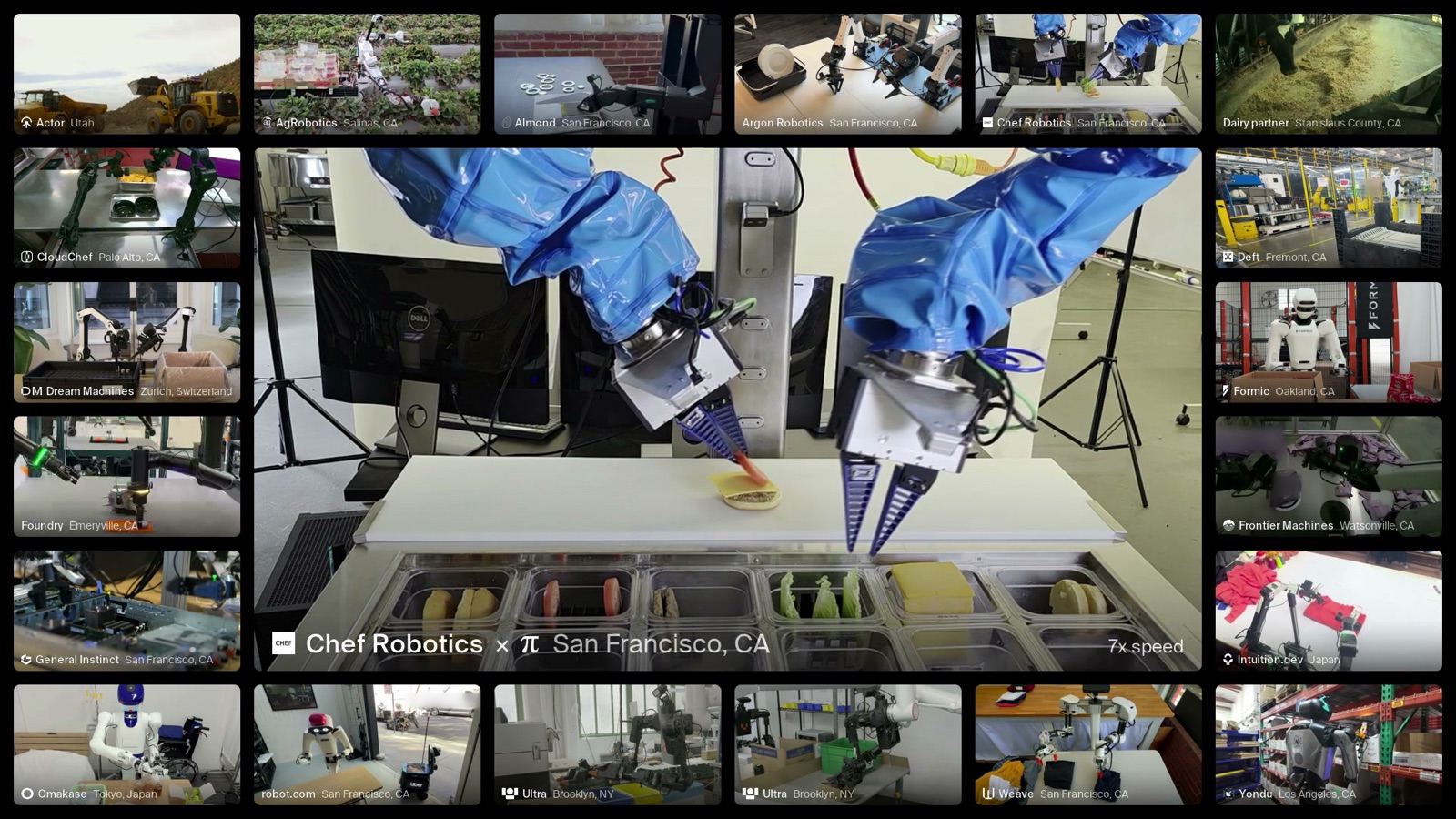
A small number of companies got early access to test whether they could improve autonomy on their own, and Pi says it was impressed by how quickly they started and progressed. The deployment mode is worth noting: most applications shown ran with cloud-hosted inference through the API — from Japan to Switzerland to deployments across the United States — and among the issues those early deployments surfaced were network-connectivity challenges in some settings.
What the early users are actually doing
One of them is Actor, which deploys autonomous heavy machinery: in a real commercial deployment its autonomous wheel loader scoops material and loads it into a dump truck with no operator inside the machine. How far such a setting can tolerate cloud inference depends on how connectivity and safety redundancy are designed on site.
Another is Almond, which builds Axol, a dual-arm robot for physical-AI builders, with the goal of Axol eventually building itself. In the demo, Axol deburrs spacers used in its own assembly using a model the team obtained after four days of iterating with the Pi API. Four days is the timescale the API means to demonstrate: adaptation need not take months.
The list also includes partners shown in collaborations such as AgRobotics, CloudChef, a dairy partner, Ultra and Weave, while the early-access roster runs longer: Argon Robotics, Chef Robotics, Deft, Dream Machines, Formic Robotics, Foundry, Frontier Machines, General Instinct, Intuition.dev, Omakase, robot.com and Yondu, plus a hackathon. Pi's summary is that these early deployments spanned a range of environments and tasks.
The technical base, and the caveats
Behind the API sits a series of published results. Pi 0.7, released on April 16, 2026, is a steerable general-purpose robot foundation model built around emergent compositional generalization: it can operate kitchen appliances it has never seen, transfer skills across robots and environments, and fold laundry on a new robot that never learned the task. Its training data mixes multi-robot data, human videos and autonomous robot episodes. Earlier work includes pi 0.5 for open-world generalization, pi*0.6 for learning from experience, and MEM memory for tasks lasting more than ten minutes.
The commercialization path shows through here as well: pi0 and pi0.5 are public, while the API sells the newest models plus managed fine-tuning and inference infrastructure. Open-source foundations with the latest capability sold as a service is the classic shape of models-as-a-service, and it explains why Pi emphasizes how quickly it can refresh the models beneath the API.
The caveats are just as clear. These results are largely company-reported, and the evaluation setups differ from standard academic benchmarks; general-purpose household ability remains a long way from reliable, and the applications shown are mostly structured settings in industry, logistics and manufacturing. Cloud inference is another real constraint: a hosted gateway spares developers from building infrastructure, but it makes the network part of the runtime path — Pi itself notes connectivity challenges in some early deployments, and for production lines and outdoor machinery, on-device inference will remain a necessary option for a long time.
Pi's own reasoning is pragmatic: real-world robotics applications are enormous in number — robotic construction, robotic surgery, warehouse automation, each deserving an entire company — and if every one had to solve physical intelligence from scratch, the challenges would be insurmountable. Putting the models behind an API accelerates the growth of the robotics ecosystem and, along the way, its own understanding of physical intelligence — which is about as direct an account of models-as-a-service in robotics as one could ask for.