NIF's 11th fusion ignition: the 8.6-megajoule record still stands
What ignition actually means
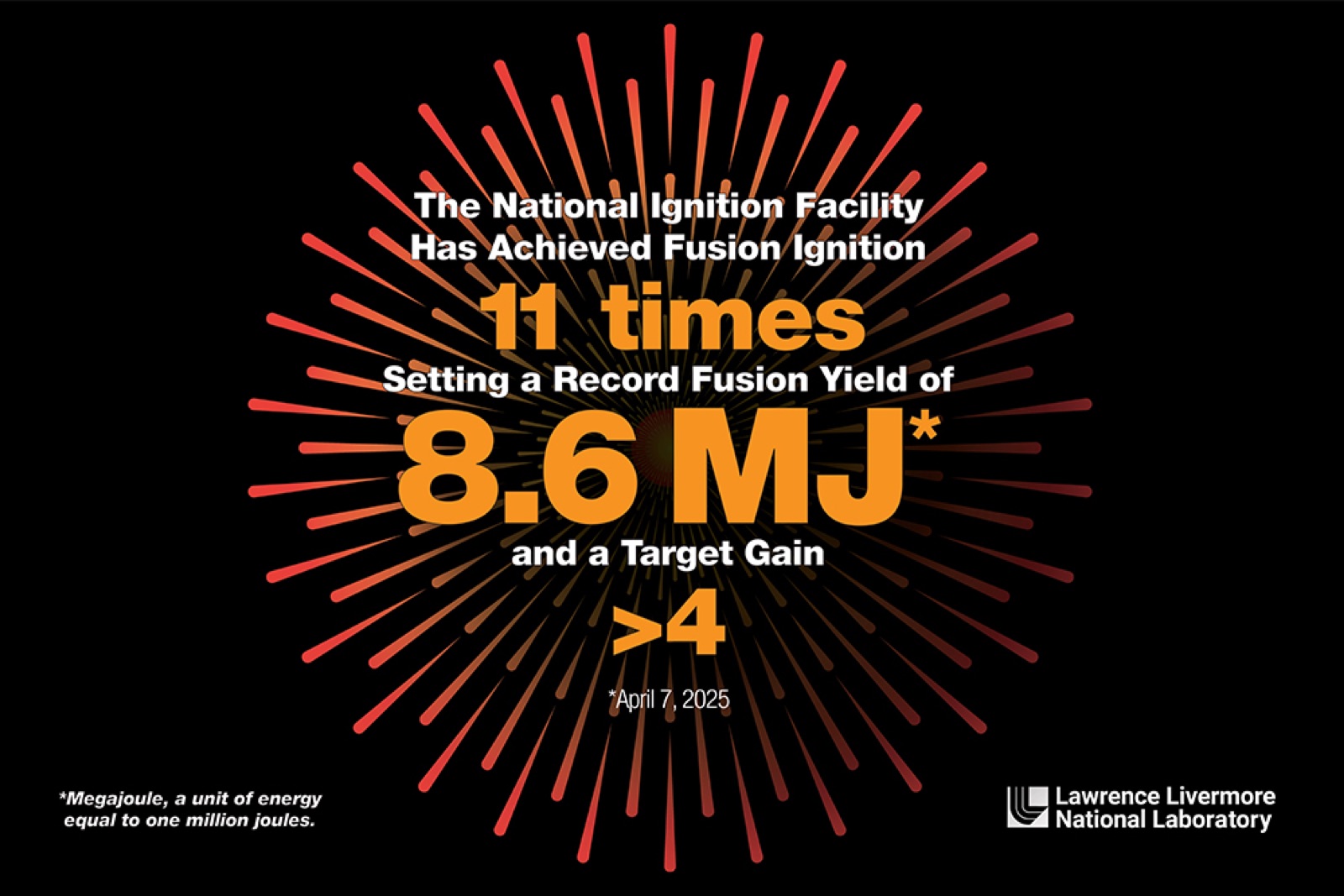
On its official National Ignition Facility (NIF) pages, Lawrence Livermore National Laboratory (LLNL) gives the latest figures: on 20 June 2026 NIF achieved fusion ignition for the 11th time, with a yield of 7.9 megajoules and a measurement uncertainty of ±0.4 megajoules, at a target gain of roughly 3.8. The single-shot record remains the 7 April 2025 experiment: 8.6 megajoules (±0.45), with the laser delivering 2.08 megajoules to the target in a 456-terawatt peak-power pulse, for a target gain of 4.13.
"Ignition" has a precise definition: it occurs when the heating power supplied by alpha particles produced in the hot spot at the centre of the target capsule overcomes the cooling from x-ray losses, electron conduction and implosion expansion. When alpha particles contribute more than 50% of the fuel's heating, a self-sustaining feedback loop — known in the field as a burning plasma — sets in, a burn wave of fusion reactions propagates into the cold fuel surrounding the hot spot, and the energy output is amplified explosively.
How does the machine do it? NIF uses indirect-drive inertial confinement fusion. Up to 192 laser beams fire into a centimetre-scale hollow cylinder called a hohlraum, generating a "bath" of soft x-rays that ablate the surface of a peppercorn-sized capsule suspended inside, producing a rocket-like implosion that compresses and heats the partially frozen hydrogen isotopes to pressures and temperatures found only in the cores of stars and giant planets, and in exploding nuclear weapons. The implosion travels faster than 400 kilometres per second, letting the fusion reactions complete before the fuel can fly apart — the fuel is confined by its own inertia, which is where the term inertial confinement fusion comes from.
The underlying physics is textbook material: fusion happens when light nuclei overcome their electrostatic repulsion, get close enough for the strong force to take over and combine into a heavier helium nucleus. When deuterium (one proton, one neutron) and tritium (one proton, two neutrons) fuse, the resulting helium nucleus — an alpha particle — weighs slightly less than the sum of the two hydrogen nuclei, and the mass difference is released as energy via E=mc², in the form of alpha particles, high-energy neutrons and electromagnetic radiation. This differs from the fission used in today's nuclear power plants, where heavy nuclei such as uranium are split; in both reactions the elements themselves change and a tiny amount of mass becomes a large amount of energy.
From 3.15 megajoules to 8.6
On 5 December 2022 NIF achieved ignition for the first time: 2.05 megajoules of laser energy delivered to the target produced 3.15 megajoules of fusion energy, well past the ignition threshold. For LLNL's researchers the task was not to celebrate but to repeat the result and keep pushing it higher — which is what every milestone since has been about.
The milestones listed on the official page read as a climbing curve: 30 July 2023, the same 2.05 megajoules in, 3.88 megajoules out; 8 October 2023, a third ignition with 1.9 megajoules in and 2.4 out; 30 October 2023, the first 2.2 megajoules of laser energy fired at an ignition target, yielding 3.4; 12 February 2024, an experiment producing an estimated 5.2 megajoules — more than double the 2.2 megajoules of input; 18 November 2024, a sixth ignition with 2.2 in and 4.1 out; and 23 February 2025, a seventh ignition producing 5.0 megajoules from 2.05 megajoules, a target-gain record of 2.44.
The 7 April 2025 shot set two records at once — 8.6 megajoules of yield and a target gain of 4.13 — which still stand. After it came a Los Alamos National Laboratory-led ignition with LLNL on 22 June 2025 (2.4 megajoules, ±0.09); a tenth ignition on 1 October 2025 (3.5 megajoules, ±0.17, target gain 1.74) that assessed whether US nuclear weapons could survive encounters with adversary missile defences and reach their targets, a demonstration of new capability for stockpile modernisation; and then the 11th on 20 June 2026.
Laser energy has its own record line: in May 2018 NIF delivered 2.15 megajoules of ultraviolet energy into the target chamber for the first time — 15% above the 1.8-megajoule design specification and more than 10% above the 1.9-megajoule record set in March 2012. Later experiments raised laser energy further, to 2.2 megajoules.
What the gain is, and what it is not
One concept needs clarifying: this target gain is the ratio of fusion energy to the laser energy delivered to the target. It is not the net energy of the facility, and certainly not electricity delivered to a grid. Running NIF's lasers consumes far more energy than the few megajoules that ultimately reach the target; reading "gain greater than one" as "fusion power plants can generate electricity now" is the most common misreading of news like this.
So why do it? The official page gives two reasons: stockpile modernisation — NIF can recreate extreme environments, letting scientists study how materials behave under weapons-relevant conditions that were previously impossible to achieve in a laboratory; and laying groundwork for inertial fusion energy. In the laboratory's words, the 2022 achievement is vital both for maintaining the effectiveness and safety of the US nuclear arsenal and for enhancing the prospects of an inertial fusion energy future.
The unsolved problems are equally specific: implosion performance is disturbed by several sources. The official list includes capsule surface imperfections, "engineering features" such as the thin membranes suspending the capsule inside the hohlraum and the fill tubes used to inject fuel, laser-plasma and hydrodynamic instabilities, asymmetries in the hohlraum's x-ray flux, and mixing of capsule material with the fuel. Pushing yields beyond the megajoule level is largely a matter of wrestling with these error sources.
Turning one success into an experimental science
The route forward is to make simulation predictive: high-resolution 3D modelling and simulation give researchers a clearer view of where perturbations come from; new diagnostics such as multiple line-of-sight neutron detectors improve visibility into target performance; and high-performance supercomputers plus deep-learning surrogate models process, analyse and simulate the mountain of data those diagnostics produce in three dimensions across many perturbation sources, so that simulations can not only explain experimental results but predict them. "Nature does not give up her secrets easily," says NIF senior scientist John Lindl — a fair summary of the difficulty.
From 2022 to 2026, 11 ignitions show the feat is repeatable; but yields swing between 2.4 and 8.6 megajoules, and the 2026 shot at 7.9 did not exceed the 2025 record — repetition itself still requires shot-by-shot tuning. For the further goal of fusion energy, target gain above one is only the first gate; behind it wait laser efficiency, repetition rate, and the mass manufacture and cost of targets. The official language keeps its distance too: experiments using higher laser energies and producing even higher yields are "expected".
A fairer reading: NIF's role now is to turn laser inertial confinement fusion from a one-off event into an experimental science that can be repeated, modelled and predicted. The diagnostics, modelling and target-design capabilities accumulated along the way serve both the safety and reliability of the nuclear stockpile and the foundations of an inertial fusion energy programme. As for how far away commercial electricity is, the official page offers no timeline — only the phrase "expected".