Tsinghua's Ding Sheng in Nature: a mouse embryo model that develops continuously from chemically induced totipotent stem cells
One cell type, through the whole of early development
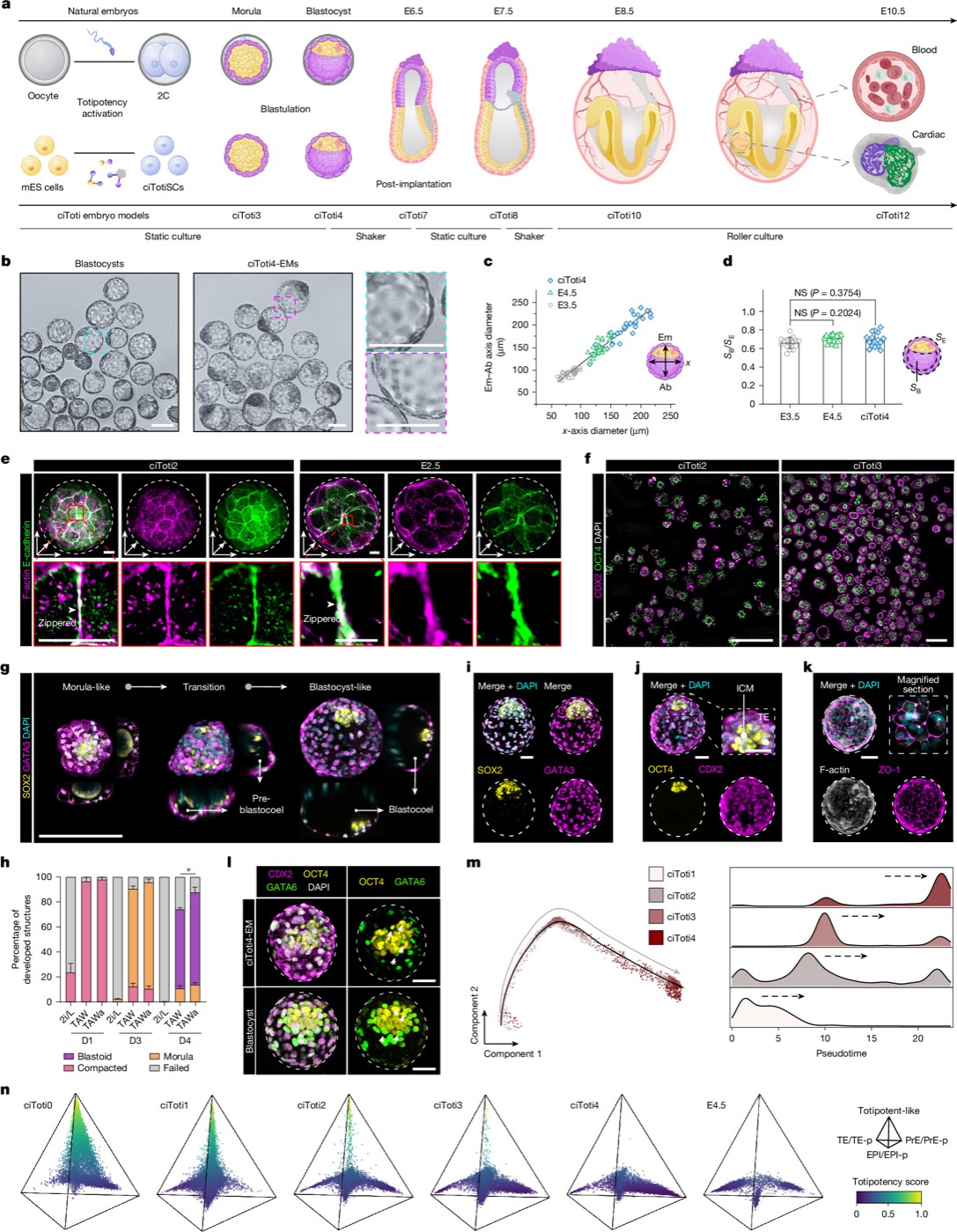
On 14 October the journal Nature published online a study from Ding Sheng's team at Tsinghua University: starting from an artificially induced totipotent cell, the researchers built a mouse embryo model capable of continuous development. The paper reports that these chemically induced totipotent-like stem cells (ciTotiSCs) first self-organised into blastocyst-like structures and then passed through key milestones — gastrulation, body-axis formation, haematopoiesis and early organogenesis — matching natural mouse embryos at embryonic day 8.5 (E8.5) in morphology and developmental timing. With extended culture, functional cardiac tissue formed in the model, closely comparable to the hearts of E10.5 natural embryos. Ding Sheng, of the Tsinghua-Peking Center for Life Sciences, is the corresponding author.
"Totipotency" here is not a synonym for "can become many cell types". Pluripotent stem cells mainly form the embryo proper (the embryonic lineage); totipotency means the ability to produce both embryonic and extraembryonic tissues — the latter including yolk-sac-like tissue and placenta-related lineages that support development. In other words, the totipotent state is one that can start an entire developmental programme, not merely one with many differentiation options.
The starting point of this work lies outside the paper itself. The team had previously used a set of small molecules to induce mouse pluripotent stem cells into cells with totipotent characteristics and to maintain that state in vitro, work published in Nature in 2023 (volume 617, pages 792–797). The 2026 paper asks the next question: can those cells organise themselves and, following spatial and temporal relationships close to those of natural embryos, continuously build complex structures? The paper cites that earlier chemical-induction work as its starting point.
The abstract states the scope: the model spans the pre-implantation morula, blastocyst and post-gastrulation stages, with both embryonic and extraembryonic compartments, and the ciTotiSCs self-organise into blastocyst-like structures closely resembling natural blastocysts in morphology and lineage segregation.
Which milestones it passed
Then come gastrulation, body-axis formation, haematopoiesis and early organogenesis — the stages of early development most likely to stall. The model resembles natural embryos of the corresponding stages across several key cell types, spatial structures and developmental timings. As Xinhua reported, embryonic tissue and the extraembryonic lineages that support development appeared in the right places, the anterior-posterior axis was progressively established, neural folds began to form, and blood vessels and blood, the germ line and cardiac tissue followed. Imaging, histology and single-cell sequencing showed the model close to natural mouse embryos at the matching stage.
The heart offers a window onto function. As development proceeded, cardiac tissue progressively formed spatially ordered atrium-like and ventricle-like chambers and began contracting rhythmically and in coordination, each chamber showing its own characteristics. After extended culture, the cardiac tissue in the model was highly comparable to that of E10.5 natural embryos.
Blood and the germ line appeared too: yolk-sac-like tissue formed vascular networks and blood islands, haematopoietic progenitors followed and produced red cells, blasts and macrophages. The model also formed primordial germ cells; transferred into dedicated culture systems, these precursors matured further and showed the capacity to enter the early stages of meiosis.
It is not yet a mouse
The limits are equally clear. According to Xinhua, the work has not produced a complete individual; as development proceeds the model's efficiency falls markedly, and some structures still differ from natural embryos. The paper's abstract says the ciTotiSCs display an extraordinary ability to autonomously recapitulate the complete spectrum of early mouse embryogenesis — note that this describes recapitulating a developmental process, not creating a viable organism.
Another easy misreading: the experiments start from already established chemically induced totipotent-like stem cells, not from turning ordinary adult mouse cells step by step into an embryo within this paper. The 2026 paper's contribution is the continuously developing model system — letting those cells self-organise and pass through multiple developmental milestones in sequence. Keeping "chemically induced totipotent cells" and "a continuously developing embryo model" distinct is the second key to understanding this work's boundaries.
Data and code are open: the single-cell RNA sequencing data generated in this study have been deposited in NCBI's Gene Expression Omnibus (GEO accession GSE292862), and the code for data analysis and visualisation is public on GitHub. For a model that aspires to be a public experimental system, that matters more than any single result — other laboratories can take the data, follow the protocol and try to reproduce or refute it.
One piece of background matters: this is embryo-model and developmental-simulation research, not cloning, and it does not involve implanting the model into a surrogate to develop into an individual. Embryo-model research using human cells is generally subject to stricter ethical review and rules internationally — limits on culture duration in vitro, for example — precisely because its subject is the earliest stages of life. Rules for mouse models are comparatively loose, but the same ethical discussion is unfolding as the technology advances.
Why a developmental model earns a place in Nature
A system that can traverse early developmental milestones continuously in vitro is valuable because it can be manipulated. Researchers can now ask on top of it: how does the totipotent state generate embryonic and extraembryonic tissue at once? Why does early development fail or stall? How do the vascular, blood and cardiac systems form in coordination over time? Such questions once depended mainly on natural embryos that are hard to obtain; now there is an observable, perturbable, repeatable experimental object.
Nor is the work isolated: the paper cites several 2025 studies of continuously developing embryo models, a sign of how dense progress in this direction has become as teams try different starting cell types and culture conditions to extend the developmental chain further. The measures that really discriminate are how far a model can go, how closely it matches natural embryos, and whether the system reproduces reliably in another laboratory.
So the restrained judgment is this: a peer-reviewed experimental system with a clear use, which shows that key processes of early development can be autonomously recapitulated by a single induced cell type — not that mammalian development can be manufactured from scratch. The roadmap the paper implies is plain: raising the efficiency of continued development and narrowing the remaining differences from natural embryos is the genuinely hard work still ahead.