The 2026 Nobel Prize in Chemistry: Kagan and Soai solve the mystery of homochirality
A puzzle more than a century old
On 7 October the Royal Swedish Academy of Sciences announced that the 2026 Nobel Prize in Chemistry goes to Henri B. Kagan (Université Paris-Sud) and Kenso Soai (Tokyo University of Science) "for the discovery of non-linear effects and autocatalysis in asymmetric organic synthesis". The 12 million Swedish kronor prize is shared equally between the two laureates.
To understand the discovery, start with chemical "hands". Many molecules exist in two forms that are each other's mirror image; chemists call them chiral, and the two mirrored molecules are enantiomers. Life uses only one of them: the amino acids in the proteins of your cells are almost all left-handed, while the sugars in the DNA double helix are right-handed. This one-handedness is called homochirality, from the Greek words for "same" and "hand".
This is not idle curiosity. Drug molecules also often come in two mirror images: one has the therapeutic effect, the other can bring unnecessary or even harmful side effects. The thalidomide scandal of the early 1960s fixed that lesson in the industry's memory: according to the Nobel Prize's own material, analysis afterwards concluded that it was the mirror image of the active substance that caused the harm. The official material uses a locksmith's analogy — you cut a key to order but always end up with two mirrored keys, only one of which fits, and the customer may well take the wrong one and damage the lock.
From Pasteur to Frank: how the puzzle was taken apart
The first link in that chain of ideas was forged in the mid-19th century. Louis Pasteur was studying tartaric acid, a substance important to winemaking. Colleagues reported that it sometimes bent polarised light to the right and sometimes did not affect the light at all, so he grew crystals and examined them under his microscope. The crystals came in two mirrored shapes; using tweezers he separated them and dissolved each group. Polarised light passing through one solution bent right, through the other bent left, and through a mixture of the two was unaffected. Some substances exist in two mirrored forms — the concept later called chirality — and the two mirrored molecules came to be called enantiomers.
In 1857 Pasteur made a second observation. He fermented the two enantiomers of tartaric acid with bacteria: the bacteria happily consumed the form found in grapes that bends light to the right, and showed no interest at all in its mirror image, which was left untouched. The idea that life's chemistry is itself chiral first surfaced. Later research confirmed that naturally occurring amino acids are always left-handed.
The puzzle then became: if chemists run a reaction that creates chiral molecules in a test tube, they always get an even mix of the two enantiomers — so how was one hand chosen at the dawn of life? In the early 1900s the German chemist Willy Marckwald carried out the first successful asymmetric reaction. The key was a chiral catalyst that made one mirror image form in slightly greater quantity than the other; the difference was small, but its existence was a breakthrough. In 1953 Charles Frank, a theoretical physicist at the University of Bristol, set out a purely theoretical model: for the chemistry to tip towards homochirality on its own, three conditions must hold — the catalyst is chiral, the reaction is asymmetric, and the reaction forms the catalyst itself (autocatalysis, a self-reinforcing effect that makes one enantiomer grow exponentially). Frank's model spread widely among chemists and became a chemistry puzzle set in lectures.
Kagan: 1986, and a curve that was not a straight line
It was Kagan who ticked Frank's second condition. In the early 1980s chemists were refining asymmetric reactions to obtain enantiomers as pure as possible. The catalysts in use had two parts: a metal atom acting as the motor of the reaction and a chiral molecule that made the reaction asymmetric. To get a pure product, researchers normally used as pure an enantiomer as possible in the catalyst, and widely assumed a linear relationship between catalyst and product — the excess of one mirror image in the catalyst would reappear in the product.
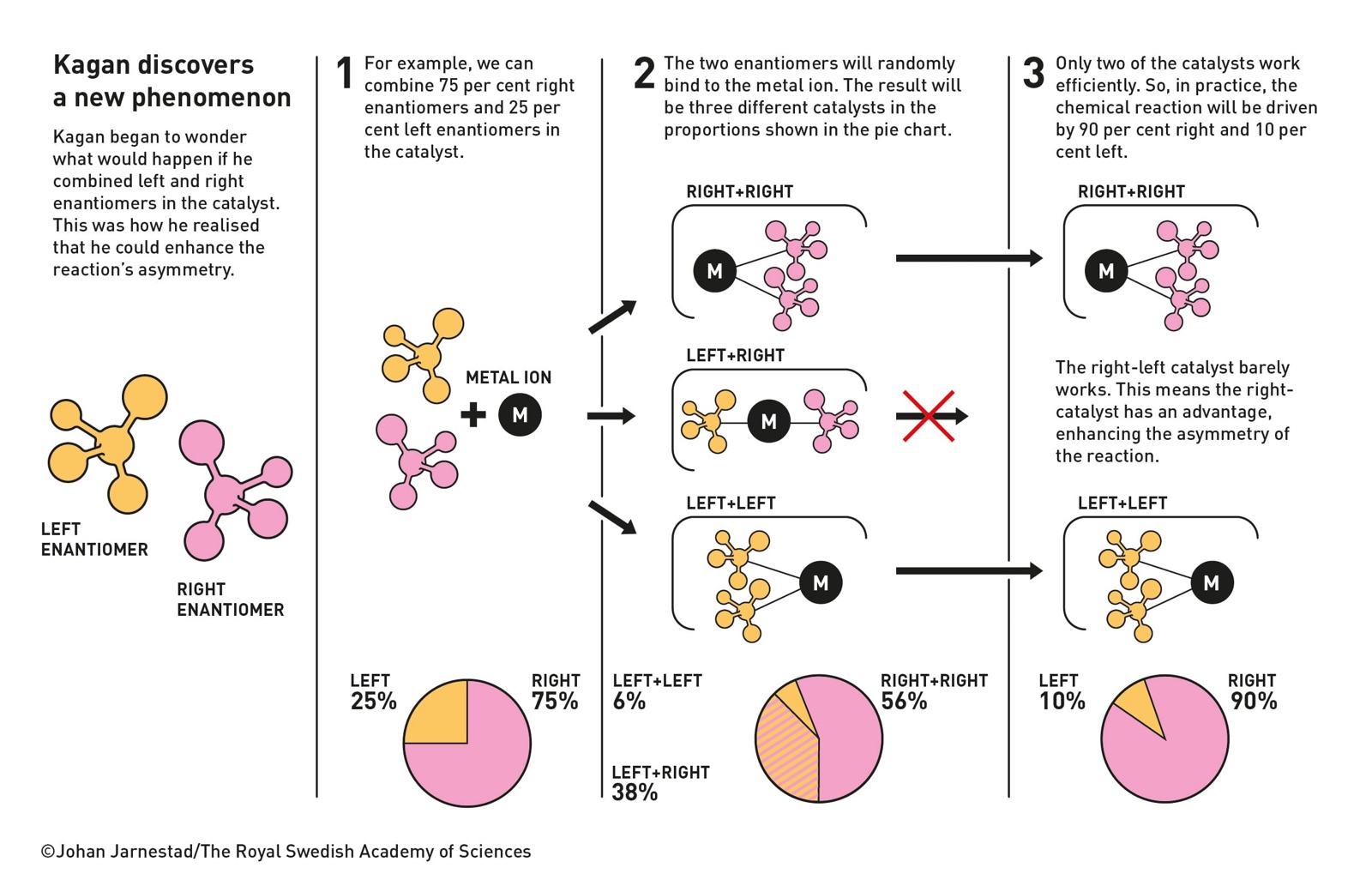
Kagan questioned that assumption. He noted that a metal atom normally binds several molecules at once, and reasoned that the metal in the catalyst must hold at least two chiral molecules. If left and right enantiomers are both present, three forms of the catalyst appear: right-right, left-right and left-left. Right-right and left-left produce mirror-image products; but how would left-right behave? The answer was that it drove the reaction far more slowly than the other two.
As a result, when he drove a reaction with different proportions of enantiomers in the catalyst, the excess in the product was not proportional to the excess in the catalyst. Plotted, the data gave not a straight line but a curve — what chemists now call a non-linear effect. An official illustration made for the 2026 chemistry prize sketches the idea: starting from 25% left-handed and 75% right-handed, the three catalysts come out at roughly 6% left-left, 38% left-right and 56% right-right. Because the left-right catalyst barely works, the reaction is effectively driven 90% by right-right and 10% by left-left. The phenomenon then became a tool: if a reaction is non-linear, the formation of one mirror image can be amplified. In 1986 Kagan described three different asymmetric reactions that display non-linear effects — a historic breakthrough that drew many chemists into the new phenomenon, among them Kenso Soai in Japan.
Soai: making molecules copy themselves
Soai was studying a reaction with a large non-linear effect. Comparing the structures of the catalyst and the product, he saw significant similarities, which sparked an idea: could he design a reaction in which the catalyst builds itself? In the early 1990s several autocatalytic reactions were known, but none was chiral. After experimenting with many molecules he found a chiral substance that could reproduce itself — 5-pyrimidyl alkanol. In a 1995 paper he started with a 2% excess of one enantiomer and ended with 87%. The reaction was self-reinforcing and met all of Frank's conditions, but it did not yet reach the enantiomeric purity of life.
He kept searching for another eight years. In 2003 he finally presented a reaction that starts from non-chiral molecules and forms only one mirror image. Both enantiomers appear at the start, but chance makes one slightly more abundant, and that tiny excess is enough for it to take over the whole reaction, ultimately making up 99.99% of the product. Repeat the experiment and the other enantiomer may take over instead, depending on the random fluctuation at the start. It was the first time anyone had created chirality from a non-chiral combination of molecules since the dawn of life, and the Soai reaction is regarded as one of the most elegant chemical experiments ever conducted.
The laureates' work is, first, a triumph of tools. Non-linear effects are now an important diagnostic when chemists design new reactions: whether a reaction is non-linear itself reveals how it proceeds, and that information can be used to optimise the reaction and push enantiomeric purity as high as possible. That matters to every company making substances intended to interact with living beings — pharmaceuticals, flavours, fragrances and agricultural chemicals — and to the production of some new materials as well.
Deeper still, it answers one of chemistry's most famous questions: how homochirality can arise. Kagan and Soai supplied the two remaining conditions of Frank's model, turning the idea from theory into a working experiment. Around the world researchers are now trying to repeat Soai's achievement, aiming at homochiral amino acids and sugars — chemistry closer to life itself.
The boundaries deserve equal weight. The Soai reaction is an artificial system, different from the chemistry of life; it shows that selecting a single handedness can arise spontaneously, not that life originated this way. For the pharmaceutical industry too, the core value lies in understanding and designing reactions rather than in a recipe ready for production.
The laureates' biographies are worth noting: Henri B. Kagan was born in 1930 in Boulogne-Billancourt, France, received his PhD in 1960 from the Collège de France, and is professor emeritus at the then Université Paris-Sud; Kenso Soai was born in 1950 in Hiroshima, received his PhD in 1979 from the University of Tokyo, and is professor emeritus at Tokyo University of Science.