The 2026 Nobel Prize in Physiology or Medicine: a light switch for nerve cells
From seeing correlation to proving causation
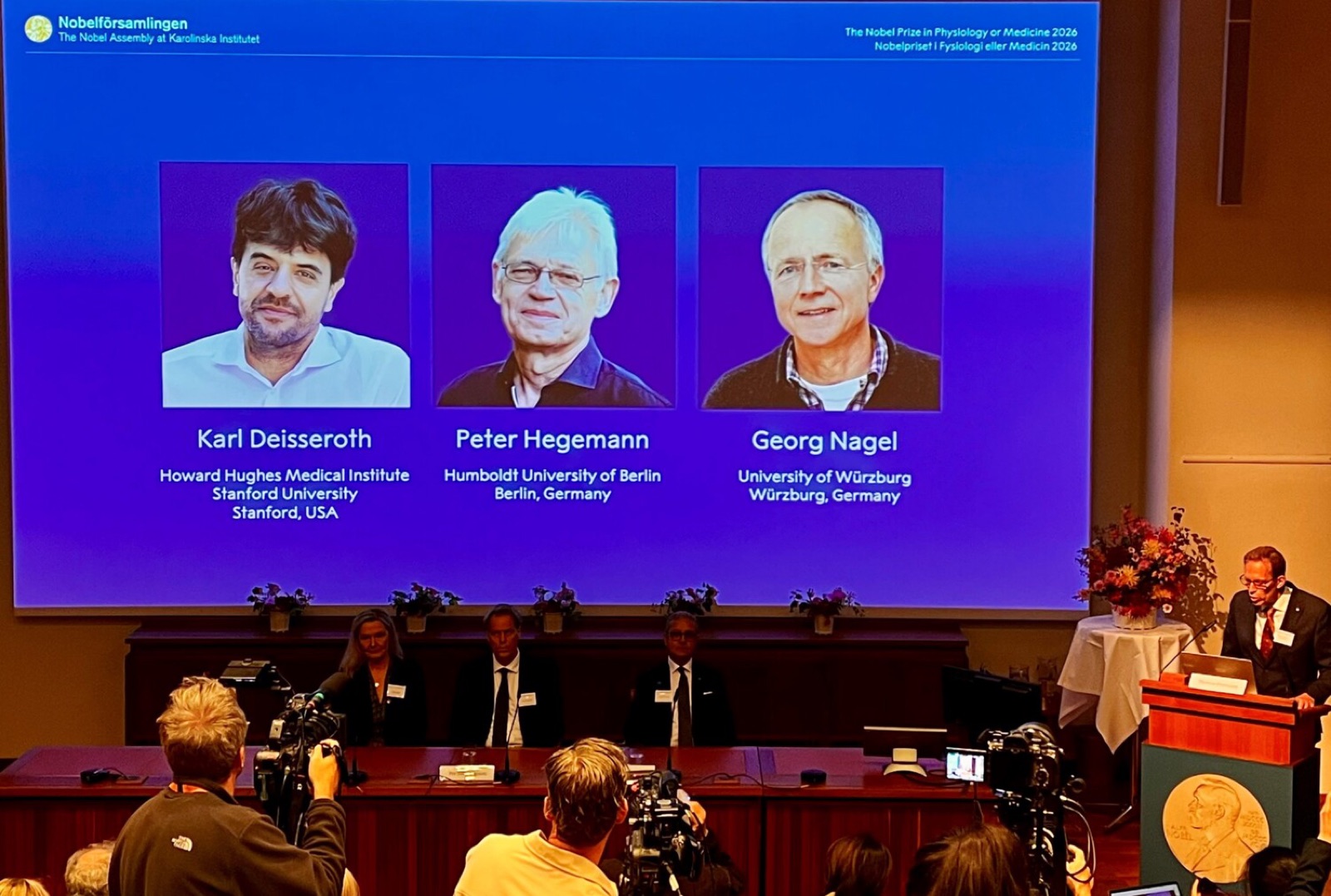
On 5 October the Nobel Assembly at Karolinska Institutet announced that the 2026 Nobel Prize in Physiology or Medicine goes to Karl Deisseroth (Howard Hughes Medical Institute and Stanford University), Peter Hegemann (Humboldt University of Berlin) and Georg Nagel (University of Würzburg) "for their discoveries concerning light-gated ion channels and optogenetics". The 12 million Swedish kronor prize is shared equally between the three.
The problem they solved is one of neuroscience's most fundamental. How the brain governs feelings, behaviours and bodily functions was long a mystery. In the 20th century researchers began to establish which areas of the brain affect which functions, but the methods available could not prove causal relationships — in the official phrasing, the picture they built of the brain was like a sketch map, full of question marks and unknowns. That is now changing.
"Optogenetics provides opportunities for mapping the brain in a way that we could once only dream of," says Per Svenningsson, chair of the Nobel Committee for Physiology or Medicine. Konstantinos Meletis, professor in the Department of Neuroscience at Karolinska Institutet, puts it even more plainly: there was no way to test what would happen to a behaviour if you activated one type of nerve cell, or quieted that type of cell — and optogenetics made exactly that possible. Researchers could therefore move from correlation to causality: from observing that a nerve cell is active when a behaviour occurs to testing whether that activity actually causes the behaviour.
Why an algal protein works as a switch
The story begins with Hegemann's curiosity. In the early 1990s he began asking how the single-celled alga Chlamydomonas detects light and swims towards it. In the 2000s, working with his fellow German researcher Nagel, he found a distinctive light-sensitive protein on the surface of the algal cell and named it channelrhodopsin.
They found that when blue light strikes the protein, a channel opens through it, charged ions flow into the cell, and an electrical impulse follows. The crucial point was this: whichever cell they put the protein into became light-sensitive.
The next step came from Deisseroth, who realised the protein could be used to control nerve cells. Researchers introduced the gene coding for channelrhodopsin into rat nerve cells grown in the laboratory, so that the light-sensitive protein formed on the cell surface; under blue light the ion channels opened and the nerve cells began to generate and transmit electrical signals just as they do in the brain. In the official phrasing, they had created a light-controlled switch for nerve cells.
From the dish to the brains of living mice
Deisseroth published the breakthrough in 2005. Two years later he made the light-controlled switch work in the brains of living mice. Optogenetics then rapidly became a central tool in neuroscience: by controlling specific types of nerve cells, researchers can study how different brain circuits influence movement, memory, emotions and behaviour.
How the tool spread matters as much as how it works. Around 2008, Meletis and Marie Carlén — now also a professor in the Department of Neuroscience at Karolinska Institutet — were postdoctoral researchers at MIT in the United States, working with Deisseroth's laboratory at Stanford. That began a long collaboration; Deisseroth was invited to Karolinska Institutet several times and held an affiliated research position there between 2013 and 2019.
"Karl is an absolutely exceptional scientist and human being. In addition to being incredibly intelligent, he is remarkably generous, and that contributed to the breakthrough in optogenetics," Carlén says. "As soon as he set up his lab and carried out the first optogenetics studies, he began sharing these tools with others. Since then they have spread to thousands of laboratories around the world. I would say that is quite unique — it has enabled laboratories everywhere to keep expanding our knowledge of the brain."
A tool still finding its uses, and a lesson about method
As a method, optogenetics is being explored as a foundation for future treatments. Meletis says the technology is already being used in attempts to restore vision in people with visual impairment, and the hope is that it will also become a tool for treating neurological disorders such as Parkinson's and Alzheimer's disease, and psychiatric disorders such as depression, anxiety and PTSD.
Its value goes beyond disease. For Meletis, this year's prize is a reminder of the value of basic research and of investing in work whose future significance is not yet known: "We must be willing to trust the unexpected, to trust major discoveries that arise from things we did not anticipate. Optogenetics did not emerge because someone decided we needed a method to cure a specific disease. It developed from people who were deeply committed to a fundamental scientific question."
He points to Hegemann's and Nagel's early work on light-sensitive algal proteins. At the time it was far from obvious how important the discovery would become for neuroscience. "What funding body would choose to support research on algae in order to discover this protein? And yet, twenty years later, it has transformed the entire field of neuroscience. That is what makes it so inspiring."
The boundaries deserve equal weight. Optogenetics requires the target cells to express a foreign light-sensitive protein, so in humans it remains research and experimental exploration — the official wording is that the technique is being used in attempts to restore sight, not that it is an established therapy. What it certainly does today is make causal relationships directly testable.
The three laureates: Karl Deisseroth, born in 1971, received his PhD in 1998 and his medical degree in 2000 from Stanford University and is professor of bioengineering and of psychiatry and behavioural sciences at the Howard Hughes Medical Institute and Stanford University; Peter Hegemann, born in 1954, received his PhD in 1984 at the Max Planck Institute for Biochemistry in Martinsried, Germany, where the prize-winning discoveries were made, and is professor of neuroscience at Humboldt University of Berlin; Georg Nagel, born in 1953, received his PhD in 1988 at the University of Frankfurt and is professor of molecular plant physiology at the University of Würzburg, with the prize-winning discoveries made at the Max Planck Institute of Biophysics in Frankfurt.