Shuran Group's New Algorithm-Hardware Codesign Work: Test-Time Scaling Comes to Hardware Design
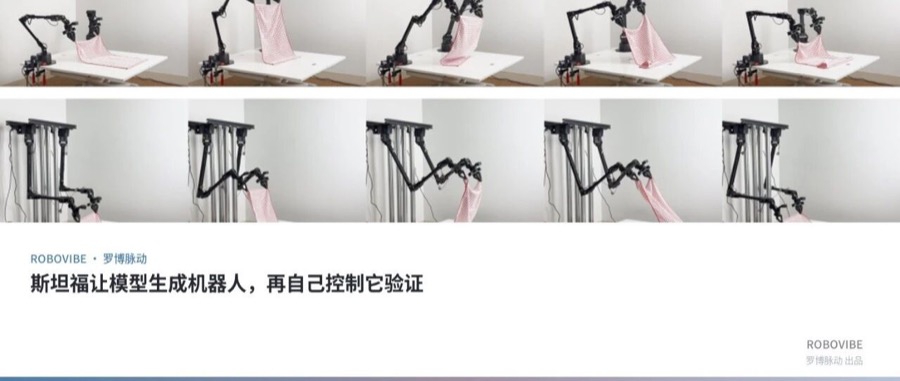
ALOHA is probably the most common dual-arm platform of the past two years, with its two arms mounted upright on either side of a tabletop. Getting it to fling a crumpled cloth open requires starting with the motion overhead and throwing forward, using inertia to unfold the cloth; the robot can do this, but it does it poorly.
Its maximum joint speed reaches 2.57 rad/s, already close to the limit of ALOHA's Dynamixel motors, while the end effector deviates 13.0 cm from the target trajectory—roughly the width of a palm. The arm length is insufficient, so acceleration must make up for it; motor speed hits its limit, and the trajectory naturally cannot keep up.
For the same human demonstration, switching to a different robot yields yet another deviation number. The policy is no longer the bottleneck here—the machine's skeleton is.
End-effector trajectories are now the most common task representation in manipulation policy learning. The entire UMI line of work decoupled actions from specific hardware, so that a single human demonstration can be collected and used by different robots; the real significance of this line is that actions finally have a hardware-agnostic format. But execution is not hardware-agnostic: when the same trajectory is transferred to different embodiments, success rates are not equal. This paper from Stanford and Columbia, Transformer Transformer, turns that statement around and asks it in reverse.
Since the action format is already universal, why must the hardware remain fixed? Given a segment of human demonstration motion, what kind of robot body is best suited to perform it—can a model directly generate that robot and prove on the spot that it can execute the motion?