Shuran Song: A Brief Overview of the UMI Lineage — Making Robot Manipulation as Simple as Possible, but Not Simpler
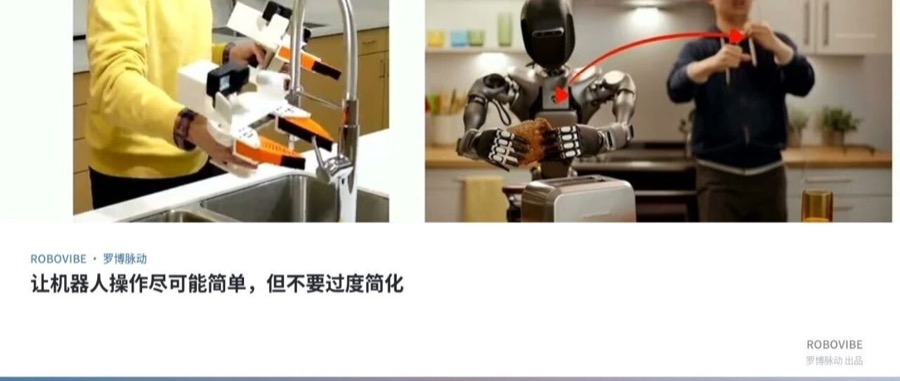
• She opens with a dishwashing robot that can wipe dishes, judge whether they are "clean," and remember to turn off the faucet, using it to make a counterintuitive point: seemingly simple manipulation is in fact extremely complex, involving deformable objects, articulated objects, fluids, and high-level semantics.
• She shows a set of robot videos that differ widely in hardware, environment, and task, many from startups and other labs—their common thread is that they are all driven by her UMI data collection and learning pipeline.
• UMI (Universal Manipulation Interface) is simply a handheld gripper plus a GoPro: the GoPro records visual observations, visual SLAM tracks camera motion to obtain actions, and one input-output pair is enough to train a policy; it was open-sourced more than two years ago and has been widely reproduced and adapted.
• Two core design principles: first, make it a wearable device so that non-experts can collect data intuitively, with tactile feedback, across environments; second, be end-effector-centric and task-centric, capturing only hand motion and local perception while ignoring the rest of the body, so the data transfers easily to other embodiments.
• Comparison with teleoperation: teleoperation requires the robot in the loop, which pins data collection to the lab and a specific embodiment and makes it hard to scale—she likens it to "sugar in robotics," easy to get started with but addictive and unhealthy.