Just Now, Skild Releases S1: Watch a Video Once, and the Robot Can Perform a Ten-Minute Long Task It Has Never Learned
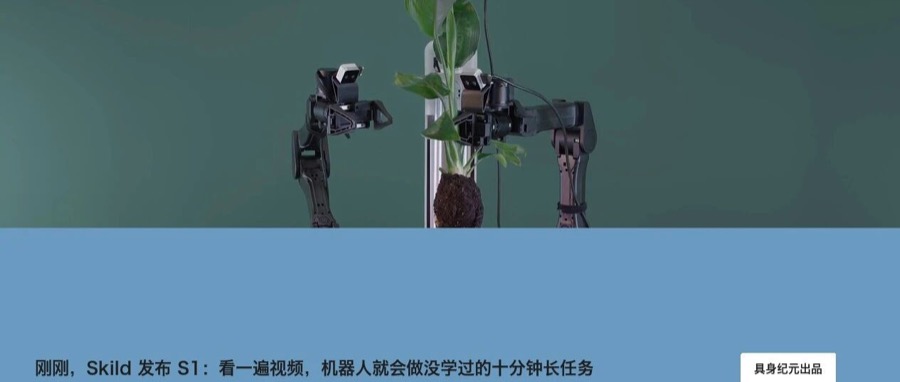
Skild AI has released operational results for S1, its flagship robot foundation model. It is not used by typing commands, nor by collecting hours of data for a new task and then fine-tuning; instead, it is shown a video demonstration—whether the task is seen or unseen, short or long—and the robot then performs it directly. The core figures officially provided are: on tasks never seen in training, in-context demonstration prompting achieves a 66% single-step success rate, while language instruction prompting with the same data and same architecture achieves only 9%.
The evolution of language modeling offers a blueprint for "how to turn a highly capable model into a genuinely useful general-purpose tool." Early Transformer-based approaches, such as BERT (Devlin et al., 2019), were already effective at understanding language, but each new application still required additional data collection and another round of fine-tuning. The key turning point from that generation of early language models to ChatGPT came from the emergence of a fundamentally different learning paradigm, later called in-context learning (ICL)—known outside technical circles as "prompting." It is this capability that distinguishes research prototypes like GPT-1 and GPT-2 from today's frontier language models: users can introduce an entirely new concept purely through prompts, and the model can give a decent response without changing a single weight.
Robotics has so far remained stuck in the BERT era. Robotics research over the past few years has shown that deep neural networks can learn a large range of complex behaviors. But to make a robot reliably perform a new task, we still have to collect hours of data and fine-tune a specialist policy. Although widely accepted, this paradigm sweeps an uncomfortable fact under the rug: to learn robust policies for moderately complex tasks, post-training data under deployment conditions must reach tens or even hundreds of hours. Furthermore, existing research has shown that when post-training data is large enough and task coverage is dense enough, even a policy trained entirely from scratch without any pretraining can match the peak performance of a post-trained foundation model (Oh et al., 2026). In hindsight this is obvious, but it forces a question: then what is pretraining for?
We believe the primary purpose of pretraining, if not the only purpose, is to let robots undergo the same transition we saw in language models between BERT and GPT-3 (Brown et al., 2020): in-context learning, the ability to learn immediately from one or a few examples.
A year ago, we released an in-context learner for locomotion control that adapts to the environment by accumulating real-time experience in the prompt (Liu et al., 2025). Today we share results for our flagship robot foundation model S1 on manipulation tasks, which was designed from the outset as an in-context learner. Show it a video of a task—long or short, seen or unseen—and it performs it.