ST's Stellar P3E: a first automotive MCU with built-in AI acceleration
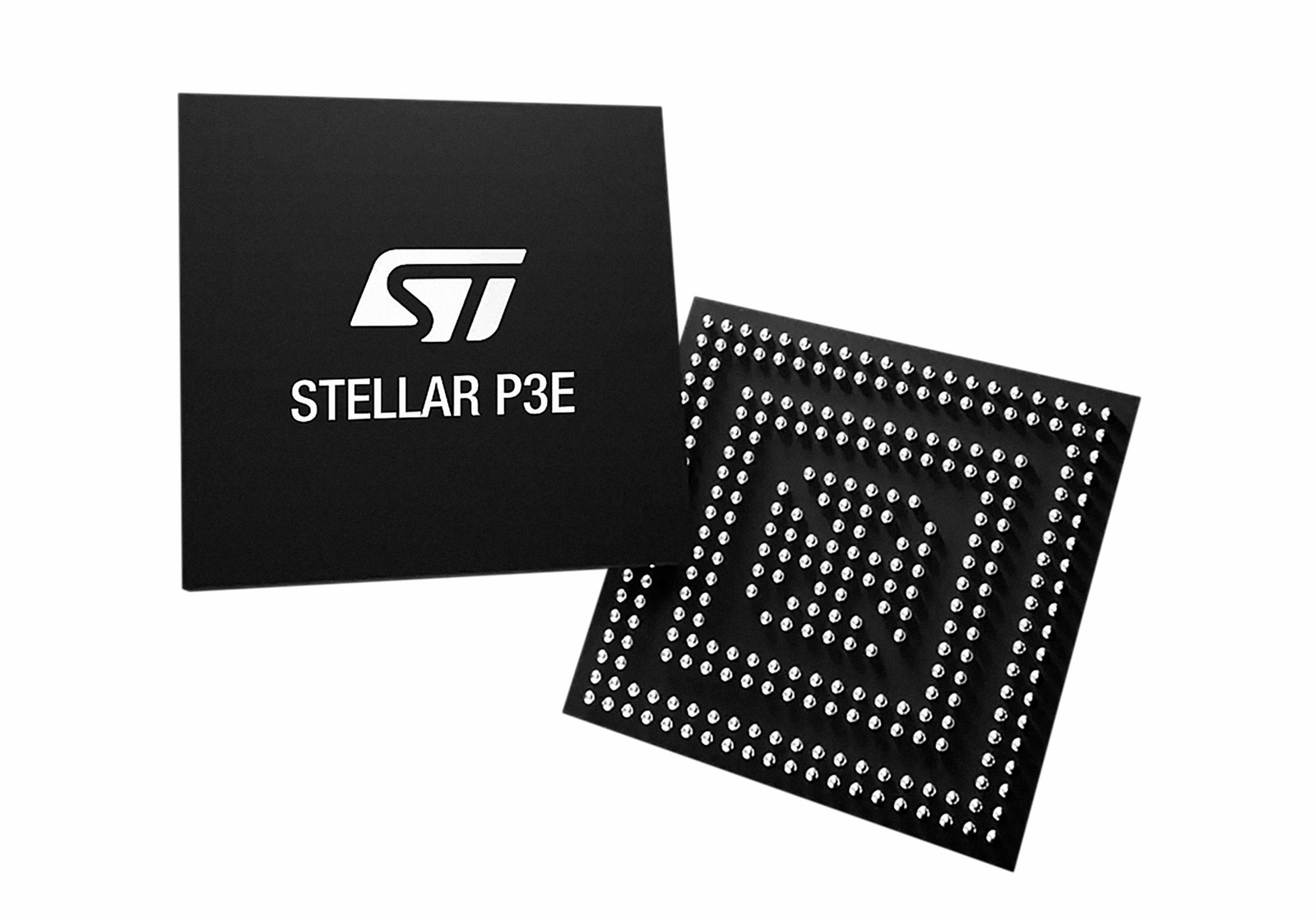
On February 10, STMicroelectronics (ST) announced the Stellar P3E. It calls the device the first automotive microcontroller (MCU) with built-in AI acceleration, aimed at edge intelligence. Put another way: while still meeting automotive and real-time control requirements, it puts hardware acceleration for neural-network inference inside the MCU itself rather than leaving it to a domain controller or the cloud.
The device targets software-defined vehicles, X-in-1 electronic control units, hybrid and electric vehicles, and body zonal architectures. X-in-1 means folding functions once spread across several controllers into a single device to cut system cost, weight and complexity — which explains why automotive MCUs need more compute, more storage and richer peripherals.
A little background makes it clear why this happens now. One main thread in automotive electronics over the past decade has been consolidating scattered ECUs: from one box per function to a handful of controllers organised by vehicle zone or domain. Consolidation means less wiring, less weight and lower cost, at the price of each controller carrying more tasks and more sensors — which calls for smarter signal processing, and that is where AI comes in.
Where the NPU sits: microseconds and “30x efficiency”
The core selling point is the integrated ST Neural-ART accelerator: a neural processing unit (NPU) with a data-flow architecture built for AI workloads. ST says inference completes in microseconds and that efficiency improves by up to 30x compared with traditional MCU core processors. That always-on, low-power inference capability maps onto real-time functions such as predictive maintenance and smart sensing that must run continuously.
Why does doing inference locally matter? Off-board — in the cloud or a domain controller — data has to leave the board, a link needs bandwidth and decisions queue up, and any link in that chain introduces uncertainty. Doing the inference on the MCU holds latency inside a deterministic range and avoids extra sensors, modules, wiring and integration work. ST’s example of a “virtual sensor” is typical: a model infers a quantity from existing signals that would otherwise require an additional physical sensor, removing that hardware.
To be clear, 30x and microseconds are ST’s own figures, measuring the efficiency of running comparable inference against a conventional MCU core — not an indication that the chip runs large models. From another angle, it shows the near-term contest in automotive AI is still about power and latency, not about how many billion parameters a model has. Automotive use cases want inference that is small and deterministic rather than general-purpose, because a model only moves from cloud to silicon if it is small and predictable enough.
The compute base and extensible memory
On the CPU side are 500 MHz Arm Cortex-R52+ cores. The Cortex-R family targets real-time, high-reliability work and is not in the same class as the general-purpose Cortex-M; ST cites a CoreMark score above 8,000, claiming the highest in its class. Also worth noting is the split-lock architecture — the same instruction can run on two cores in lockstep for safety or on separate cores for performance, letting designers trade functional safety against peak throughput.
Memory is the other half of the story. The integrated xMemory is based on phase-change memory (PCM), with twice the density of traditional embedded flash and automotive qualification. Its value is not raw read/write speed but extensibility: software storage can grow dynamically to hold new functions and firmware without a hardware redesign — for software-defined vehicles, adding features without changing the board is the whole point.
The relationship between NPU and CPU needs stating too. The NPU does not replace the Cortex-R cores but offloads regularised computation: deterministic control logic, real-time scheduling and safety mechanisms still run on the cores, while the NPU handles parallellisable, quantisable work such as matrix multiply-accumulate. Whether that division is sound decides whether determinism survives — the most fundamental difference between automotive and consumer AI silicon.
Development tools and production timing
The P3E is fully supported by ST Edge AI Suite, a toolchain spanning dataset creation through on-device deployment; within it, NanoEdge AI Studio is now available across the entire Stellar MCU family. The device is also integrated into Stellar Studio, ST’s all-in-one environment for automotive engineers. Hardware plus software is meant to standardise edge AI deployment rather than leaving each team to build its own flow. An all-in-one toolchain matters especially in automotive: the shorter the chain from dataset to certification material, the less rework.
From an industry standpoint the direct consequence is that features are no longer decided by hardware: adding a function used to mean adding a sensor or a controller, whereas now a different model on the same hardware can deliver new behaviour. When ST says OEMs can introduce new functions and more intuitive behaviour through different AI models, cutting the need for extra sensors, modules, wiring and integration work, that is the change it means.
Across ST’s portfolio the direction is consistent: on the general embedded side the high-performance AI MCU is the STM32N6, announced in December 2024 — the first STM32 with a Neural-ART accelerator, a Cortex-M55 core at 800 MHz, up to 4.2 MB of RAM, an ISP and camera interface, and roughly 600 GOPS. The difference is context: the N6 serves general embedded designs, while the P3E places AI under real-time control and functional-safety requirements.
Constraints deserve mention too. An MCU has far less storage and memory than a design with an external accelerator, so models must be quantised and pruned to fit, and automotive qualification limits how often software can change. Those constraints make it a fit for fixed tasks running for years, not for frequently iterated model experiments.
On timing, ST plans to start production of the Stellar P3E in the fourth quarter of 2026. For carmakers that means the selection window opens during 2026, while design and qualification have to start well ahead to line up with a platform change. One judgement follows: the NPU-isation of automotive MCUs has begun, and AI is no longer merely an inference module in the layer above but part of the real-time control loop. For automotive electronics teams that means topics once owned by algorithm specialists — model compression, compute budgets — will start appearing on MCU engineers’ calendars. Whether they actually reshape a vehicle’s electronics will depend on how volume customers use them.