STM32C5 announced: a Cortex-M33 entry line from $0.64
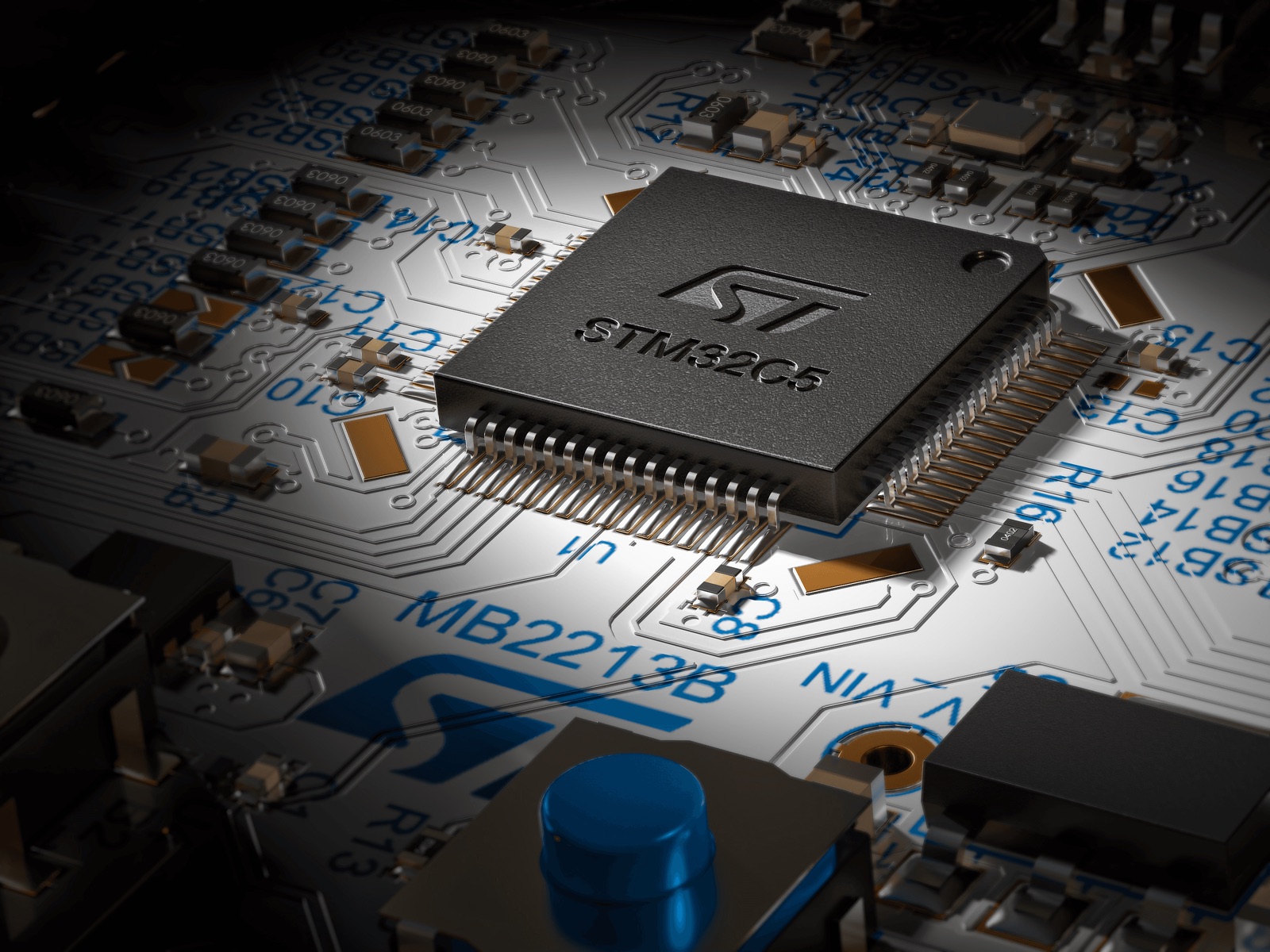
On March 5, ST announced the STM32C5 series, an entry-level STM32 family built on an Arm Cortex-M33 core at up to 144 MHz, with up to 1 MB of Flash and 256 KB of RAM, starting at about $0.64 for orders of 10,000 units. Target applications range from smart thermostats and electronic door locks to industrial smart sensors, robotic actuators, wearables and computer peripherals.
Why announce an entry-level line separately? Because at the entry level, value for money decides everything. The STM32C5’s positioning is to push Cortex-M33 performance into a price point where Cortex-M0 or Cortex-M23 used to be the only option; for products that once got by with simple logic, that means spare cycles for finer sensing and control without trading away accuracy for cost. Put another way, it is courting the projects that never used to afford a Cortex-M33.
The product logic of an entry-level MCU hides here too: the contest is not absolute performance but a just-enough balance. Clock speed, memory, peripherals and price trade off explicitly — a little more Flash can break the cost target, one missing peripheral can send a customer elsewhere. The STM32C5 pushes compute up and makes configuration composable, letting customers find a fit inside one architecture.
Cortex-M33 pushed down to the $0.64 tier
The gap between Cortex-M33 and the lower-end M0 and M23 is not clock speed but instruction capability. The M33 targets more modern embedded requirements and handles real-time maths such as digital filters, noise suppression and debouncing — precisely the computing that dominates sensor signal conditioning. ST places it on its proprietary 40 nm process: cost-efficient, capable of higher clocks, and competitive for memory above 512 KB.
Memory and power design confirm the positioning: on-chip Flash starts at 128 KB and reaches 1 MB, leaving room for new features; the supply scheme uses a single low-dropout (LDO) regulator, freeing pins for user I/O; and DMA has two instances with at least four channels each so transfers can run in parallel, easing the core’s load, sharpening responses and simplifying software. For entry-level projects those details often decide whether the CPU has headroom left for the actual application logic.
Packages run from a 3 mm × 3 mm UFQFPN20 up to a 20 mm × 20 mm LQFP144, and the series is in production now. Production status matters to schedule-sensitive projects: it means design-in can start immediately rather than waiting in a sample queue. For development there are STM32 Nucleo boards and a display extension board from Riverdi, with TouchGFX for building entry-level graphical interfaces — and for small devices, whether a screen-based interface is possible is often the line between commodity and premium. That also explains why ST pairs an entry-level line with a display extension board: making “can it have a UI” a question that already has an answer.
Even entry level must pass security and temperature checks
On security, the STM32C5 targets SESIP3 and PSA Level 3 certification, with memory protection, tamper protection, cryptographic engines (AES symmetric encryption and hashing), and temporal isolation (HDP) protecting secure boot and firmware update. The STM32C59x and STM32C5A3 variants add a hardware unique key (HUK), secure key storage, and hardware accelerators for symmetric and asymmetric cryptography with side-channel protection.
Operating range matters just as much for cost-sensitive designs: ambient from -40°C to 125°C with junction temperature up to 140°C, and the device still runs at its maximum rated frequency at top temperature. ST also stresses support for industry and appliance safety standards such as IEC 61508 SIL-2 and IEC 60335-1/60730-1 Class-B. Putting security and temperature figures into an entry line shows the competition has moved from “who is cheaper” to “cheap and certifiable”. For products shipping into European and North American markets, that question comes up from the very start of a project.
What those certifications mean is worth explaining. SESIP and PSA are assessment schemes for IoT security capability, and a higher level means more mechanisms have been independently verified; for buyers they turn a vendor’s security claim into something checkable. The IEC standards work the same way, setting requirements for functional safety and appliance control software that decide whether a product can ship.
Toolchain updates matter just as much
The software side saw substantial changes. A new STM32CubeMX2 adds a preview feature that gets reference code to developers faster; STM32CubeC5 introduces a code-size-optimised HAL2 that exposes all hardware features while leaving more memory to the application. A partner notes that HAL2 is lighter and closer to the hardware, and that porting code across STM32 families is easier — onboarding cost often decides project schedules more than another few megahertz. For teams already familiar with STM32, the change is less about learning a new world than writing less boilerplate.
The ecosystem also includes hardware evaluation tools and a new examples library for the STM32C5, two free integrated development environments (STM32CubeIDE and STM32CubeIDE for VS Code), and ported middleware including FreeRTOS, LwIP, USBX and FileX. They cover the most common networking and file needs, so customers can ship without porting anything themselves. For entry-level projects, these unglamorous pieces are what actually determine development speed.
Customer use cases make the positioning clear: ST’s examples include safety-related heating and HVAC control as well as AC chargers that need metering, encryption and multiple interfaces. The first cares about real-time behaviour and predictability, the second about security and connectivity — both live in the cost-sensitive but certifiable segment, exactly where entry-level MCUs earn their keep.
The path has not changed: still Arm
To be clear, this is not a change of direction. The STM32 line remains entirely Arm: Cortex-M for general-purpose MCUs, Cortex-A/M for MPUs and Cortex-R52 for automotive Stellar parts. In 2026 ST also announced that some general-purpose STM32 devices will be produced in China, starting with H7 and then H5 and C5 — a manufacturing and supply-chain move rather than an architectural one.
Two trends in entry-level MCUs follow: price competition keeps pushing lower, and cores keep trickling down — Cortex-M33 has now reached the $0.6 tier. For cost-sensitive designs that is another footnote on the stability of the Arm route, and a question RISC-V must answer head-on in the mid-to-low end: at the same price, will customers take the mature ecosystem or the newer architecture? Judging by the past two years, the answer differs by market segment.