Unitree's Dex5-S dexterous hand: 22 DoF from about $6,350
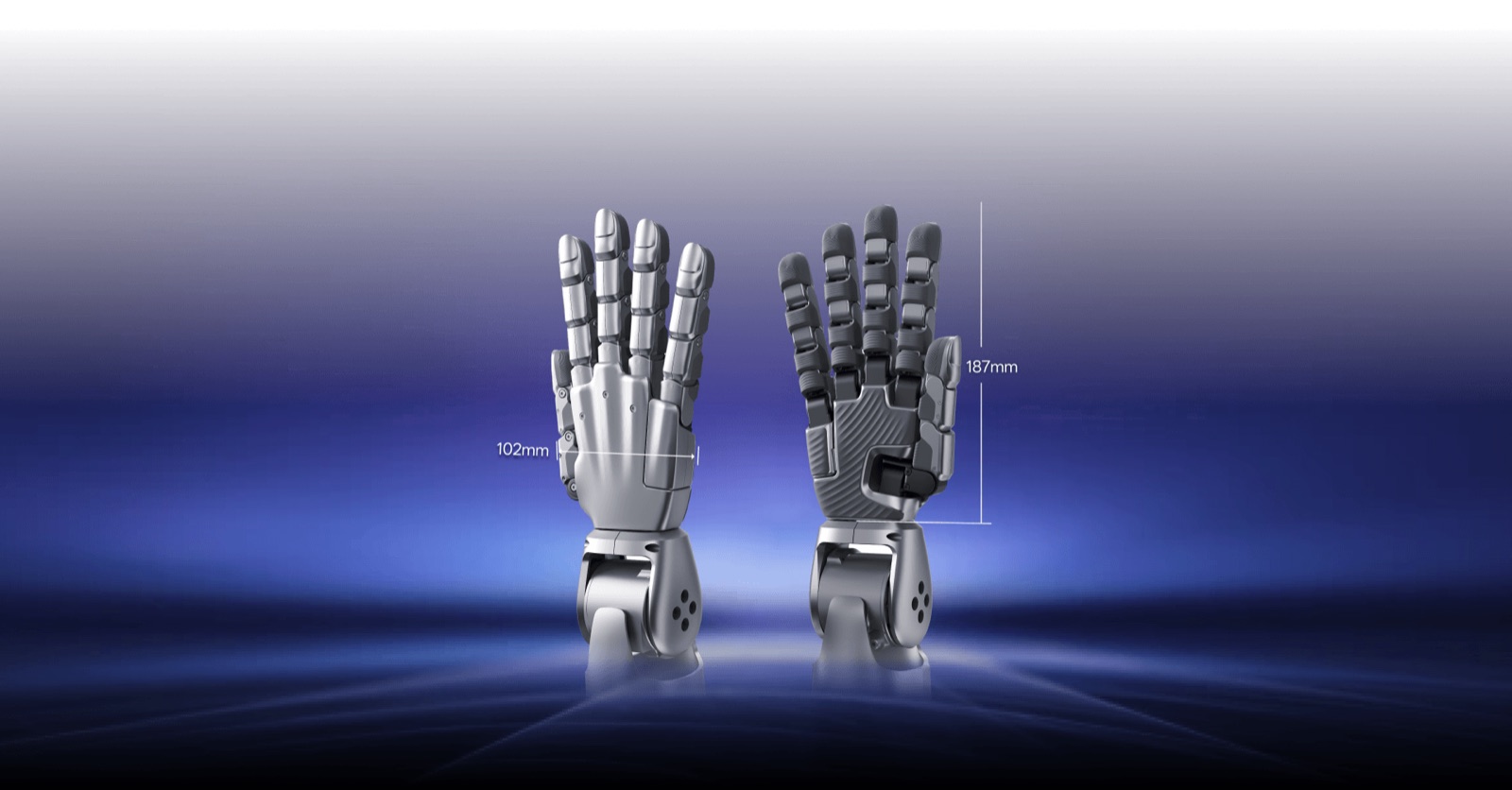
How the 22 degrees of freedom are divided
On September 21, Unitree announced the Dex5-S dexterous hand. By the company's own listing it is built at 1:1 human hand scale, with 22 degrees of freedom per hand, direct-drive backdrivable joints, dual encoders, 1 kg continuous and 2 kg peak payload per hand, priced from about $6,350. That price, next to those specs, is where the weight of the news lies.
The 22 degrees of freedom are not evenly distributed. The thumb gets 5, the index, middle and ring fingers 4 each, and the pinky 5 — including a new roll axis on the pinky. Unitree makes that a selling point, because in a human grip the thumb and pinky cooperate differently from the other three fingers; hands that skimp on pinky freedom give up grip stability.
Placed in Unitree's own lineup, the picture sharpens: the company's dexterous-hand catalog already lists Dex5-S, Dex2/5, Dex1-1, Dex5-1 and Dex3-1, and Dex5-S sits at the highest freedom class among them. This is not an isolated launch so much as an existing product line moving up a tier.
Actuation and feedback are the other set of keywords. All 22 motors are direct-drive and backdrivable with dual encoders: direct drive means fewer stages between motor and joint, backdrivability means an external force can push a joint backward, which helps both safety around people and force control, and dual encoders make joint position readings more dependable. The spec sheet also notes an impact-protection structure that shields the gears from extreme external impacts, covering all 22 degrees of freedom.
On payload and endurance Unitree is blunt: the best training is training uninterrupted by overtemperature alarms. That is why it emphasizes a 2 kg peak payload, a 1 kg continuous payload and a bending-endurance test — for anyone collecting data or teleoperating, whether a hand can keep working for hours matters more than a peak figure. The distinction matters: a continuous rating is what separates a production tool from a demo prop.
Interfaces, control rates, and one cable less
There are three interface options: Gigabit Ethernet in a 1000BASE-T1 configuration, USB and high-speed RS-485. The supply range is 15 to 65 volts through an XT30 power connector, with 200 W peak power. In other words it does not require a particular robot platform; common robot power rails and buses will connect.
Control rate varies by interface: Ethernet and USB reach 1000 Hz, while high-speed RS-485 runs at 50 Hz. Control frequency bounds how fine force and compliance control can get — 1000 Hz is what supports operations needing high-rate force feedback, while 50 Hz suffices for many grasping tasks but struggles with finer contact control. Anyone doing imitation or reinforcement learning looks at these two numbers first.
Beyond the bus, the richness of feedback and commands matters just as much. The link runs at 6 Mbps and can report joint mode, position, velocity, torque, temperature, voltage and current, while accepting commands for joint mode, position, velocity, torque, stiffness and damping. Whether position and torque stream back at high rate determines the quality of data collection and how fine a motion a policy network can learn.
One practical detail is easy to miss: in the Gigabit Ethernet configuration, a palm camera plugs straight into the hand instead of needing its own external cabling. For an end effector working in tight spaces, one less cable usually means one less failure point — and a wrist that is not constrained by wiring.
Physically it measures 102 x 187 x 26 mm and weighs 620 g, with an aluminum-alloy housing built on precision micro gearboxes. In the spec table, Dex5-S and Dex5-S Pro share identical degrees of freedom, payload, dimensions and weight; the main difference is that the Pro version adds tactile sensing — whether that is needed depends on how much a task depends on knowing its contact state. Read together, the choice is arithmetic: if a task depends on knowing whether an object was grasped or is slipping, tactile sensing earns its cost; for moving objects of a fixed shape, the standard version is enough.
What $6,350 means
The price deserves its own paragraph. Dexterous hands have long been one of the biggest cost and reliability bottlenecks in humanoids: more degrees of freedom means more complex transmission and harder-won reliability, while shipment volumes were too small for costs to fall. Comparable products in this class, such as Shadow Hand-type devices, have often cost several to more than ten times as much.
That is why cheap is itself the news. When a hand drops from the tens-of-thousands range to from $6,350, the bar for building embodied-AI datasets, collecting teleoperation data or running university experiments comes down — the end effector stops being the scarcest link. The spec sheet says 22 degrees of freedom, but what decides whether it gets used at scale is purchase price, lead time and spare parts.
Unitree's cadence is not limited to hands. In October it opened preorders for the upgraded G1+ humanoid, with its Japanese distributor taking reservations from October 13, and during 2026 the company listed in Shanghai. A company that builds quadrupeds, humanoids, dexterous hands, joint motors and lidar at once can push parts and whole machines to market together, which is a cost advantage in itself.
For the industry, a low-cost, high-degree-of-freedom hand means the end effector is turning from a custom part into a procurable one. When bodies, hands and models can all be supplied at volume prices, the missing pieces between a humanoid demo and volume deployment get filled in one by one. Hardware is only the premise, though: making all 22 joints actually useful still requires models, data and a full software stack. What remains is software: making a 22-DoF hand genuinely useful needs policies that control it well and data at sufficient scale — teleoperated demonstrations, training pipelines covering objects of many shapes, and fast ways to reproduce failures. Lowering the hardware cost and reliability bar is what lets more people work on that at once.