Unitree lists on the STAR Market: A-shares' first humanoid robot maker opens up 629%
The opening price of "the first of its kind"
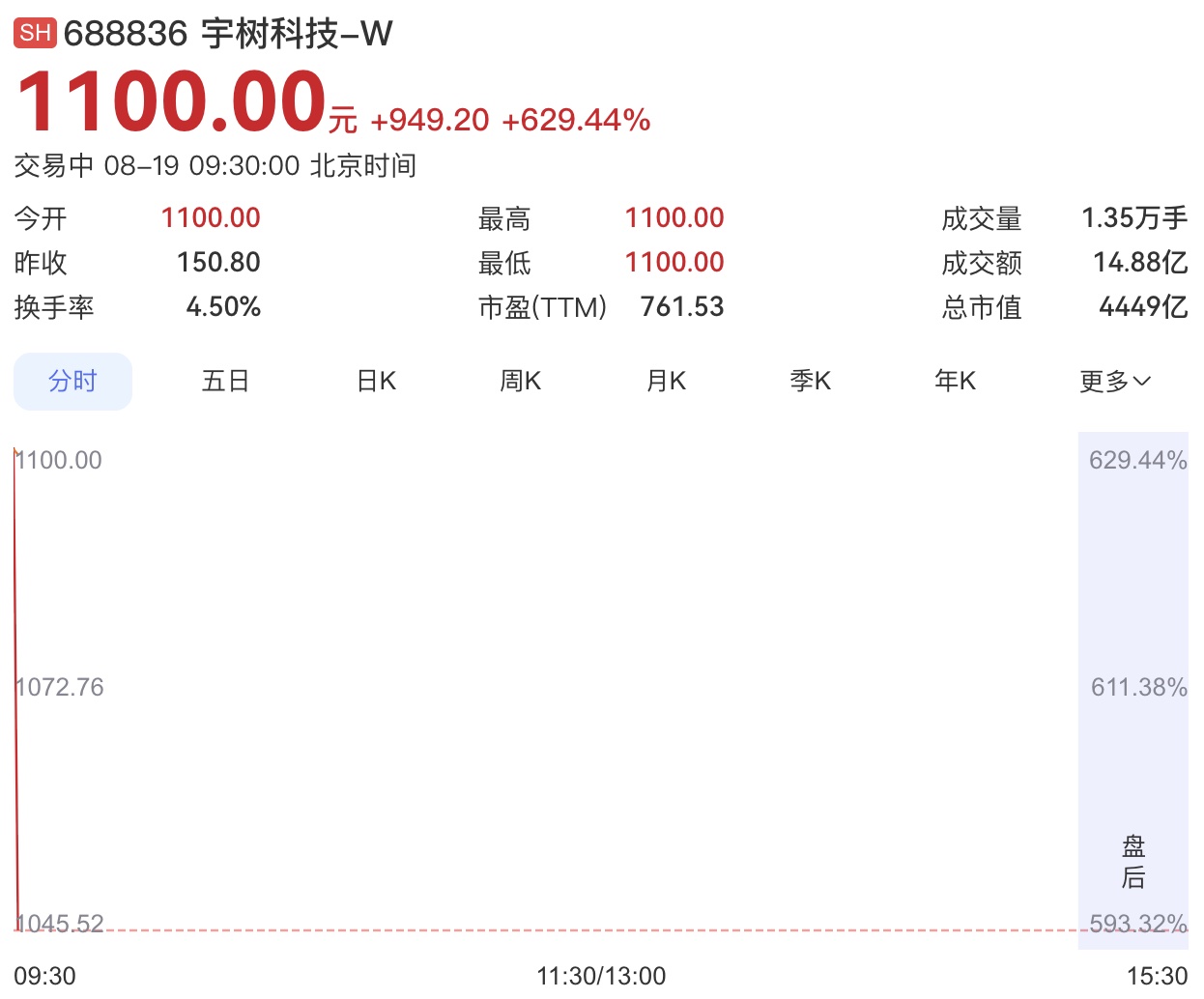
On August 19, Unitree Technology (688836.SH) began trading on the STAR Market of the Shanghai Stock Exchange. It opened at 1,100 yuan per share, up 949.20 yuan, or 629.44%, from its 150.80 yuan issue price — a market value of 444.9 billion yuan. The phrase the market had been waiting for, "the A-share market's first humanoid robot company", finally landed that day. The exchange notice published a day earlier was restrained: the company's A-share capital stock is 404,464,340 shares, of which 30,087,720 shares would begin trading on August 19, under the abbreviation "Unitree Technology" and the code "688836".
The more striking figure is the valuation attached to the deal: the diluted price-to-earnings ratio reached 219.23, far above the industry average of 38.56. The offering comprised 40,446,434 shares, equal to 10.00% of the post-issue share capital, with no sale of existing shares — all of this round was new money going into the company rather than existing shareholders cashing out.
Demand in the subscription process is another signal. Nearly 9,784,600 investors took part in valid online subscriptions, more than the 9,428,800 who applied for Changxin Technology, making Unitree the most heavily subscribed new listing on the STAR Market. The allotment rate was just 0.0181%, a record low for online allotments on the board, earning it the nickname of the hardest new share to win. Payment discipline, by contrast, was excellent: according to the offering results announcement, online investors gave up only 8,734 shares, worth about 1.3171 million yuan, and institutional investors placed no cancellations at all.
The raise also exceeded the original plan. Unitree's total proceeds came to 6.099 billion yuan against the 4.202 billion yuan in its prospectus, and about 5.917 billion yuan after deducting issuance costs. More than 85% of the money goes to research and development across four projects: intelligent robot model research, robot body research, new product development and construction of an intelligent robot manufacturing base. For a company known for hardware, putting the money into "models" is a statement in itself.
Before Unitree, humanoid robot makers lived almost entirely in the private market: funding, valuations and orders were all settled in private rounds, leaving outsiders with little basis for pricing such companies. By bringing the "robotics hardware plus high-dynamics motion control" route to the public market, Unitree means its gross margins, shipment mix and research spending all get reviewed quarterly — and the value of having that sample may matter more than any single day's opening price.
Who gained in this IPO
Before the offering, founder Wang Xingxing held 86,714,964 shares directly, or 23.8216%, and another 9.5367% indirectly through the employee equity platform Shanghai Yuyi, for a combined 33.3583% — some 18.312 billion yuan of equity value.
Among outside institutions, Meituan was the biggest winner: through three entities — Hanhai Information Technology, Galaxy Z and Chengdu Longzhu — it held a combined 9.65% before the offering, the largest stake of any external institution. Sequoia China came second with 7.11% through platforms including Ningbo Sequoia and Xiamen Yaheng.
The strategic placement list is just as revealing. A total of 8,089,300 shares, 20% of the offering, were placed with nine institutions including DeepSeek, entities related to Tencent, PetroChina Kunlun Capital, China Southern Power Grid Finance and Tianyi Capital, alongside employee asset-management plans and the underwriter's co-investment share. Three companies tied to DeepSeek founder Liang Wenfeng together received 1,191,600 shares, worth about 180 million yuan.
Mutual funds and private funds also subscribed heavily, with E Fund, Southern and ICBC Credit Suisse among the public funds receiving allocations alongside leading quantitative investors. Early-stage shareholders such as Matrix Partners China and Shunwei Capital also stand to book substantial equity gains. Some commentators argue that Unitree's core value as the first humanoid robot company to list in A-shares is that it establishes a public pricing benchmark for humanoid robot makers, shifting the market's investment logic from thematic trading toward industrial pricing.
Revenue still concentrated in a single setting
The prospectus shows that Unitree shipped more than 5,500 humanoid robots in 2025, and that humanoid revenue overtook quadruped revenue for the first time to become its largest source of income. But revenue remains heavily concentrated in research and education procurement, with large-scale deployment in industry and consumer homes still to come — the shared bottleneck of the whole sector: whoever finds a repeat-paying general setting first gets the ticket to the next round.
In the first half of 2026, Unitree reported revenue of 1.152 billion yuan, up 48.54% year on year, and net profit of 274 million yuan, compared with a loss of 32.0245 million yuan a year earlier. Explaining the combination of slower revenue growth than its historical compound rate alongside a large profit jump, the company said the year-earlier period included 349 million yuan of share-based payment expenses booked as non-recurring items. Profit excluding non-recurring items fell 19.34% year on year, mainly because research, sales and other period expenses grew faster in the first half of 2026.
Cash flow deserves attention too: net cash from operating activities was 232 million yuan in the first half, down 32.53% year on year. The company attributed the decline to outflows for goods purchased, period expenses and employee compensation growing significantly faster than cash inflows from sales. In one sentence: the business is expanding and the team is hiring, and cash is going out faster than it comes in.
After "Superman", the real exam
On the eve of the listing, Unitree unveiled a new humanoid named "Superman", capable of a two-metre high jump and a top speed of 12.66 metres per second — another display of how fast the company iterates hardware. Athleticism has always been Unitree's comfort zone: from quadrupeds to humanoids, its products have long led in high-dynamics movements such as running, jumping and tumbling.
But that is not what public markets grade. On one side, Tesla's Optimus, Boston Dynamics and a roster of Chinese companies keep raising their bets, and competition keeps intensifying. On the other, Unitree's hardware and motion-control strengths stand out while its embodied large models remain a weak spot; the pace of iteration on key components such as dexterous hands, and progress in downstream settings, will directly shape how the market judges the company's long-term value.
Turning technological advantage into orders at scale is the exam this first listed humanoid robot maker must now pass. The answer will shape more than Unitree's own market-cap curve: it will give a first public-market pricing reference to a queue of humanoid robot companies lining up to list.