Xinhua: humanoid robots move into "working mode" on production lines
Policy sets the timetable first
On June 28, Xinhua published a report titled Looking at embodied intelligence moving into working mode. Its starting point is not a robot but a policy document: the Ministry of Industry and Information Technology and the State-owned Assets Supervision and Administration Commission jointly launched a 2026 action program for real-world training of humanoid robots and embodied intelligence, with staged goals attached.
The notice sets two milestones. By the end of 2026, key products such as humanoid robots should be the first to complete application validation and routine deployment in a set of representative scenarios, entering working mode; and more than a hundred high-value application scenarios should be distilled, broadening the embodied-intelligence application landscape and driving deployment at the ten-thousand-unit level. The measure of success, in other words, is scenarios, deployment and volume — not papers and demos.
Translated into product language, those clauses mean passing acceptance, finding scenarios and scaling volume. The hardest part is routine deployment: a successful demo can lean on luck and retries, whereas working every day demands success rate, cycle time, fault recovery and operations all together. That is why the report does not stop at policy but takes its cameras into a real factory.
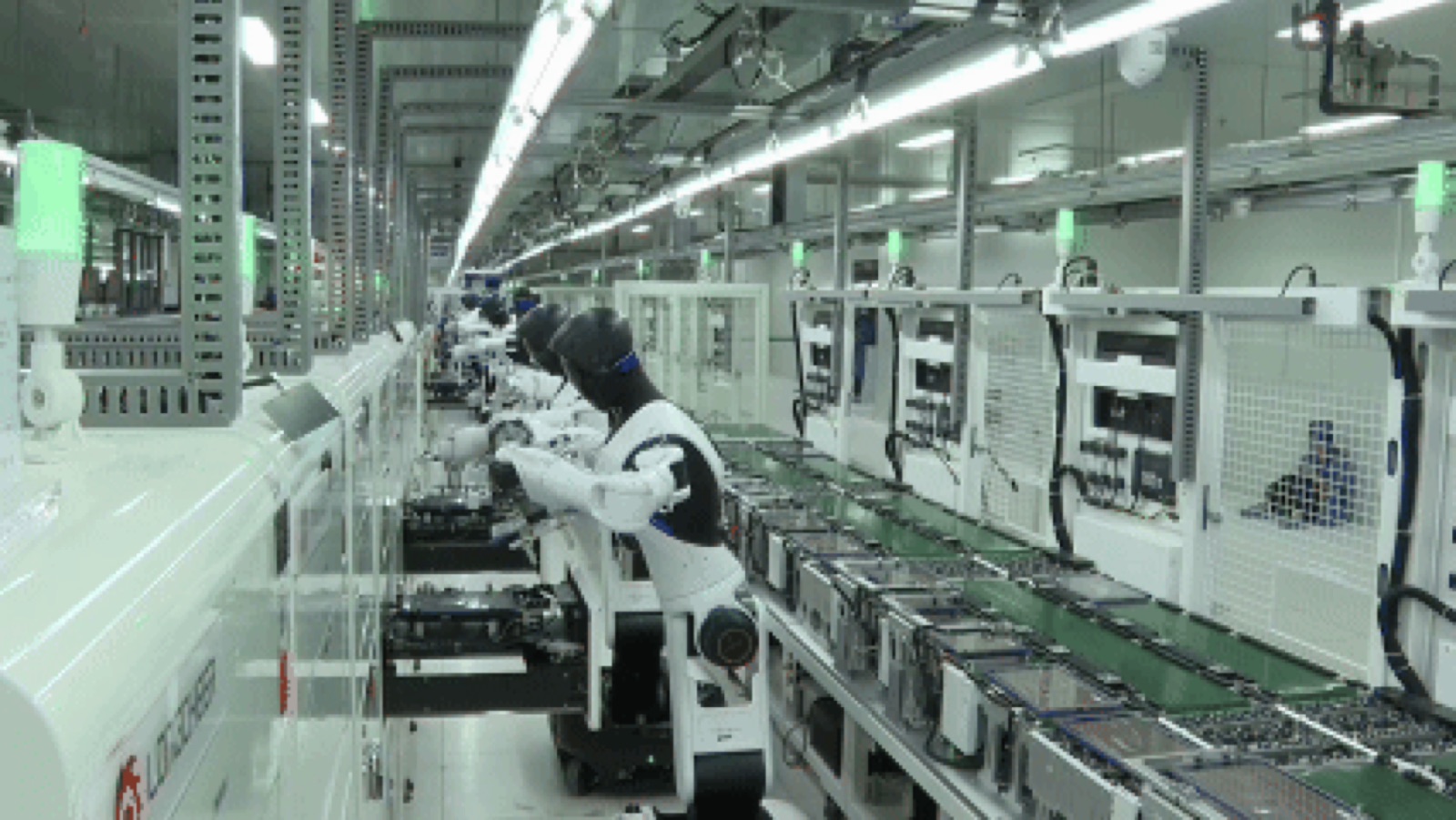
The cameras focused on a livestream from June 23 to 28: eight AgiBot Genie G2 humanoids working continuously on the same line in the MMIT test section of Longcheer's Nanchang factory for six days, ten hours a day, broadcast to the public throughout. Xinhua frames the questions directly: what did this livestream validate, how mature is the technology behind working mode, and what does it say about the industry's path ahead?
From four robots for eight hours to eight robots for six days
To gauge the weight of this livestream, start with the control case: back in April, four Genie G2 units completed an eight-hour run in the same factory with a 100% success rate. This time three dimensions scaled at once — from a single workstation to the whole section, from four robots to eight, and from eight hours to six days. The question changed with them: from whether humanoids can get into a factory to whether they can work steadily, in numbers and over time.
The numbers are specific. By the fifth day the eight robots had logged more than 54 cumulative hours, produced 14,925 units across 55,107 operations, with a 99.987% success rate. Converting that: 99.987% implies a failure rate of roughly 0.013%, which against a base of over fifty thousand operations means failures on the order of single digits — for a line that must run six days straight, that speaks to stability rather than infallibility, since what is really being tested is whether the line keeps running after something goes wrong. Output and operation count are also different units: more than fifty thousand operations yielding some fourteen thousand units means each product passed through multiple pick-and-place steps rather than one action per finished item.
The key word is working the same line together. A single robot at a single station keeps failures mostly contained; several robots operating in one section couple cycle time, avoidance, task allocation and exception handling together, so any one robot's pause can propagate down the line. That is why a six-day shared-line livestream says more than any edited demo reel.
Two capabilities: vision-driven control, and becoming a manageable process step
Peng Siwei, vice president of AgiBot's Genie business unit, splits the validated capability in two. The first is high-precision visual inspection and precise motion control: incoming materials in the test section are irregular, every piece offset, so the robot must grasp and place accurately — powered by an end-to-end reinforcement-learning model trained on real hardware. The second is system integration: the robot is not a standalone workstation but a process step that can be supervised and managed within the wider production system.
Irregular incoming material is the dividing line. On a highly structured line, fixtures and locating mechanisms guarantee where a part will be, so the robot can repeat one fixed trajectory; with random positional and orientation error, it must first see, then decide, then adjust its trajectory online, and the robustness of the policy directly sets the success rate. End-to-end reinforcement learning on real hardware means the model is trained on data collected by real robots, from real failures — a different route from learning in simulation and transferring to the floor.
The second capability is often underestimated. A robot that can work is only a machine-level achievement; turning it into a process step requires the line to know what it is doing right now, when it can take the next task, and how it exits or hands off to a person when something goes wrong. Xinhua calls this being a process step that can be supervised, and it is the most practical threshold between a factory floor and a lab — the difference between working mode and demo mode.
The list of challenges, and judgment from the floor
Going from four robots to eight surfaced more difficulty than expected. Li Long, general manager of the robotics business unit at Longcheer, lists specifics: robots colliding with robots, arms fighting each other, lidar dropping frames — all exposed and resolved through joint engineering work. He stresses that this is not simply moving robots into a factory but a systemic capability, one that also needs an operations team behind it. On what comes next, he says the economics, the people and the support are all on the table now, and everyone has to work together to play this hand better.
That list reads like a standard catalogue of multi-robot difficulty: single-unit reliability is not fleet reliability, and once robots share space, avoidance, scheduling and safety redundancy become the main problems; in a real plant sensors also face dust, glare and occlusion, where a single dropped frame can interrupt a whole operation. Surfacing those issues one by one across six days of continuous running is the most valuable part of the livestream.
Liu Chengjun, founder of the Industrial Internet Study Society, offers the broader judgment: the six-day livestream is in essence a test of whether intelligent robots can take root on industrial floors, and it brings a new perspective on human-machine collaboration. Where people and machines once sometimes competed or resisted each other, he says, the sight of machines and workers coexisting and cooperating will become the classic image of the factory of the future.
Read together with policy goals, the keyword for 2026 really is working mode: ten-thousand-unit deployment is the direction policy sets, more than a hundred high-value scenarios are the targets to find, and a six-day shared-line livestream provides one testable sample. Whether that is delivered depends not only on success rates but on operations teams, unit economics and the daily details of human-machine collaboration — none of which makes it on camera, and all of which decide whether those robots show up on the line again tomorrow.