XPeng commissions its humanoid production line: first IRON walks off unaided, volume production set for year-end
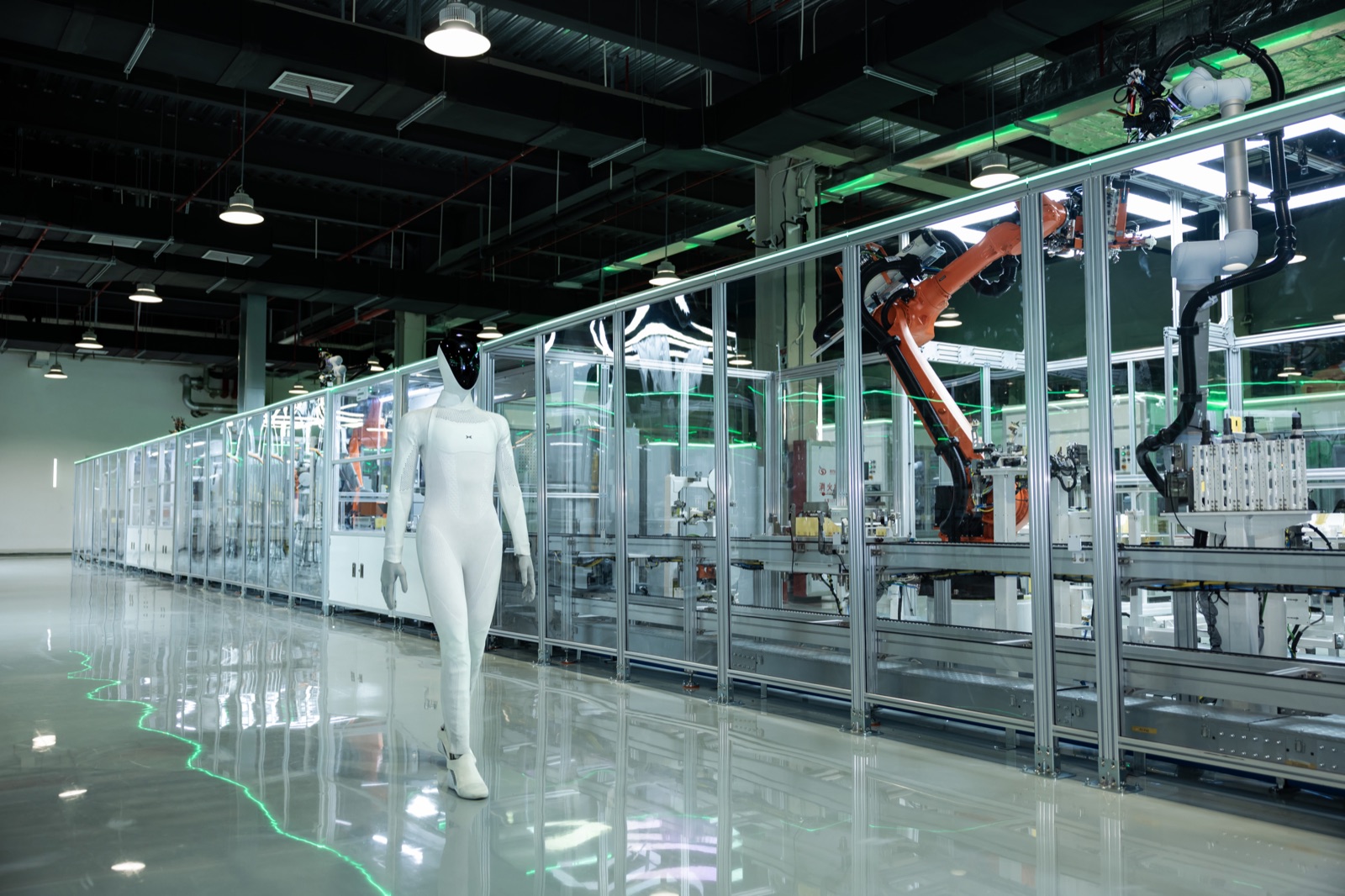
A production line with "no precedent to follow"
XPeng said on its official website in September that its robot production line is now in operation, and that the world's first high-order general-purpose humanoid completed automated final assembly and walked off the line on its own — a key step from development prototyping to line manufacturing and a major move toward volume production. The company calls it the world's first automated production line for high-order humanoid robots, and describes it explicitly as built for volume production.
The industry reality behind that phrase: robots have long been assembled in small batches, half by hand, and manufacturing at scale is a widely recognised difficulty. Building one impressive prototype and building thousands with consistent quality are two entirely different capabilities — the first depends on engineers, the second on processes, tooling, inspection systems and supply chains.
XPeng's approach is to graft the mature quality system of the car industry directly onto precision humanoid manufacturing: the group designed and developed the line itself, built a mass-production quality system to automotive-grade consistency standards, and developed the line forward from volume-production targets. The company says core process automation exceeds 80%, aiming for a high-precision, highly flexible, intelligent manufacturing system that keeps critical steps consistent and lays the groundwork for volume production and rapid expansion.
XPeng Group chairman and CEO He Xiaopeng describes it this way: the robot production line is created from nothing, with no precedent to follow, and XPeng is creating an entirely new category of production line. Going forward the company will keep pushing for faster production takt times and larger-scale robot manufacturing capability, exploring a new path for robot manufacturing in China and globally.
76 degrees of freedom and 2,250 TOPS
On the product side, XPeng positions its humanoid as a "high-order" robot that is extremely human-like, AI-driven and built to the highest safety standards, intended to become a next-generation general-purpose humanoid platform that supports a wide range of applications and self-improves in the real world.
On the body, the official figures are: what the company calls the industry's leading human-like physique and form, the first fully covered flexible lattice, 76 degrees of freedom across the body and 21 per hand. Degrees of freedom are the precondition for dexterous manipulation, and 21 per hand approaches the joint count of a human hand, giving it the hardware basis for fine grasping and bimanual tasks.
On intelligence, the key numbers are compute and where it runs: IRON carries three Turing AI chips for 2,250 TOPS of effective compute. XPeng says this lets its physical AI model run on-device, completing complex work autonomously without teleoperation while keeping inference latency low and data secure — putting the model on the robot rather than in the cloud serves both response speed and keeping data on site.
He Xiaopeng frames the goal as broader than the factory: to build a new kind of robot with full generalisation that can genuinely enter daily life, improving how people live and eventually becoming a companion in people's lives.
More than $900 million and three growth curves
Almost in parallel with the line opening, capital also made a large bet: on August 24, XPeng's robotics business closed a first equity financing round of more than $900 million at a post-money valuation above $6.3 billion, a record for a single private equity round in China's embodied intelligence sector. The company says this reflects the market's recognition of its position in physical AI, its technology route, volume manufacturing capability and long-term commercial value.
In XPeng Group's own narrative, robotics is one of the growth curves that sit alongside the car business and globalisation: the group describes three curves — vehicles, robots and globalisation — and treats this first humanoid walking off the line and the line's commissioning as an important step in landing its physical AI strategy.
As for the company itself, XPeng Group defines itself as a physical AI company with a fully in-house technology stack spanning Turing AI chips, a physical-world foundation model and tightly integrated hardware and software applications. From that shared base it builds intelligent electric vehicles, Robotaxi services and humanoid robots. Its headquarters are in Guangzhou, and it is dual-primary listed on the New York Stock Exchange and the Hong Kong Stock Exchange.
Starting from stores and campuses
On deployment, XPeng's timetable is: entry into volume production by the end of this year, beginning with commercial applications in XPeng's own stores and campuses, and a formal market launch and delivery in China and overseas markets in 2027. The first "customers", in other words, are its own retail and service network rather than outside factories.
The logic is not hard to follow. Stores and campuses are controllable settings: foot traffic, task types, lighting and floor conditions are relatively predictable, and internal teams can step in immediately when something goes wrong. They also create a data loop — every reception, guidance and carrying task feeds back into the model and application iteration. For a general humanoid platform still climbing its learning curve, getting the takt time right inside its own venues is a more pragmatic step than chasing large external orders.
A sober caveat is in order: commissioning a production line is not the same as shipping at scale. Core process automation above 80% describes the manufacturing process; the volume production target is set for the end of the year, while the formal launch and deliveries come in 2027, with ramp-up, yield, safety certification and scenario validation in between.
Making the "production line" the star of the announcement is itself a footnote to 2026. For the past two years, progress in humanoid robotics mostly arrived as video: running, flipping, folding clothes, sorting parts. What really decides whether a category stands up is whether the product can be built at a predictable cost, takt time and consistency, and then run continuously at a customer site rather than being filmed once. Production lines, yields and delivery volumes entering robot news suggests the focus of competition is shifting from "can it be done" to "can it be built, sold and serviced".
Still, the significance of this line may extend beyond XPeng. Until now, humanoid competition played out mainly over algorithms and body specifications — who could produce the most impressive movement or the cleverest policy. When a car company arrives with automotive-grade quality systems and an automated line, manufacturing consistency becomes a competitive dimension of its own. For the industry, that may be a harder moat to catch than any demo video.